Canada's 2026 Sovereignty Obsession is Unprecedented
Today, the final episode is out for Gloves Off – Season 2. We are never putting our gloves back on.
What Are We Fighting For?
Throughout this season, host Stephen Marche has been thinking about economic resilience, defence, technology and geopolitical strategy for Canada. Last season, the show asked: how can we survive? This year, it’s all about how we can win.
Fundamentally, the question animating the “how we can win” conversation has been: What does the future hold for a middle power alliance? And what might Canada’s role be in shaping that future?
At The Canadian Shield Institute, we’re interested in these same questions, which is a big part of why we were excited to collaborate with Gloves Off.
As we wrap up this phase of research partnership, we thought it would be interesting to zoom out, and reflect on how the sovereignty conversation has evolved over decades. So we used public data to analyse how Canada’s parliamentary discussions have evolved over time.
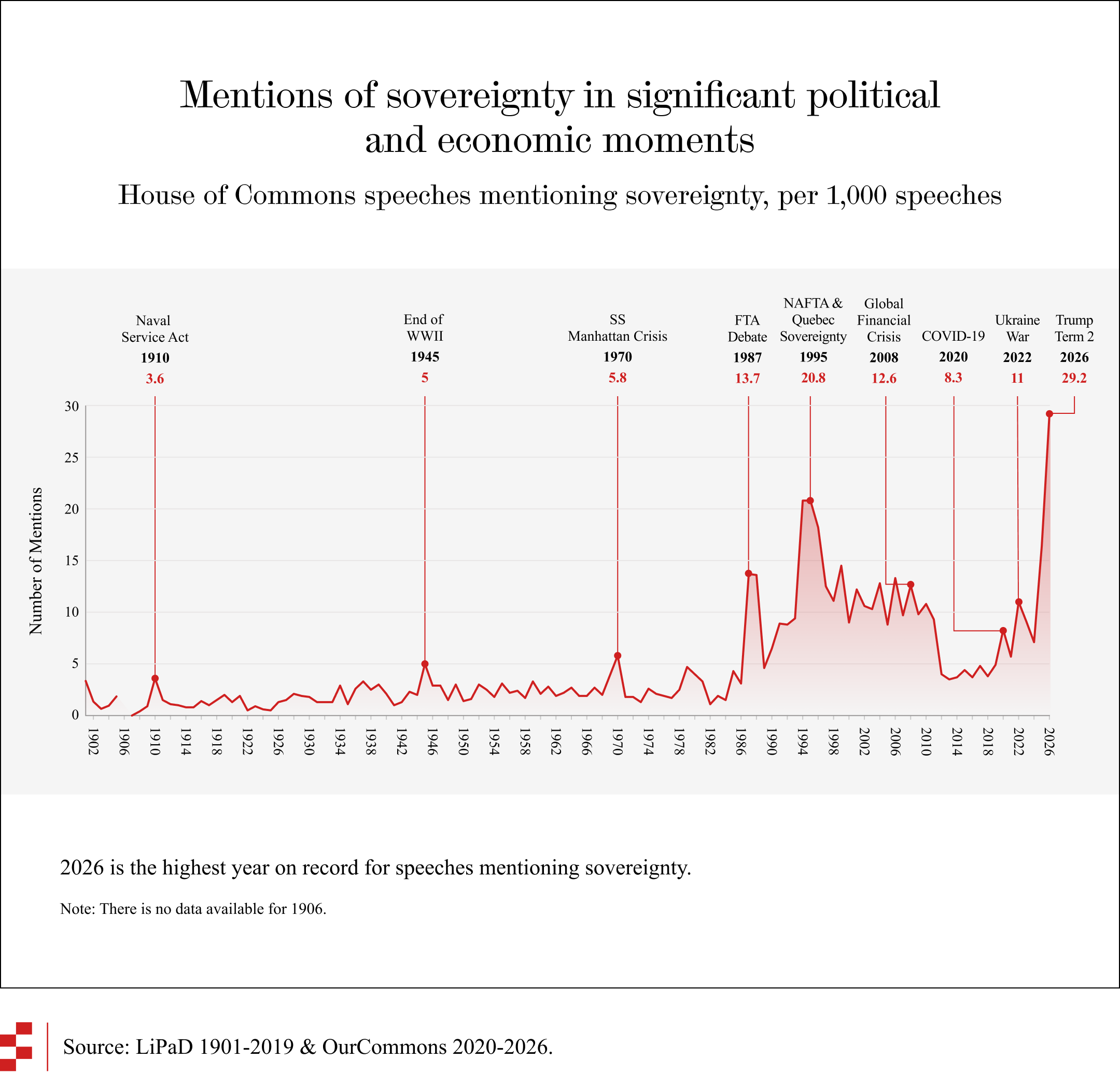
We’ve included a detailed methodology of our linguistic analysis at the end of this post, but to get started, let’s just look at the raw mentions of the word “sovereignty” and “sovereign” going back to 1901.
Unsurprisingly, sovereignty spikes during shocks, but our current moment is on a whole different level.
2026 is the highest year on record for speeches mentioning sovereignty.
Sovereignty also has more dimensions now.
As the chart below shows, the leading context for sovereignty discussions in 2000 was Quebec. What’s interesting is that sovereignty really meant “national unity” in that context, and that frame was demoted to second place in the 2020s.
Trade and investment have become the biggest concerns, which makes sense in a world where the U.S. President Donald Trump is musing about annexing Canada, and the United States is waging economic warfare against us. Other themes like foreign interference, sovereign technology capabilities, and arctic sovereignty also speak to the anxieties of the current moment.
The chart below shows the leading themes in the 2000s.
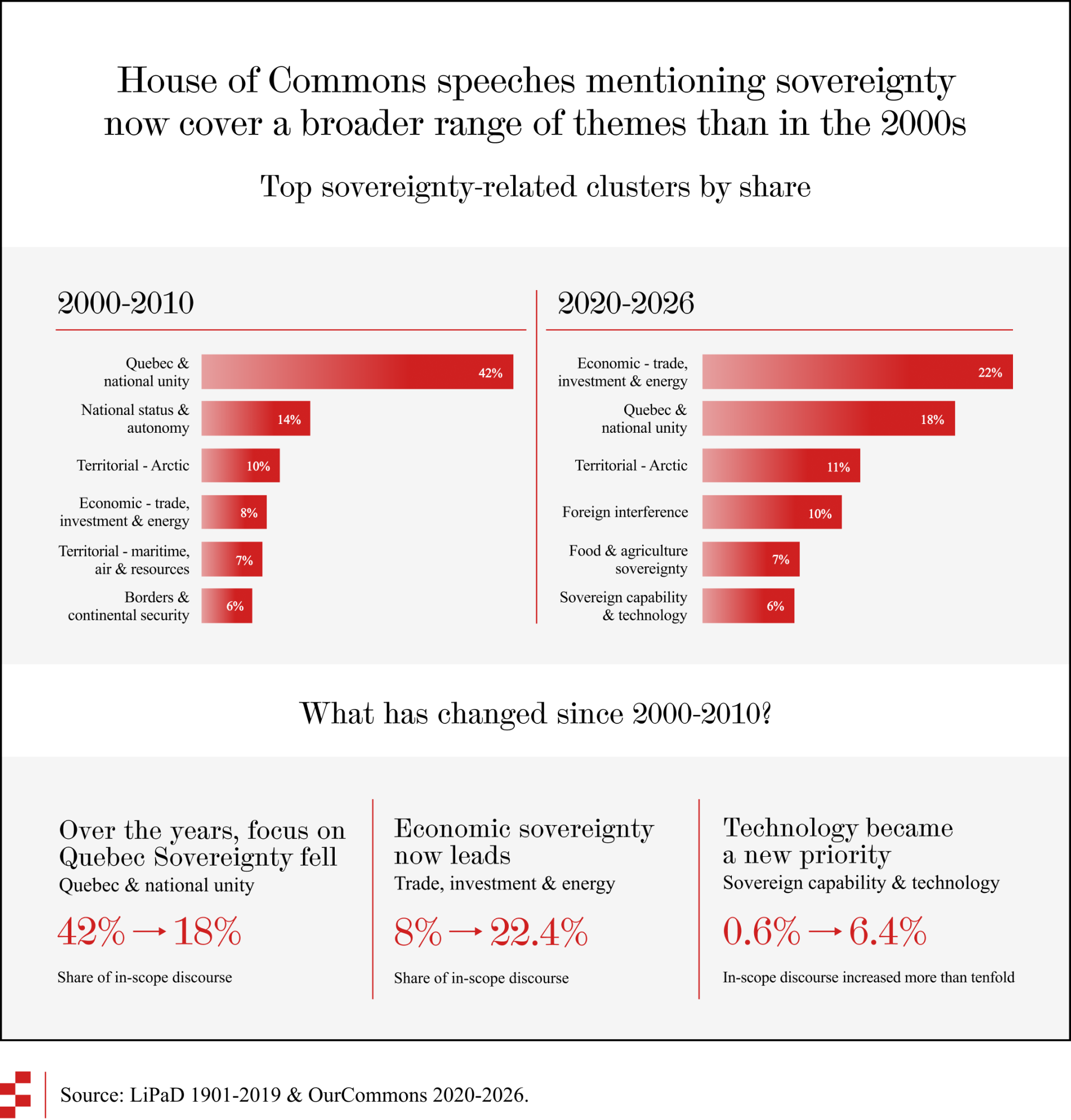
By 2020, digital sovereignty appeared explicitly for the first time, economic sovereignty had become the leading theme, and capability and technology had emerged as a meaningful cluster.
What’s striking is that we can also see concern about economic sovereignty in Parliamentary debates, dating back to the 1960s.
Economic sovereignty is back, but in a new form. It is no longer only about defending control. Increasingly, it means building national capability and resilience.
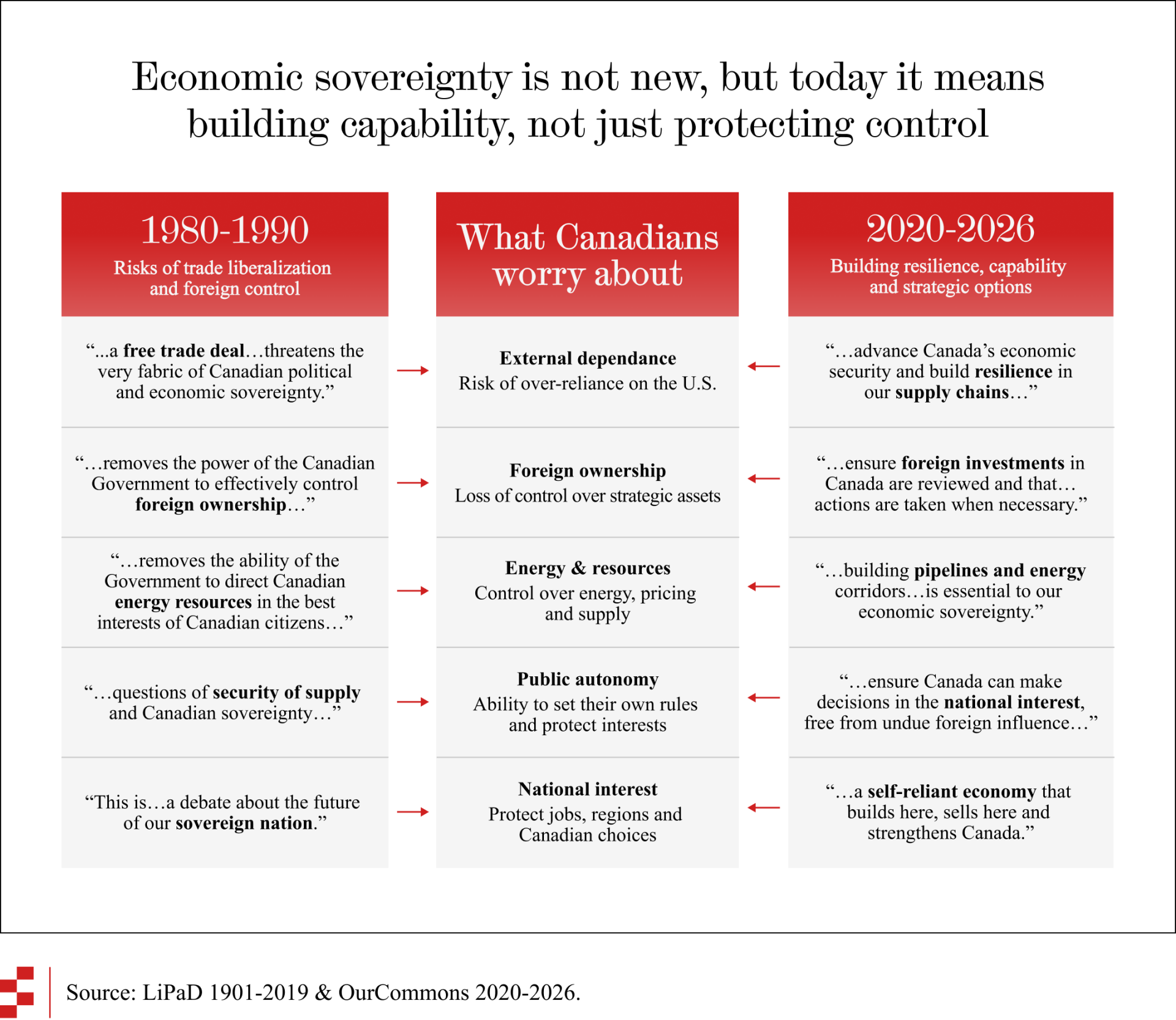
The takeaway here is that “sovereignty” can be grandiose and abstract, but it’s rooted in something specific: the capacity to act, and the resilience to be able to chart our own course as a country.
Given their own specific history within Canada, we can take some real lessons from Quebec on this front.
In 2020, Quebec tried to create something like its own Amazon: a province-backed online marketplace designed to help consumers buy local and give Quebec businesses a stronger foothold in the digital economy. The ambition was admirable. The government recognized a platform dependency and tried to build commercial infrastructure of its own. But the marketplace shut down four years later after failing to generate enough revenue to remain viable.
Other, more modest platforms are showing greater promise. Leslibraires.ca and Booksellers.ca bring independent Canadian bookstores together through shared online storefronts. Together, they amount to a serious effort to build independently owned online-book retail infrastructure across both of Canada’s language markets—and an obvious counterweight to Amazon.
These alternatives remind us that Canadians do not have to remain passive customers of foreign firms. We can also be builders and stewards of the digital infrastructure on which we rely. We wrote eight chapters about those Foundations of Digital Sovereignty, which you can read here.
This incremental push towards a more digitally sovereign state is perhaps a place where the so-called “middle powers” can band together, as Prime Minister Mark Carney has alluded to (and as Gloves Off host Stephen Marche has fixated on, over the past 8 weeks!)
Other governments have been actively building and commissioning digital public infrastructure of their own. Brazil created a central-bank-operated instant-payment system. India assembled public rails for identity, payments and data exchange. Germany is developing an open-source workplace suite for the government, while France has introduced state-controlled tools for messaging, videoconferencing and file transfers. None of these initiatives makes a country technologically self-sufficient. But each replaces a measure of foreign dependency with domestic capacity, giving the state more control over the systems through which public and economic life now runs. It is genuinely exciting work.
We can partner in many of these sorts of projects, and initiate some of our own. But making that shift will require more ingenuity, coordination, and initiative than Canada has demonstrated so far. That is the sovereignty work ahead of us.
Looking Back at Gloves Off – Season 2
It has been a blast to complement the Gloves Off conversations with original research and visual analysis.
For Episode 1, we mapped Trump’s industrial policy. For Episode 2, we mapped Carney’s trade pivot in a living resource that we have continued to update. For Episode 3, we visualized Canada’s trade pivot in four charts and gave the same treatment to the country’s automotive value problem.
For Episode 4, we developed two case studies: one on quantum computing and one on—wait for it—aluminum cans. For Episode 5, we traced Canada’s history with dual-use technology and put the proposed five per cent defence spending target into context.
For Episode 6, we created a day-in-the-life visualization of the technologies that shape everyday life. For Episode 7, we analyzed the submissions made to the Office of the United States Trade Representative from umbrella groups that represent Big Tech.
The final Cross-Check episode drops tomorrow, and we will update this post when it is live.
Thanks for listening.
How We Did the Linguistic House of Commons Analysis
Ok, here’s the nerd stuff: We took the LiPad data, which allows a search of the Hansard from 1901 to 2019 and searched all those speeches and pulled out every single sentence that contained the word “sovereign” (which also catches “sovereignty”, “sovereignist”, and so on).
We did not exclude any sentence at this stage, even sentences that seemed off-topic like “sovereign debt” (a money term) or “gold sovereign” (an old coin).
Each sentence we found is called an ‘occurrence.’ If one speech said “sovereignty” five times, that counted as five occurrences. We ended up with tens of thousands of them.
Although, a single sentence on its own can be confusing. So for every occurrence, we also grabbed the sentence before it and the sentence after it (a rolling three-sentence window centered on the mention). Three sentences together tell you much more than one.
Next comes the technical part:
Turn each mention’s meaning into numbers (embedding). We fed every three-sentence window into a language model called all-MiniLM-L6-v2, a well established sentence embedding model. It reads a piece of text and outputs a list of 384 numbers that capture its meaning. Think of this as a specific location on a giant map of meaning. Sentences that mean similar things get placed close together; sentences that mean different things land far apart.
Simplify the map so patterns are visible. A 384-dimension map is impossible to picture and hard to cluster. So we compressed it down to 10 dimensions using a standard technique called Uniform Manifold Approximation and Projection (UMAP), which shrinks the map while keeping close things close and far things far.
Draw the neighbourhoods automatically (density clustering with HDBSCAN). We then used a clustering algorithm called Hierarchical Density-Based Spatial Clustering of Applications with Noise (HDBSCAN) to find the crowded neighbourhoods on the simplified map. Each neighbourhood it finds is a cluster (a group of mentions that all mean roughly the same thing). In order to consider a neighbourhood, it must have at least 15 mentions.
The above 3 steps were executed separately for each decade. We did not decide the meaning ahead of time and look for them. We allow each decade’s own words to form their own neighbourhoods. Each era tells its own story instead of us forcing one story across the century.
For every cluster, we read sentences sitting right at its centre. Those centre-most sentences are the most typical examples, so they tell us what the cluster is about. We gave each cluster a plain-English name, like “Quebec & national unity” or “Economic – trade, investment & energy”.
This is also the point where we handled the off-topic mentions. When a neighbourhood turned out to be about money-market (“sovereign debt”), or another country’s sovereignty (not Canada’s), we gave it a set aside label.
Next, for each decade we ask: of all the real sovereignty mentions (the ones we did not set aside), what share fell into each meaning? So we can finally say things like: “In the 1990s, about 6 out of every 10 real sovereignty mentions were about Quebec”. These are the in-scope mentions.
Fun fact: the first mention in the data is on February 6th, 1901, from Prime Minister Sir Wilfrid Laurier. He said: “The recent demise of the great and noble lady who was for more than sixty years our Sovereign should call from us, as our first duty, the adoption of an address to His Majesty the King.”
Thank you to Michael Serbanis, who conducted this analysis.

Subscribe to