What Quantum, Aluminum Cans, Guns and AI All Have In Common
You might’ve noticed that we’re in a bit of a trade war.
On the Gloves Off podcast, Stephen Marche has been grappling with what Canada’s trade strategy should be.
Episode 3 of Gloves Off considered How Canada Wins at Trade.
Episode 4 asks: How Canada’s Economy Can Thrive.
Shield has been partnering with Gloves Off on research materials as we think about Canada’s sovereignty strategy.
This week, Canadian Shield Institute’s Matthew da Mota wrote a good case study on the state of play in Canada’s nascent quantum computing sector.
Canada incubated the foundational research that developed modern AI technology, and ultimately foreign tech companies swooped in and seized the opportunity to commercialize that technology. We missed an opportunity to capture a share of this multi-trillion dollar technology, because we didn’t have the economic strategy and the policy framework to bring homegrown innovations to market.
There’s good reason to believe that quantum might be the next big thing, and it’s still early enough for Canada to carve out a lucrative role in this technology.
So, have we learned from our mistakes? Will we let foreign competitors swoop in again?
Meanwhile, Emily Osborne has written up a different case study this week on aluminum cans. Beer and soda cans may not seem like cutting edge technology, but if you look back at the hundred-year manufacturing history, you see some of the same patterns.
Canada is the fourth-largest producer of aluminum in the world, in spite of the fact that:
- We don’t actually mine the ore, and
- We don’t actually have the rolling mills to turn commodity aluminum into cans.
Basically, we’ve claimed a niche for ourselves as an intermediate processor, turning Brazilian ore into aluminum that the Americans buy and manufacture into cans.
Is this success, because we’re in the supply chain? Or is it failure, because we’re in a low-value intermediate niche?
When you start seeing the economy in these terms, you look at the massive Meta data centre in Edmonton differently. Is this a good niche for us, or is this the digital equivalent of producing raw aluminum so that Meta can make the cans?
The same questions crop up in Canada’s defence procurement, whether it’s nitrocellulose for ammunition production, or buying submarines from the Germans.
What strikes me about all of this is the fact that we don’t seem to have much of a cohesive strategy? Each of these issues, from quantum to cans, data centres to guns, is treated as a stand-alone issue, litigated on its merits.
The Canadian Shield Institute is studying the problem, and you’ll be hearing more from us on this soon.
One interesting thought in all of this comes out of a chart developed by Michael Sarbanis on the Shield team.
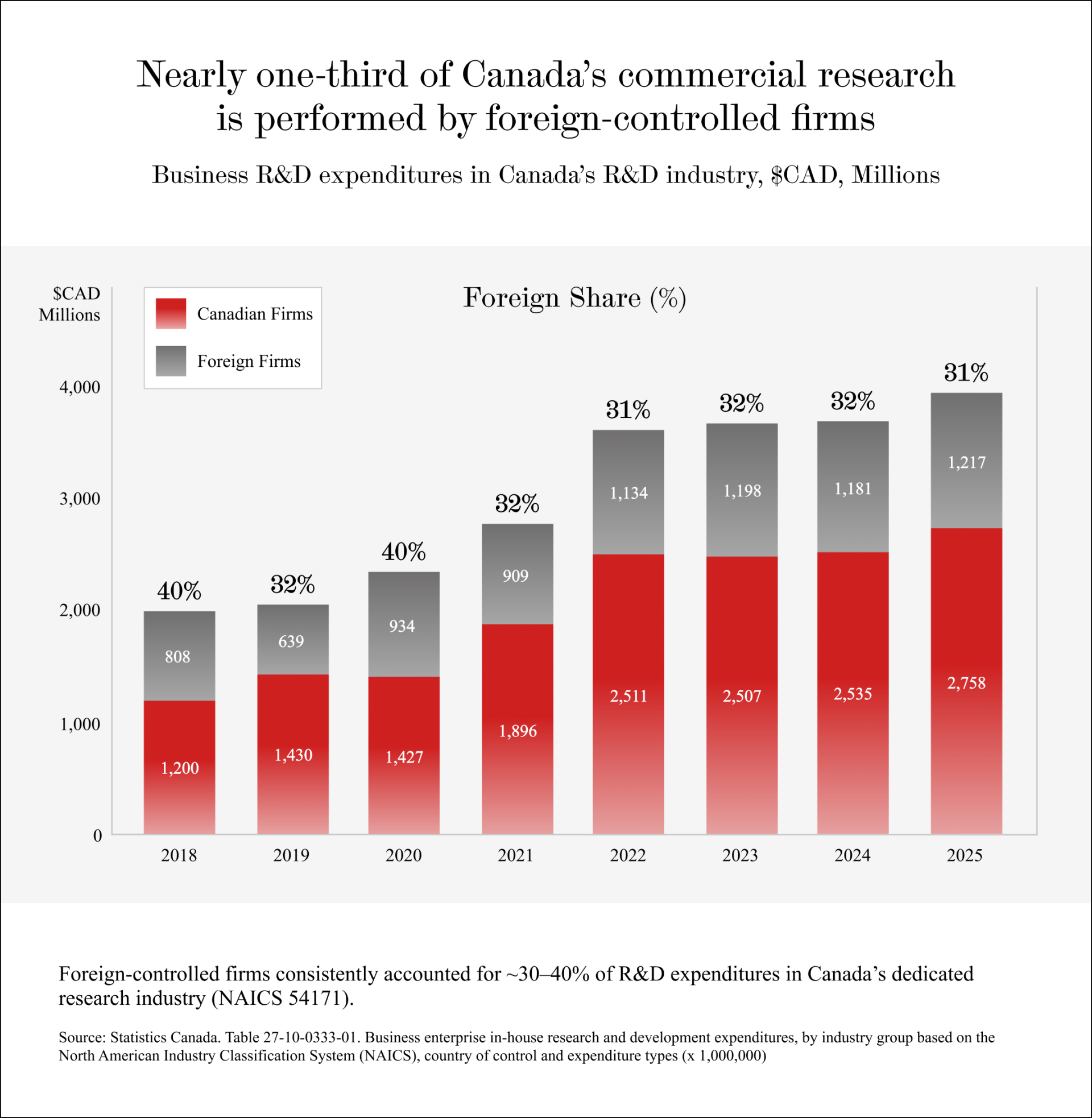
One niche where Canada truly excels is research and development. The downside of this is that ideas and technologies incubated in Canadian labs often get commercialized in other places, and we see very little economic benefit from it.
It’s wonderful that Canada is known as the smart, highly-educated place where companies can set up advanced research labs.
Now we need a real plan for capturing value. Are we consciously pursuing an economic strategy for how we plug into global value chains across industries, or are we just fumbling around and letting value flow out to foreign companies?
Prime Minister Carney talks about Canada pursuing a “variable geometry” strategy, but if we’re not rooted in some kind of competitive policy framework it’s easy to squander opportunities.
In fact, you could maybe argue that Canada has already been doing that for far too long, and our economic underperformance is the result.
Listen to Canadian Shield Institute Managing Director Vass Bednar discuss some of these issues in more detail on this week’s episode of Cross Check:

Subscribe to