A Day in the Life Without American Tech
What would happen if overnight we suddenly lost all access to American tech?
Nobody is saying that we’d ever wake up one morning and find all digital services from American companies suddenly and mysteriously shut down. But what we do know is that the United States is taking an increasingly aggressive and belligerent tone towards Canada, and we can no longer rely on them as an unwavering ally and friend.
Canada is deeply integrated with the United States in many ways, but there is arguably no area where we are more deeply enmeshed than the digital realm.
One way to appreciate the scope of Canada’s dependency on the United States is to imagine what would happen if a zombie apocalypse or some other mysterious calamity knocked out all American tech overnight.
Some of the products we’d lose access to are quite obvious: most forms of social media; Microsoft Teams, Zoom and Google Docs; along with several streaming platforms.
Other dependencies are a little less obvious, but force us to confront the extent of our dependence on American tech: any Visa or Mastercard credit cards along with certain payment terminals; the apps stores run by our phones American operating systems, and any digital product (regardless of where the company resides) that depends on American cloud services. Cloud infrastructure in particular is so dominated by American hyperscalers that it is difficult to comprehend how devastating it would be to suddenly lose access to their services.
Even an outage at just one American cloud provider — AWS — this past fall was enough to affect over 1000 companies across the world, including several Canadian ones.
So what does a day in the life without American tech actually look like?
6:45 AM
7:00 AM
7:15 AM
7:30 AM
8:00 AM
8:15 AM
8:30 AM
8:45 AM
9:30 AM
10:30 AM
12:30 PM
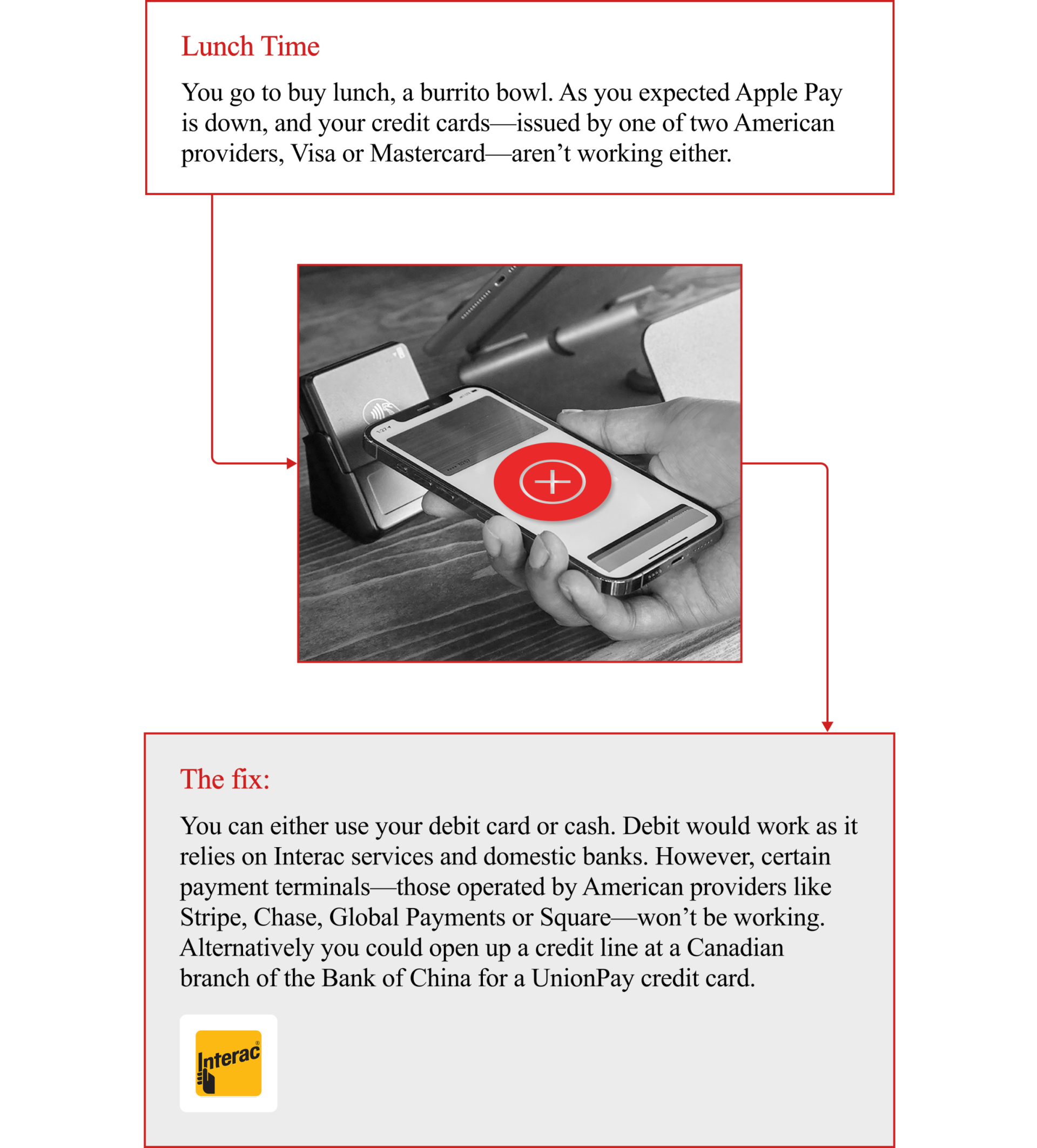
1:00 PM
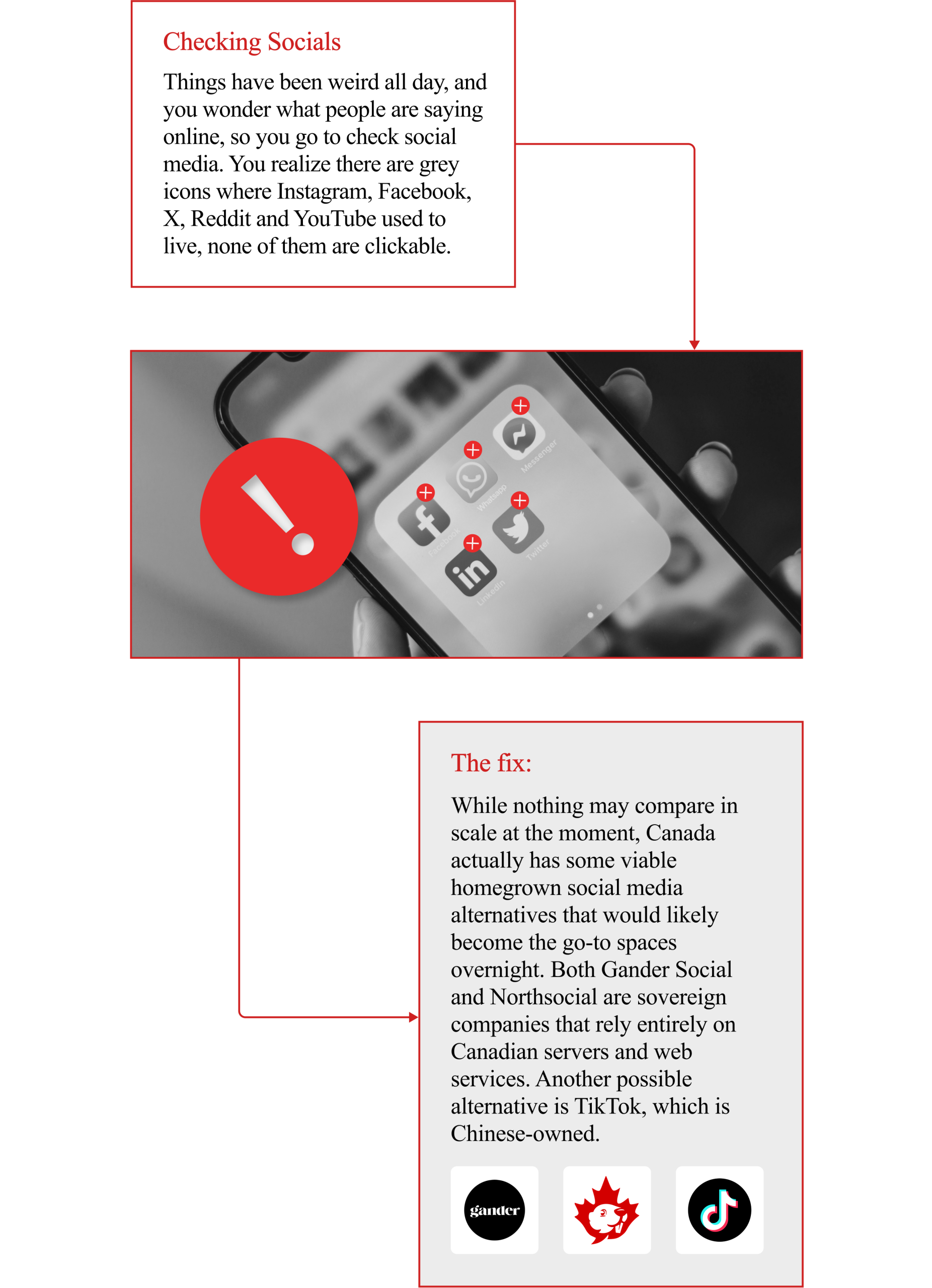
1:15 PM
2:30 PM
5:45 PM
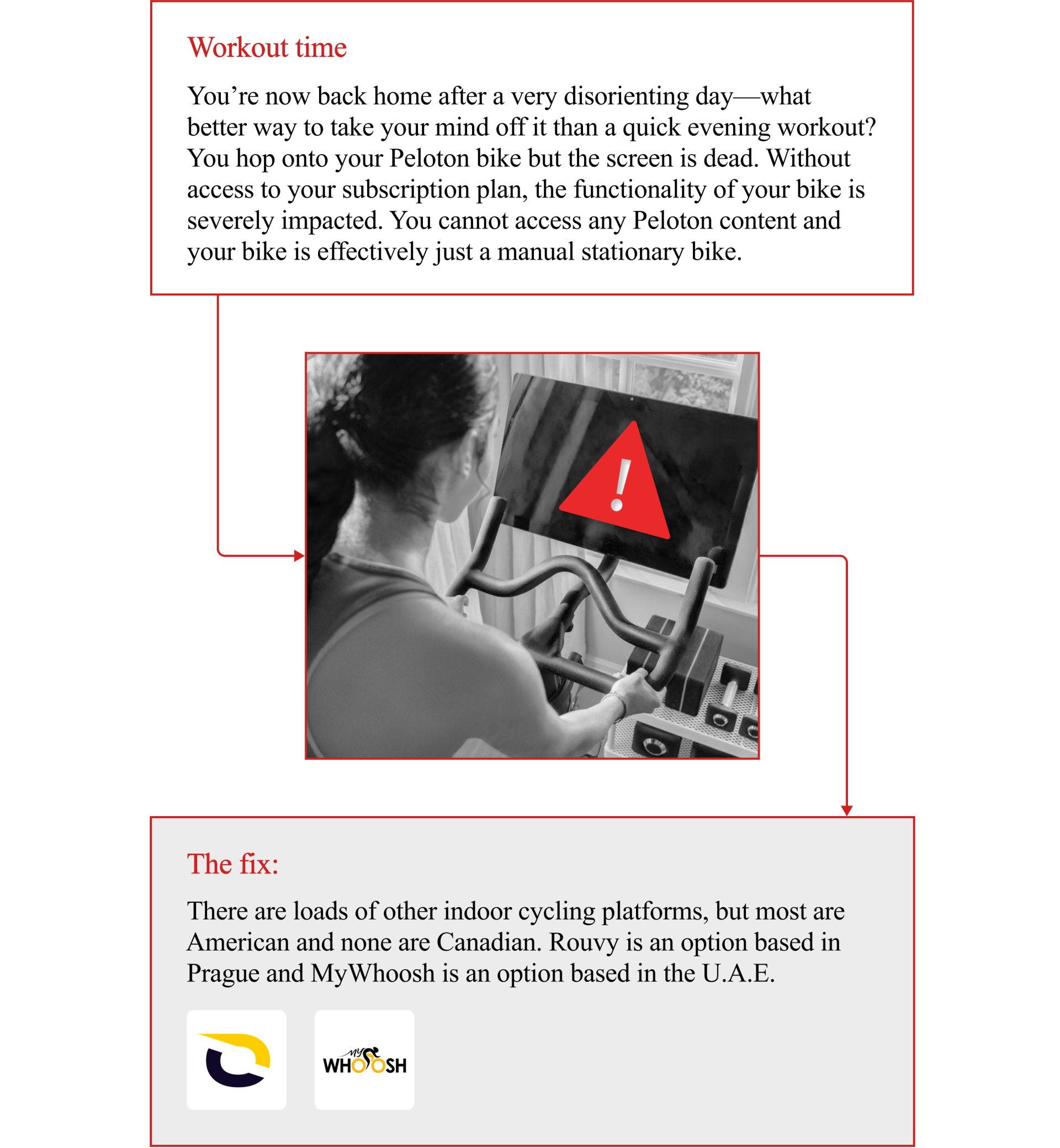
6:45 PM
7:00 PM
9:00 PM

If you’re curious to learn more about any of the non-American tech options mentioned in this rundown:
- Tado is a German company selling smart thermostats and other home technology. They host all their servers and infrastructure within Europe.
- ThinkOn is a Canadian cloud service provider. It is currently the only Canadian provider pre-approved for government use.
- Shift is a web browser founded by a Canadian tech company called Redbrick, though it does rely on Google’s browser and search engine. Qwant is a French search engine, hosted in Europe, and can be used on standard browsers or through the Qwant app. It markets itself as a privacy-preserving alternative to the dominant search engines.
- Typewire is an email provider owned and operated in Vancouver, with its own private servers and cloud infrastructure on Canadian soil. Proton, a company started in 2014 in Switzerland, is another alternative email provider.
- Element offers chat and video services and is built on the U.K.-based Matrix open standard for interoperability. Other EU-based options for work communications include Jitsi Meet, an open-source videoconference software, or NextCloud Talk, a communication platform supporting chats, meetings and webinars.
- Kobo sells e-readers and operates an e-book store. The company was founded in Canada but was acquired by Rakuten, a Japanese tech conglomerate, in 2011.
- cDox is an alternative to Google Docs, built by a Canadian designer and developer. Data is stored in Montreal, with options for EU residents to store their data locally coming shortly.
- Cohere offers enterprise AI tools and was founded in 2019 in Toronto. Mistral AI is another frontier AI company, based in France.
- Gander Social and Northsocial are two Canadian social media apps that rely entirely on Canadian servers and web services.
- From June 2025 to 2026, iOS and Android commanded 99.98% of the mobile operating system market in Canada.
- TouchBistro is a Canadian POS and restaurant management system. It was recently acquired by Harris Computer, a Canadian firm with a portfolio of software businesses. It does use AWS to store customers’ sales data, according to a TouchBistro online support page.
- Rouvy, based in Prague, and MyWhoosh, based in the U.A.E., are two indoor cycling apps that can serve as alternatives to American apps like Peloton.
- SkiptheDishes is a food ordering app that already competes with American ones like UberEats and DoorDash. It was founded in Canada but was acquired by Dutch conglomerate, Just Eat Takeaway, in 2016. Its operations are however supported by AWS.
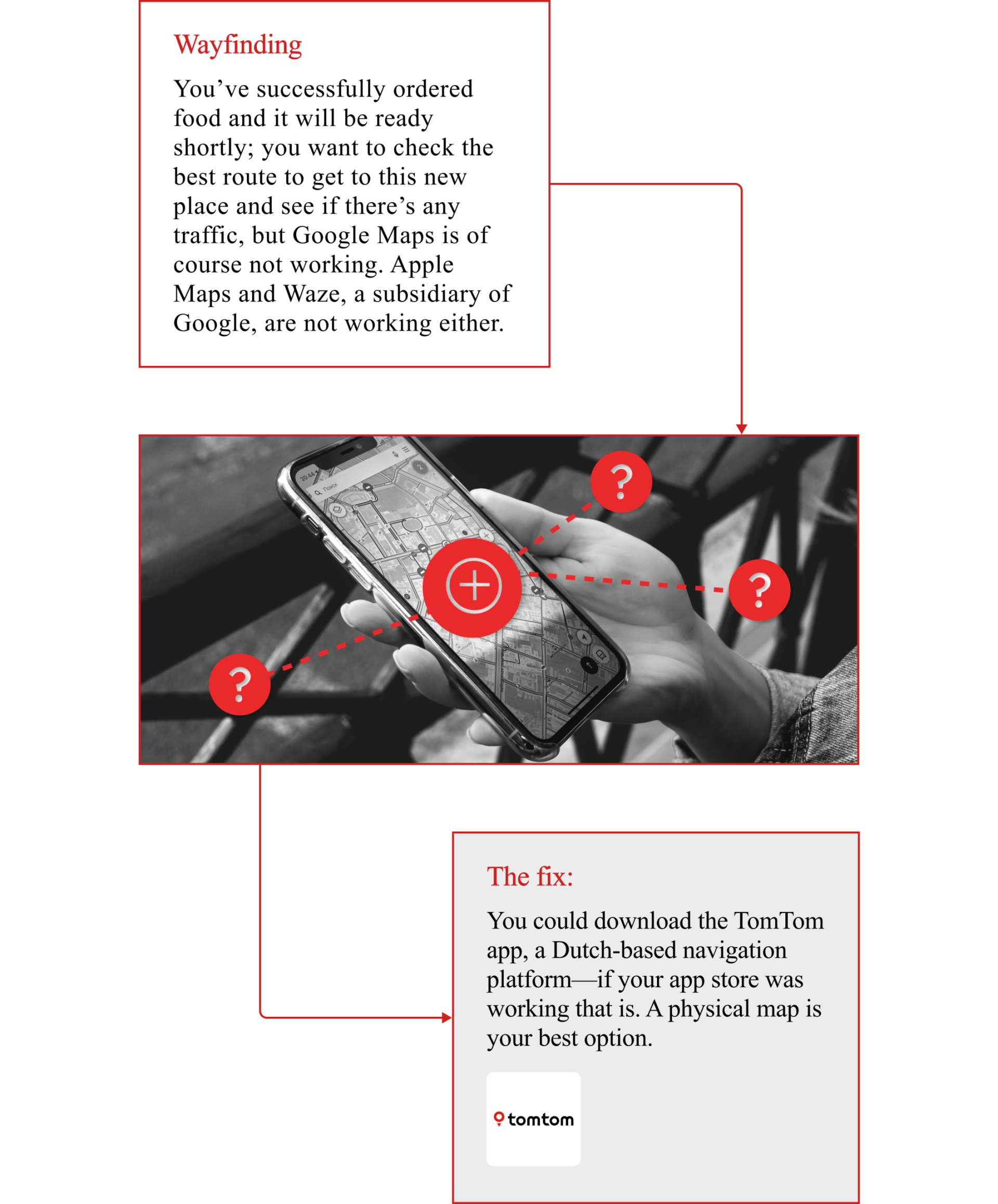
- The TomTom app is a Dutch-based navigation platform.
- Crave and CBC gem are two Canadian options for accessing movies and shows. Unfortunately, they do not run on only Canadian infrastructure: Crave relies heavily on AWS for its cloud hosting needs and, a few years ago, an interview with a Senior Director at CBC revealed that the CBC’s video streaming platforms run on American cloud. A more recent Amazon blog post from 2025 shows that CBC uses AWS to verify the authenticity of its video files.

Subscribe to