Big Tech’s CUSMA Wish List
Episode seven of the Gloves Off podcast considers influence.
Host Stephen Marche traces the rise of the global right-wing influence project that’s funded by tech billionaires like Peter Thiel and Elon Musk.
This ideology helped propel Donald Trump back to the Oval Office, and helped prompt the geopolitical rupture that we are all now navigating. So how should Canada grapple with these ideas, and the influence that their proponents wield?
Ahead of the CUSMA review, a number of major U.S. business councils have written down what they want from Canada, why they want it, and how they think the United States should use trade policy to achieve various goals. It’s all part of a transparent process in the U.S., where written submissions to the Office of the United States Trade Representative get posted — like how federal budget submissions become part of the public record here in Canada.
Side note: The Government of Canada conducted a public consultation on the operations of CUSMA between September and November of last year. But Canada hasn’t made all those submissions public. The Canadian Shield Institute offered a perspective on the Canadian side; you can read what we wrote here.
The submissions to the U.S. Trade Representative are wonky documents, but it’s where we start to see a really clear articulation of what private firms want to see from American trade policy.
We focussed on umbrella lobby groups that represent some of the largest technology firms in the world. They are:
- The Information Technology & Innovation Foundation (The ITIF) is a Washington-based technology policy think tank that has an office in Canada;
- The Computer and Communications Industry Association (The CCIA) is a U.S. trade association for internet and technology companies, and it directly represents major platforms;
- The U.S. Chamber of Commerce is a huge, economy-wide U.S. business lobby.
- The Information Technology Industry Council (ITI) is a global technology-industry trade association that is headquartered in Washington;
- The Business Council of Canada is an association of chief executives of Canada’s largest companies;
- The Canadian Chamber of Commerce is a broad federation of businesses and local chambers.
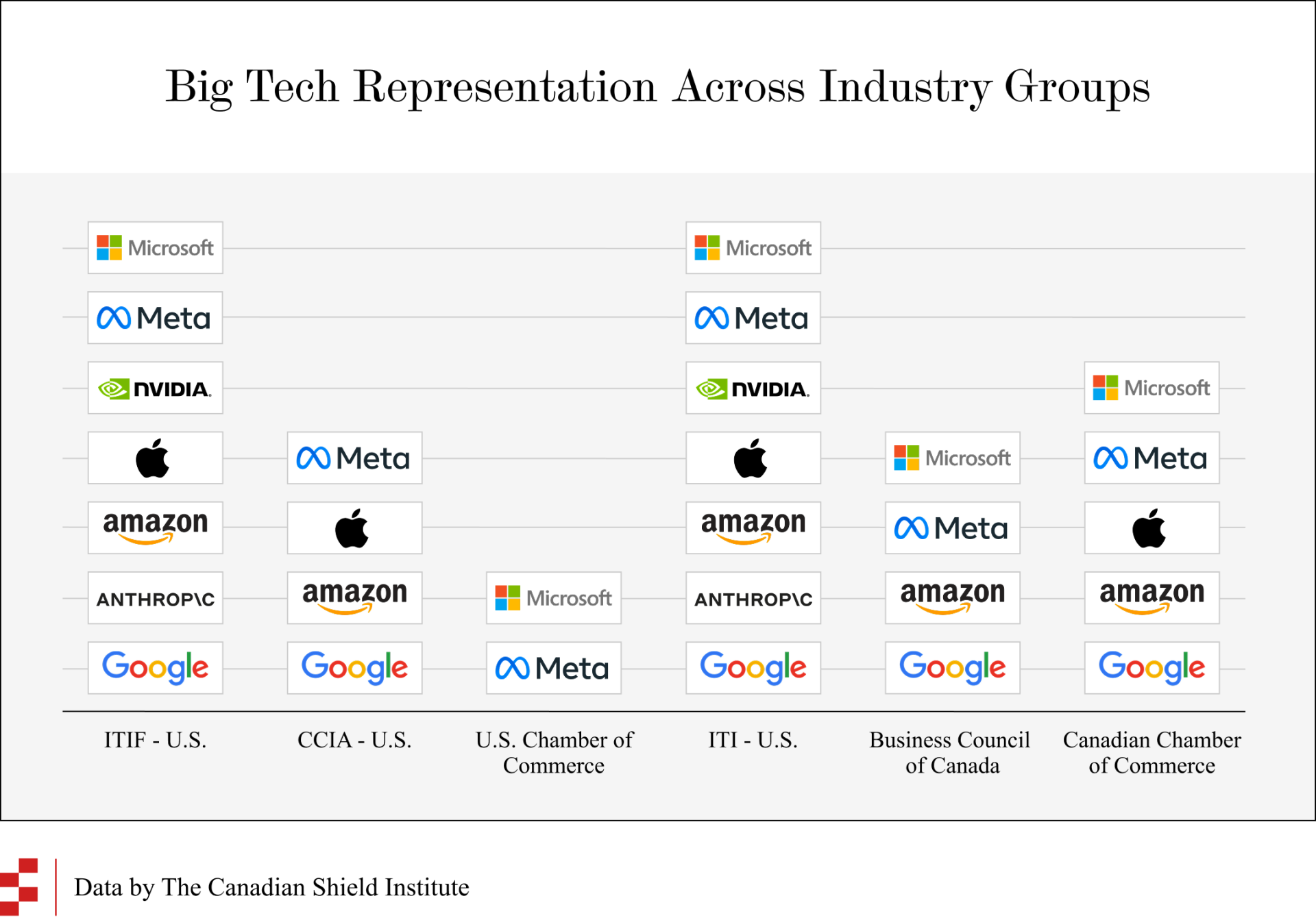
Here’s our snapshot of how Big Tech is represented across different industry groups:
We’ve written about this corporate capture before.
We included two ‘Canadian’ lobby groups because the Business Council of Canada also represents Amazon, Meta, Microsoft and Google, and the Canadian Chamber of Commerce represents all of those groups plus Apple. The U.S. Chamber of Commerce doesn’t disclose their members, but Microsoft and Meta representatives are on their board of directors.
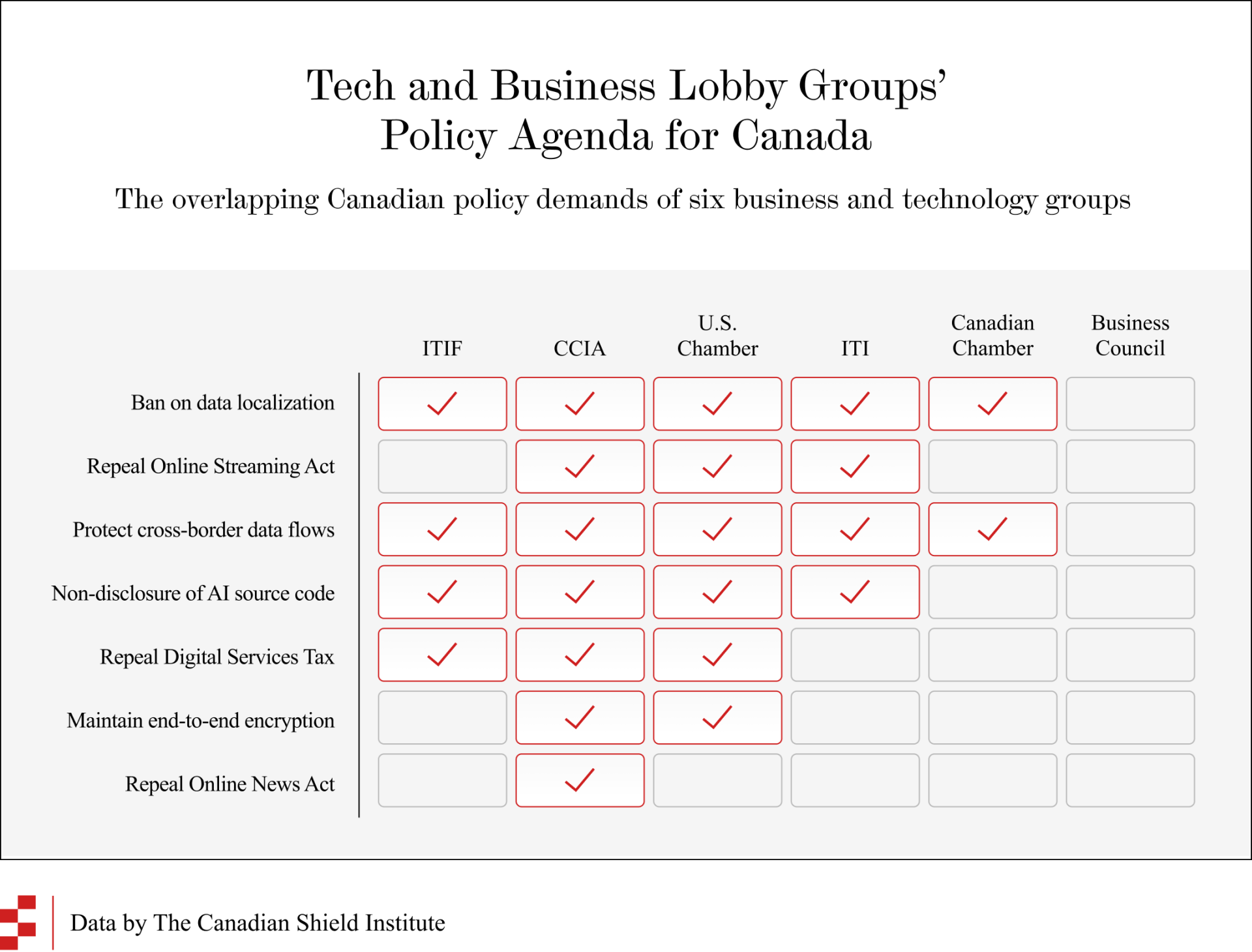
Despite being written by different organizations with different members, the USTR submissions converge on a consistent set of asks:
- protect cross-border data flows;
- prohibit data-localization requirements;
- strengthen protections against disclosure of source code and AI model weights;
- align AI rules across the three countries;
- recognize industry-developed standards;
- open up government procurement;
- ban digital-services taxes (already done in Canada); and
- push back against Canadian cultural, news and streaming policy.
Several groups also want guaranteed industry participation in new trilateral digital-policy forums.
The Information Technology and Innovation Foundation is especially candid. They argue that American leadership in writing digital-trade rules safeguards the U.S. technological position and allows American companies to scale internationally. A modernized CUSMA, it says, should create a more predictable environment for U.S. cloud, software and AI providers, supporting Washington’s goal of exporting an “American AI technology stack.” It also recommends curbing what it calls restrictive “digital sovereignty” frameworks.
(That’s us! We’re the pesky ones saying that Canada should be sovereign! We wrote eight whole chapters on it. Not sorry!)
American domination of the technology stack is the animating idea behind much of the USTR lobbying. It seems like American firms do not just want Canadians as customers; they want businesses, governments, and individuals to be totally reliant on the American technology stack, without any other options for cloud services, payment systems, AI models and more.
Part of this is economic, obviously. But it’s also about hard power.
The 2025 U.S. National Security Strategy talks repeatedly about American technology dominance, and about how American platforms and standards should be used to shape global systems of power.
We see the U.S. lobbyists pushing to maintain existing source-code protections in CUSMA’s digital chapter. No government should casually demand a company’s proprietary technology as the price of market access. But a sweeping prohibition can make it harder for regulators, courts or independent auditors to understand how systems work, effectively short circuiting any effort to regulate technology companies.
As the trade war continues, Canada should remember that tariffs are only the loudest and most reactive form of economic pressure. The bigger negotiations that shape the future are about who gets to regulate AI, where data may be stored, which firms receive public contracts, what Canada can require from foreign platforms and whether the country can deliberately cultivate domestic technological capacity.
If we accept the implicit bargain that the lobby groups are pushing, Canada holds onto U.S. market access, but only if we surrender the ability to regulate or assert sovereignty in the digital realm.
Canada should not enter the CUSMA review determined to preserve trade at any price. We should identify the policy tools we may need over the next decade, and avoid permanently bargaining them away in return for temporary relief.
Big Tech has clearly stated its national interest. It’s time for the Federal Government to be clear what ours is.

Subscribe to