What It Takes To Ditch American Tech
This week, the Gloves Off podcast is confronting one of the most thorny problems facing various countries right now: The global dependence on American Big Tech. Shield has already grappled with this in significant detail through our Foundations of Digital Sovereignty series, and this week we published a simple thought experiment: What would it look like if you woke up tomorrow and all American tech stopped working?
Also this week, Gloves Off host Stephen Marche talks to experts about why domestic alternatives to American Big Tech are necessary to address sovereignty risks.
Here’s what we know for sure: There’s a real appetite from Canadians to find alternatives to American products and services. A few searches through r/BuyCanadian reveals a community of Canadians (about 164,000 as of July 2026) who are deeply committed to reducing their dependence on American supply chains and companies as much as possible, including tech companies. Where there aren’t Canadian options, EU-based options are often framed as the next best choice.
The good news is that many alternatives do exist. While Canada still remains dependent on a handful of American companies, Canadian alternatives exist across several categories.
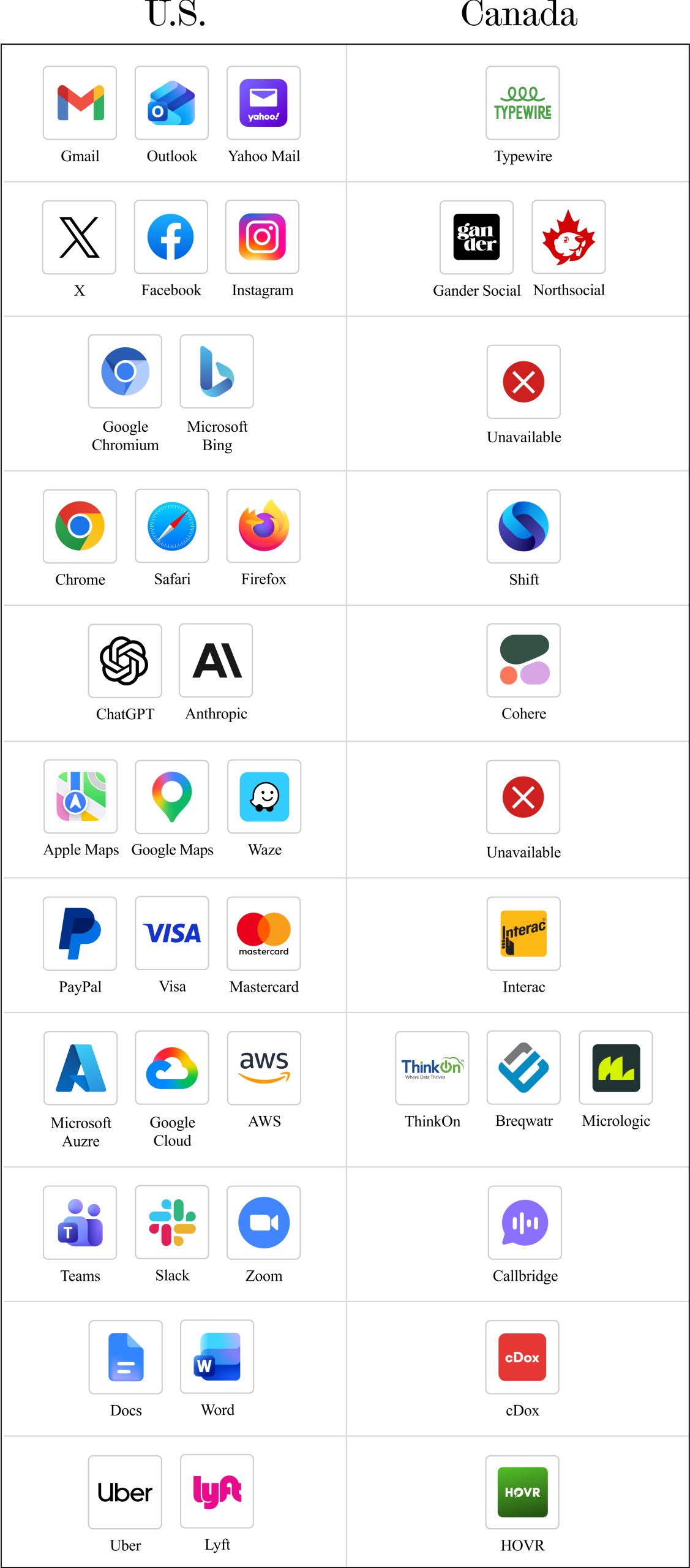
Admittedly, Canadian alternatives being “available” isn’t enough for many people to make the switch.
For a multitude of reasons, “buying Canadian” for software is a lot more complicated than in other industries and continuing to rely on American products is the path of least resistance.
Take social media for example. “Network effects” is the idea that many technology systems get better when more people are also using the same system. The network effects on X or on Instagram make it difficult to swap for Gander or Northsocial, unless you can convince all of your friends to leave as well.
The same network effects on American platforms makes them even more valuable to Canadian small businesses who rely on them for advertising or marketing.
Scope and scale are other concerns. The Google Workspace and Microsoft Office 365 are valuable because they are entire ecosystems—and no Canadian alternative yet matches the scope of products they offer. Thus switching to cDox, a Canadian alternative to Google Docs, may only be a partial solution if it means relying on American office software for all other use cases, or it may require patchworking several different tools together.
HOVR is a rideshare app that is not only Canadian, but also aims to be a fairer alternative. The service initially launched in the Greater Toronto Area, but the company has plans to expand across Canada. However, it may have difficulty competing with Uber and Lyft’s scale and command over drivers, which will mean longer wait times or cancelled rides for passengers.
In the cloud services market, there are several genuinely Canadian companies, like ThinkOn or Micrologic. However, the scope of these Canadian services is not yet on par with those provided by American firms.
Switching to any one of these services might incur high switching costs, either through the time and hassle required to learn a new system, or because the big American incumbents deliberately engineer their systems with a lack of interoperability, making it difficult to transfer data.
In some places, there are simply no alternatives. Two American companies dominate the credit card landscape globally: Visa and Mastercard. So, while Interac provides us with a strong debit system, much of our payment infrastructure is ultimately controlled by foreign firms.
One way to expand available options is by using government procurement to support sovereign alternatives. For example, France’s government is building its own videoconferencing platform for public servants called Visio — hosted on sovereign cloud infrastructure, to replace Zoom and Teams. France, Germany, Poland, Luxembourg and the Netherlands, are all building their own government alternatives to WhatsApp and Signal.
The Canadian federal government says it will support Canadian firms through its Buy Canadian policy, but so far the results have been underwhelming.
Leveraging government purchasing power to support Canadian companies to scale up is certainly part of the solution, but it is also worth asking whether the federal government should be playing an even bigger role in supporting the development of Canadian alternatives.
We do not need our federal government to be building Canadian alternatives across the entire tech stack, but if we are serious about “buying Canadian,” we also need to be “building Canadian.”
Taking direct inspiration from the EU, perhaps a sovereign messaging platform for parliamentarians—a fairly narrow use case for now, with the potential for the scope to expand—would be a good place to start.
Correction: An earlier version of this post included a graphic that incorrectly listed Cohere as an American company. Cohere is, in fact, a Canadian company headquartered in Toronto, Ont.
The Canadian Shield Institute regrets the error.


Subscribe to