Sovereignty is Calling
Who makes phones ring? And who can stop them?

A new app called Neon was quickly removed from the app store this week after TechCrunch revealed the program exposed recordings of people’s phone calls. As many as 250 million phone calls are made per day in Canada. How much of that information is being exposed along the way?

There are many areas of Canada’s everyday economy that are totally predicated on trust with the United States. Through a series of handshake deals, business arrangements and trade pacts made over decades, dependency on the United States has become a defining feature of much of Canada’s critical digital infrastructures.
One of those embedded and unnecessary weaknesses occurs every time you make a phone call.
It’s a somewhat ironic vulnerability, given Canada’s pride in the patenting of the telephone by Alexander Graham Bell in 1876.
But nowadays, a key pillar of Canada’s telecommunications system is reliant on Neustar, a U.S. tech company.
Neustar, now part of TransUnion, built and runs a range of telecom “plumbing” services: number routing, caller ID databases and other registry-style data services.
Behind the scenes, telecommunications carriers don’t route the ten digits that you dial on their own.
At least not anymore.
Until the late-1990s, phone call routing was simplified by the fact that telecom giants like Bell and Rogers each managed their own proprietary list of phone numbers and didn’t allow those digits to be transferred to other providers. That was quashed through competition reforms that achieved wireless number portability for consumers, making it possible to easily switch carriers.
Now, when Canada’s telecoms route numbers they must query a database to see which network actually serves that phone number. The key tool is the Number Portability Administration Center (NPAC), which then returns a location routing number so the call can be sent to the right switch.
Canada’s NPAC is administered by Neustar under the Canadian Local Number Portability Consortium.
What began as a positive consumer protection initiative, resulted in Canada outsourcing an important piece of technological infrastructure.
So what?
There are a lot of obvious subjects that come up when we start talking about digital sovereignty, such as Canada’s vulnerability to Washington’s CLOUD Act, which lets U.S. authorities compel data from U.S.-controlled firms even if that data is stored abroad, or the impacts of the constraints imposed through the digital chapter of CUSMA on Canadians.
But there are also so many cases where our digital dependency — and exposure — is underdiscussed and unexpected.
Even outside of the CLOUD Act’s confines, we’re constantly volunteering domestic information — in this case, who is calling who, and when.
But the real risk isn’t continuous data streaming to the U.S., it’s control risk. Key registries and trust anchors Canadians rely on are operated by U.S.-controlled firms subject to extraterritorial laws and courts. That’s an inherent national security vulnerability.
Plus, we need this system to be able to make phone calls. What happens if a formerly trusted partner turns it off?
Telecommunications makes its way into Heritage Minutes with Thomas Eadie and Signal Hill. And of course, Alexander Graham Bell. It’s part of the story our country tells itself about innovation, and we have lots to be proud of.
Reliance on U.S. call systems is a historical flub. Canada could have built a sovereign system that routed calls ourselves. It’s not hard to imagine an alternative, even with a U.S. provider offering support in the interim.
By allowing our telephony infrastructure to become interdependent with a U.S. firm, Canadians have abdicated our role as innovators and ceded control over systems we built.
It’s in the national interest for essential communications infrastructure to be operated under Canadian jurisdiction and governance. This is the same starting point that is motivating the country’s current consideration of a sovereign cloud.
BTW, a 1971 report from the Science Council of Canada warned of this: A “laissez-faire” attitude will eventually result in the supply of most computing and information services via spur lines from U.S. computer communications networks. Such an outcome is completely unacceptable on economic and social grounds.”
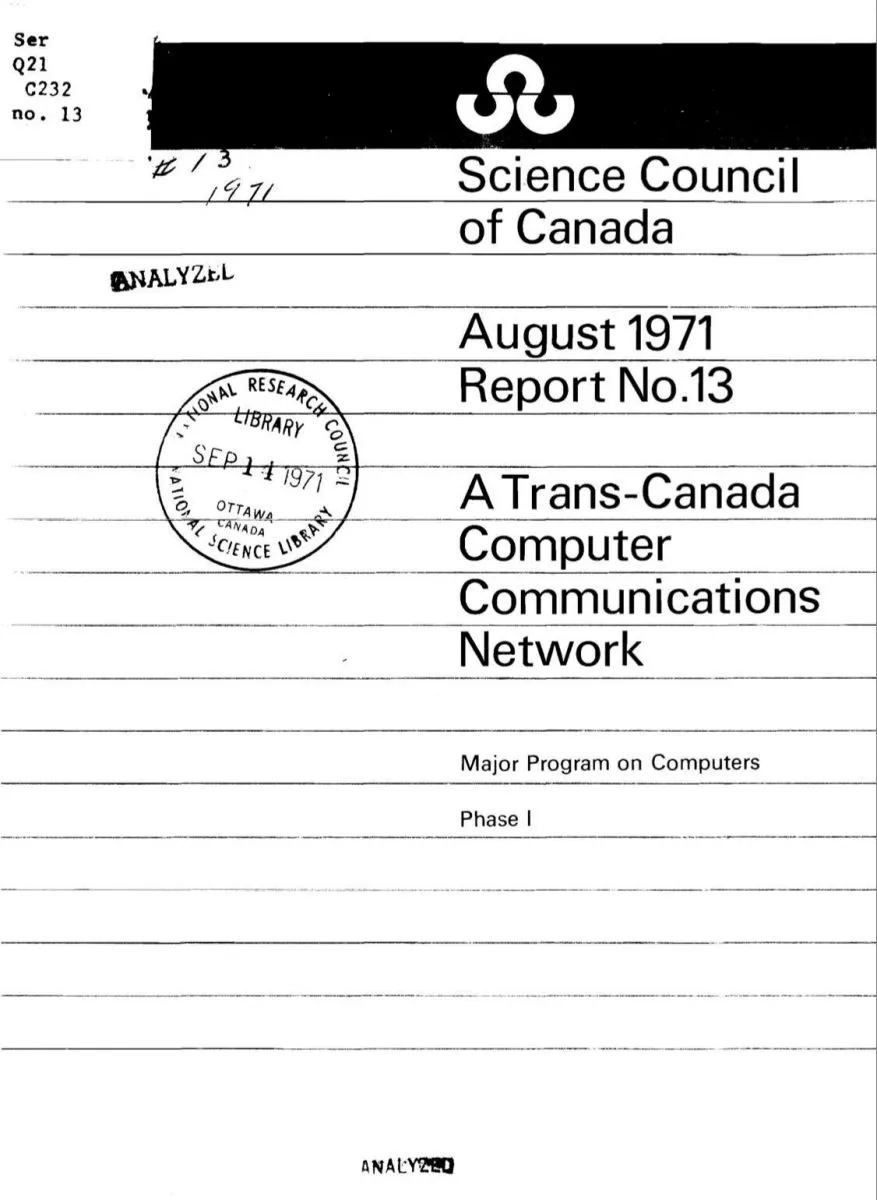
If you want to read more about Canada’s dependence on U.S. communications infrastructure, Robert Babe’s Telecommunications in Canada (1990) and Dallas Smythe’s Dependency Road (1981) are two great places to start, as is Andrew Clement’s Canadian Network Sovereignty: A Strategy for Twenty-First Century National Infrastructure Building (2018), which covers how this same routing dependency also happens with the internet.


Canada and the EU Can Be Friends With Benefits
Ever since Prime Minister Mark Carney visited the European Parliament in September, we’ve been thinking about what a deeper alliance across the Atlantic Ocean could mean. As we hit send on this email, Carney is meeting with António Costa, President of the European Council, and Ursula von der Leyen, President of the European Commission, in Montreal. At the end of it all, we’re expecting an announcement of … something. There have been a lot of anonymous tips in news reporting, but at the Canadian Shield Institute, we prefer to read the formal communiqué rather than trying to interpret whispers. In the run-up to the summit, we’ve been doing a bit of research, and we published a few articles to set the stage.
EU Media Marketplace
The Europeans are trying to break the AdTech duopoly. Canadian companies have tried to work together to create an alternative to Google and Meta’s dominance. So far, Canada’s efforts have fallen flat. Will this new EU enterprise fare any better? Read our analysis here.
We find this whole situation very interesting for two reasons: First, Canada and Europe have a lot of the same problems right now. We’re all trying to figure out how to reduce vulnerability from the United States, and that vulnerability extends to digital reliance on private-sector technology platforms. It seems like we could benefit by joining forces, but it’s going to take some work figuring out exactly what that looks like in practice. Second, AdTech is just really interesting! Programmatic targeted advertising is the economic engine of the internet, and in turn this kind of advertising is hugely influential on culture and society. AdTech dictates what kinds of businesses thrive and what kinds of content gets posted online. Once you start researching it, AdTech quickly starts to look like one of the most important dimensions of digital sovereignty. If the online economy is entirely dominated by systems controlled by a handful of big American technology companies, realistically both Canada and the EU will always be on the back foot on digital governance.
Digital Services Trade
Speaking of being on the back foot, did you know that U.S. digital services exports to Canada are worth more than all the autos, steel, aluminum, lumber, potash and electricity put together? Why aren’t we talking about digital trade policy more in the negotiations with the United States? Read our analysis here.
And the European Union is in a similar position. The EU has done a lot more to assert digital governance, but their trade deficit on digital services just keeps going up. This is a kind of reliance that creates a meaningful vulnerability if the United States keeps playing hardball. Read our analysis about EU digital trade here.
Digital services might be a promising area for Canada and the European Union to work together. When the final communiqué is delivered from the Canada-EU summit, we will be combing through it for specific mentions of digital trade collaboration.
Digital Sovereignty Policy
Despite the EU’s digital dependence, we see a lot to admire in how the Europeans have been trying to assert their digital sovereignty. To be blunt: They’re trying things! Canada has often been slow to pass meaningful digital regulation, and quick to walk back policies that offend the Americans. The EU has enacted some really interesting regulations. Could Canada use “digital trade alignment” as cover to follow the EU’s lead? Read our analysis here.
The Bottom Line
Overall, when it comes to digital governance, we have a lot of hard work ahead of us. Digital policy is complicated and opaque, and it’s not enough to just pass a good law. Ongoing enforcement is a real challenge too. But this is one of the most pressing policy issues of our time, and with the accelerating deployment of AI systems, this issue is only going to become more urgent. It’s not as easy as striking a deal to sell soybeans, but digital governance is an area where Canada and the EU are natural partners, and it’s something we should be working on.

Subscribe to