Europe Wants Digital Sovereignty; Trade Data Reveals Deepening Digital Dependence
Yesterday, we talked about Canada’s digitally delivered trade with the United States.
Our basic argument is that too much of the trade conversation is fixated on physical stuff — steel, lumber, dairy, cars — but we fail to appreciate the magnitude of the trade in digital stuff.
The digital economy is worth an awful lot of money! U.S. digitally delivered services in Canada are bigger than steel, aluminum and lumber combined.
Given Canada’s deepening ties with the European Union, we wanted to understand what their digital trade looks like too.
As we’ve written about, the EU is generally far ahead of Canada in terms of digital sovereignty, and building the systems and regulatory frameworks required to assert some level of digital autonomy.
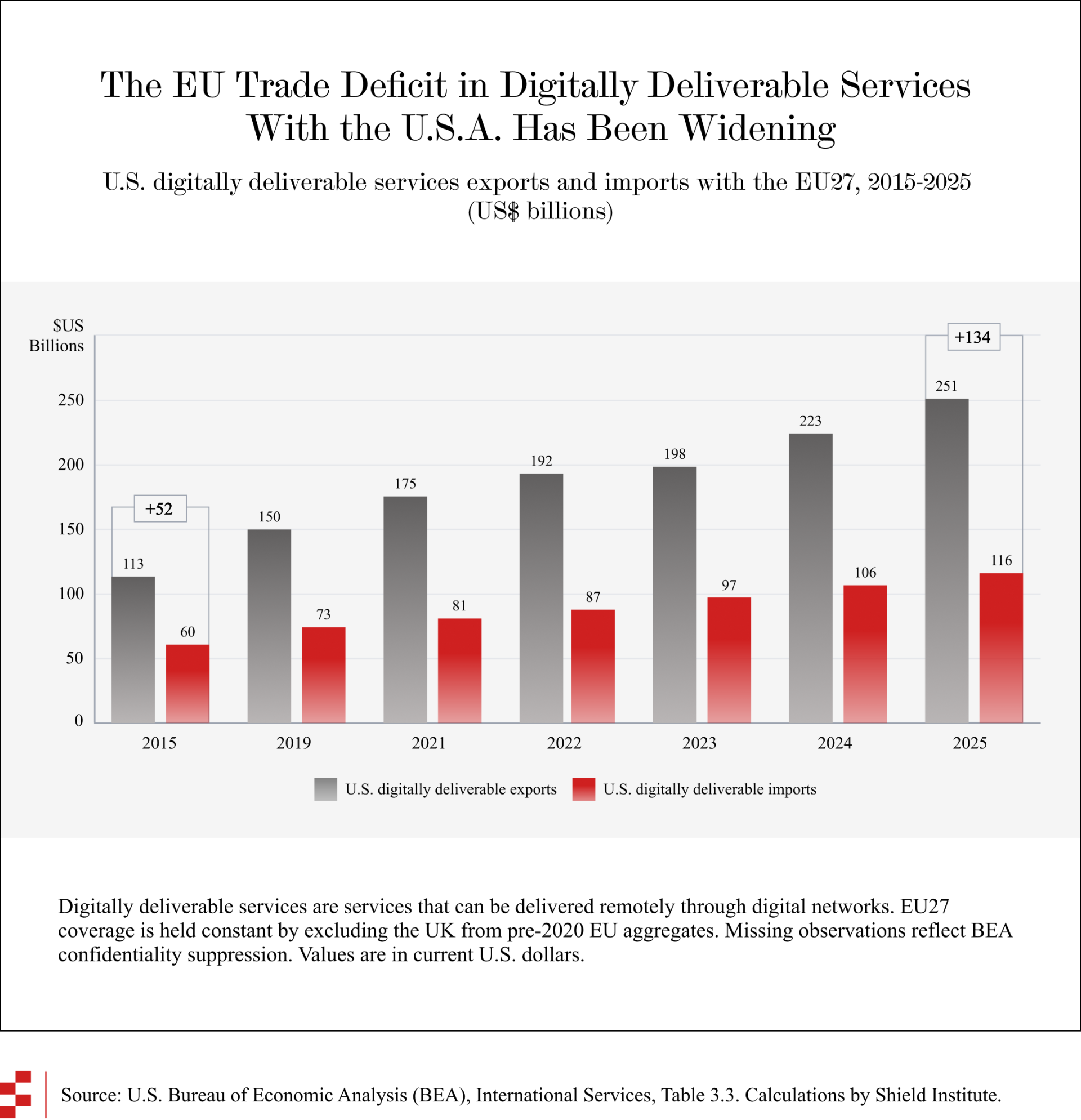
But looking at the data, we see that U.S. exports of digitally deliverable services to the EU (like cloud services, software, advertising, anything that can travel over a network) more than doubled in a decade; from US$113 billion in 2015 to US$251 billion in 2025.
Today, digitally delivered services make up two-thirds of all U.S.-EU services trade.
The scale is pretty wild.
To put that in context, here are the biggest categories of physical goods that Europe sells to the United States:
- Pharmaceuticals — US$192 billion
- Road Vehicles — US$45 billion
- Industrial Machinery — US$36 billion
- Electrical Machinery — US$33 billion
- Power-Generating Machinery US$25 billion
By comparison, the United States sells a whopping US$251 billion in digitally delivered services!
This kind of makes intuitive sense when you think about it. Pills are easier to ship than cars. And nothing is easier to ship than software and data zipping along fibre-optic cables.
To some extent, this is also the genius of U.S. President Donald Trump’s tariffs.
By fixating on physical goods, he is attacking the area where the United States imports the most, while ignoring the fact that the United States sells far more in terms of digital trade to Canada, the EU, and many other countries too.
We’re fighting a trade war over cars and steel while the biggest flow is actually digital.
In the face of the Canada-European Union summit this week, we’ve been thinking about all the ways that both jurisdictions are grappling with the current geopolitical challenges being posed by the United States.
We’re both worrying about digital sovereignty, global trade, defence and geopolitical volatility. On many of these files, it seems entirely possible that Canada can provide solutions for Europe’s problems, and vice versa.
This Summit is fundamentally about allies managing critical dependencies together. Sovereignty doesn’t have to be a solo sport, and digital can’t be an afterthought because it’s intangible.
About the Data
Figures are in current U.S. dollars from the U.S. Bureau of Economic Analysis (International Services Tables 2.3 and 3.3, and affiliate statistics) and U.S. Census Bureau trade data, with EU27 coverage held constant. “Digitally deliverable” means services that can be delivered remotely, whether or not they were. Calculations by the Canadian Shield Institute.



Subscribe to