The Spooky Intangible Assets That Haunt our Economy
There’s no movie series like the Amityville Horror.
As of today, there are more than 100 Amityville movies. (Different sources disagree on the precise number.)
The Amityville sub-genre includes the likes of:
Why is this happening? What malevolent demonic force is pelting us with Amityville movies?
The answer is: Intellectual property law.
While nearly all other major movie franchises are based on some kind of copyrighted intellectual property, Amityville is the name of a town in New York where some gruesome murders occurred in a house.
Nobody can copyright the word “Amityville” so any struggling director can put “Amityville” in their low-budget horror movie to make it seem a little bit more legit.
When you understand the dynamics of intellectual property law — trademarks, patents, copyrights and such — you see these intangible forces shaping our world absolutely everywhere.
Intellectual property is why Tylenol sells (successfully!) for more money in the drug store next to chemically identical generics that sit right beside it on the same shelf.
The biggest, most powerful companies on earth today — Google, Apple, Microsoft, OpenAI, Nvidia — are primarily in the business of commercializing intellectual property.
When it comes to prioritizing intellectual property, and pursuing smart strategy to ensure that Canadian companies are able to compete and thrive, Canada has historically been weak.
Canada's Patent Applications Per Million Population Has Stagnated
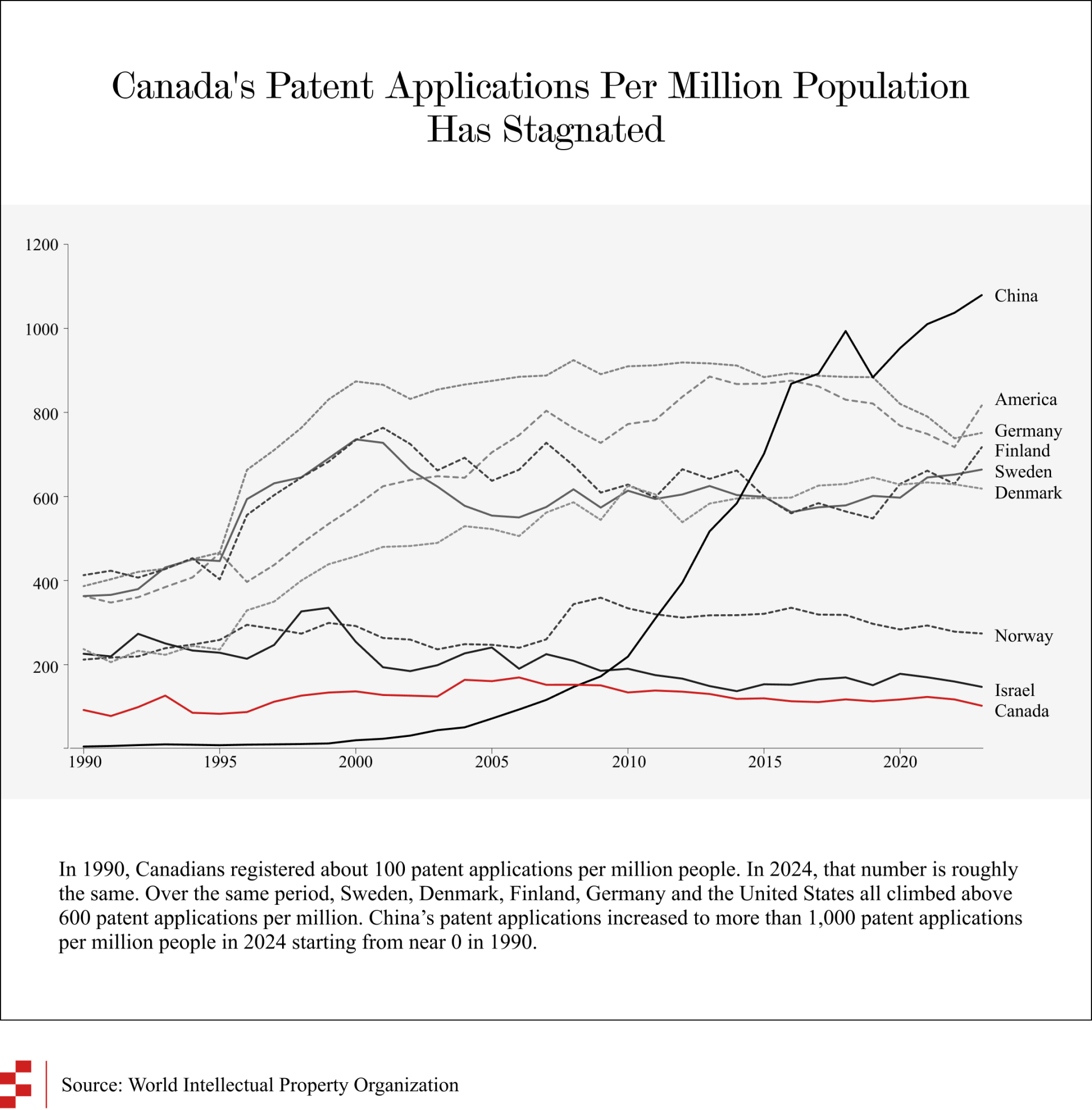
Last year, in the 2025 federal budget, we were encouraged to see the federal government acknowledging this weakness, and promising to conduct a serious review of our policies:
“To further strengthen the intellectual property ecosystem in Canada, the government will conduct an intellectual property performance review to identify new ways to partner with emerging and scaling intellectual property intensive firms, increase domestic investment in leading and high-potential firms, retain and commercialise intellectual property in Canada, and help firms to protect and commercialise their intellectual property in foreign markets to advance trade diversification.” (Page 94)
At the Canadian Shield Institute, we think that this kind of IP policy is one of the most important issues for smart economic policy in the 21st century.
A big part of why Canada’s playing catch-up on artificial intelligence is because Canada doesn’t have a good system for turning publicly funded research into the kind of intellectual property that can be commercialized.
It’s disappointing that the government still hasn’t convened a comprehensive review of Canada’s intellectual property ecosystem. There was a very narrow consultation last spring on specific legal minutia around patent filing agents and such (we participated!), but this was far from the kind of sweeping IP performance review that we need to see.
We think that Canada needs a new institution — an Innovation Asset Bank — that co-ordinates intellectual property strategy and acts as a custodian of key publicly-funded IP.
We talked about this idea a little bit in our policy series Foundations of Digital Sovereignty earlier this year. And we’re presenting on this next week in Ottawa, at the Canadian Intellectual Property Office’s Data and Research Conference. (A great opportunity for the government to announce the comprehensive IP review? We can only hope!)
This week, Finance Minister Francois-Philippe Champagne announced that he will deliver the 2026 federal budget on Thursday, November 5.
When we get our hands on the document, one of the first things we’ll be looking for is any updates about whether the government is still planning to launch a serious IP review.


Subscribe to