We Need to Rethink Skills Training
Unless you work in the Department of Finance or the Prime Minister’s Office, nobody really knows what will be in the 2026 federal budget.
But when Finance Minister François-Philippe Champagne rises in the House of Commons next month to deliver the budget, it’s a safe bet that the spending document will include money for training and skills development.
When it comes to pretty much any kind of economic challenge, the government loves to announce that workers hit by hardship will be given new training and skills development.
When the government delivered the “AI For All” strategy earlier this year, laying out a plan to navigate disruptive artificial intelligence technology, one of the key pillars of that strategy is workforce training programs.
In response to the U.S. trade war, the federal government announced $570 million, which included training and skills development for displaced workers.
When COVID-19 hit in 2020, the government announced $1.5 billion in workforce training and skills development money to help displaced workers.
A lot of this money flows to provinces through Workforce Development Agreements, so the money gets announced twice. Pick a province at random, and look in their provincial budget and there’s a pretty good chance that the government is saying something about training and skills development.
But there are some interesting problems with Canada’s approach to training and skills development that the Canadian Shield Institute has been studying this year, in a project for the Future Skills Centre.
We’ll be publishing a larger research paper soon, but for this week’s newsletter, we wanted to share the key issue that this research is looking at. With the 2026 federal budget looming, and all manner of economic disruption prompting more calls for retraining and skills development, policymakers should be rethinking their approach.
The main problem we see is that Canada actually already has the highest level of education among any OECD country.
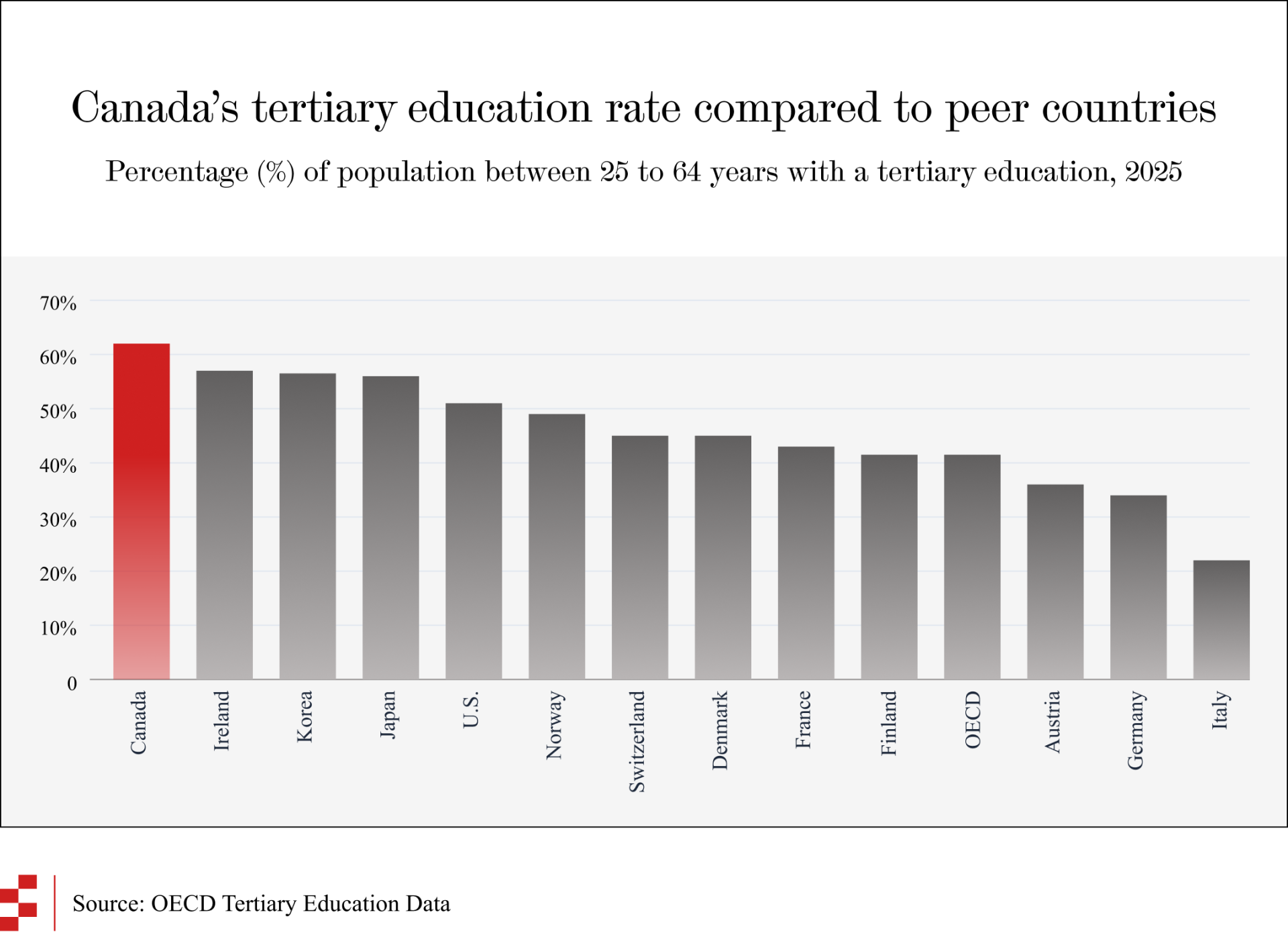
You’d think that lots of highly educated adults would be great for the economy. But in reality, what we actually observe is that Canadian workers mostly just feel that their talents are being wasted.
A major research survey conducted by the OECD asks respondents to describe their skills in relation to their job requirements. Respondents are given four options:
- My skills are higher,
- My skills match the job requirements,
- My skills are lower than what is required, or
- I don’t know
Canadians reported the second-highest rates of over-qualification in the OECD, after only the United States.
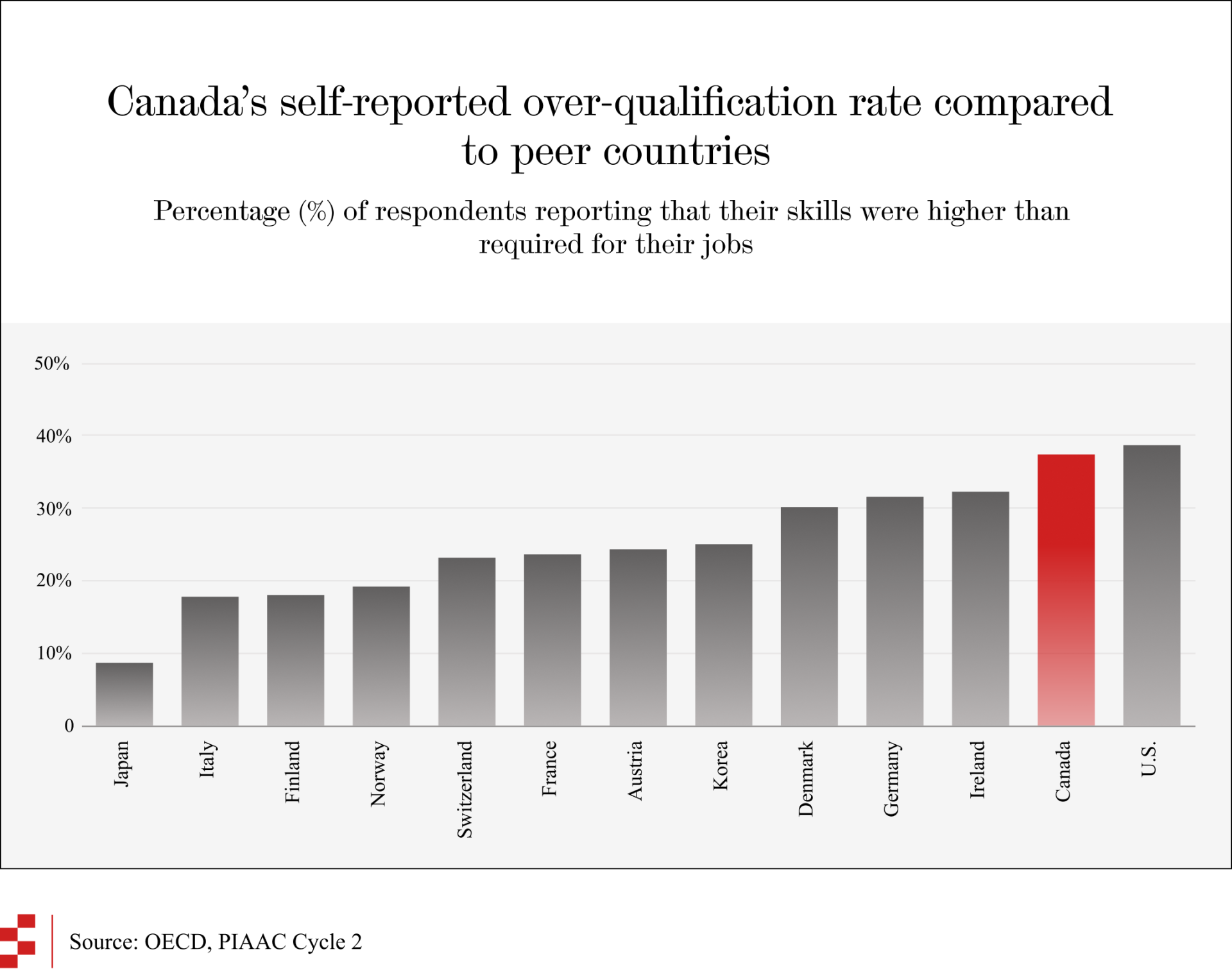
Now, this self-assessed data isn’t perfect. Because survey respondents are judging themselves, this data runs the risk of capturing what you might call … excessive self-regard. For example, we see that men tend to say that they have higher skills than the job requires at significantly higher rates than women. This doesn’t mean that men are actually more highly qualified than women.
But one area that we found particularly interesting is how workers’ self-perception shows up when they have participated in skills training in the past year.
People who had training paid for at least partly by their employer, and workers who had training at least partly during work hours were significantly less likely to say that they felt overqualified for their current job.
Workers who go out and get skills training on their own, paying for it themselves, are more likely to say that they have more skills than their job requires.
This makes a certain amount of intuitive sense. When the company is paying for your upskilling, you’re probably going to be learning skills that the boss can put you to work using right away.
On the other hand, if you’re going out to get your own skills training, there’s a greater chance that you’re learning skills that may be different from what your job requires.
What if the answer is to do more to bring employers into the conversation? More funding for employer-directed training might also be a way to get companies to create new entry-level positions, and then train up workers to fill the emerging needs of tomorrow.
As it stands, the Canadian labour force is being battered and disrupted by economic forces, new technology, and geopolitical volatility. And mostly as a country our answer has been: Take some more training and get a microcredential to prepare yourself for the new economy.


Subscribe to