Canada's U.S. Digital Services Imports Are Worth More than the Steel, Lumber and Electricity We Sell
The digital economy is a bit of a blind spot for the Canadian government.
If you go to the Statistics Canada “Digital Economy and Society Statistics” hub, and start clicking around, you get a lot of severely outdated links.
- “Measuring digital economic activities in Canada: Initial estimates” hasn’t been updated since 2019
- “Canada’s international trade in information and communications technologies (ICT) and ICT-enabled services” hasn’t been updated since 2018
The most recent data from Statistics Canada we could find is from 2023, when the government agency valued our total digitally delivered commercial services exports at $70.3 billion.
Statistics Canada does not actually seem to track digitally delivered commercial services imports, so we have to go looking for other sources to figure out what our trade balance is on digitally delivered services.
The U.S. Bureau of Economic Analysis has some good data, and when we started looking at their digital trade numbers, we found that Canada imported $70.3 billion in digitally deliverable services from the United States.
To underscore: Canada sold about $70.3 billion in digital services to the whole world, and the U.S. sold about $70.3 billion just to us. Weird coincidence that these two numbers are exactly the same, right? We had to check and re-check, just to be sure.
NOTE: This isn’t strictly an apples-to-apples comparison. Statistics Canada measures actual digitally delivered services, whereas the BEA measures services that could be delivered digitally. And let’s be honest, they are probably being delivered digitally. They’re not putting CD-ROMs in the mail.
Methodology aside, the larger point here is this: The trade imbalance is huge.
But actually, the trade imbalance is even bigger!
The BEA also tracks services sold by U.S. subsidiaries operating in Canada — so, like, if Microsoft Canada is selling services to Canadians.
This data gets frightfully complicated, and it’s not possible to clearly identify digitally delivered services. But we can get a general sense of scale.
So, for example, in the BEA data, when we look at just the information industry, we see that Canadian subsidiaries of American companies are selling $23 billion worth of services.
We can’t say for sure that all of the $23 billion is digitally delivered services, necessarily. But a lot of it probably is.
One key takeaway here: If Canada is prioritizing low-value sectors and industries, and failing to account for high-value trade, then we are going to sign bad trade deals.
Here’s a chart that illustrates the relative scale of digital services, compared to some other key industries that we’ve been talking about quite a bit during the trade fracas.
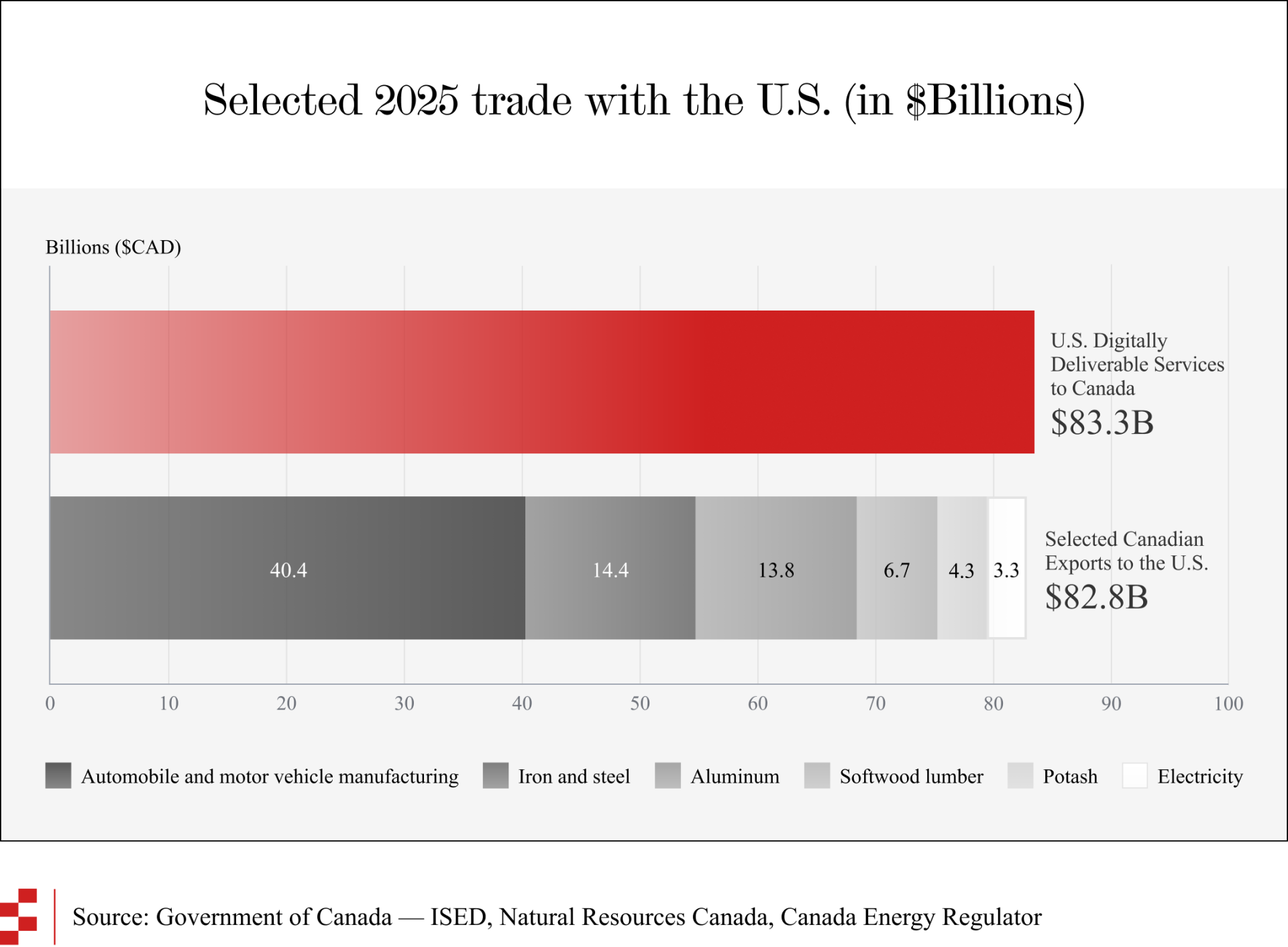
As you can see, digitally delivered services are a whole lot bigger than many of those physical goods sectors.
And remember, this is only the direct digital trade stuff we’re tracking. We’re not including the foreign subsidiaries here because the data is too messy.
But consider: what happens when Microsoft Canada sells Microsoft 365 and Azure? Or Google Canada sells advertising? Or when you pay for your Amazon(.ca) Prime subscription?
We also have no good way of accounting for the many “free” services that monetize in other ways, through advertising and data collection. These are also digitally delivered services, and they have an economic impact, just not directly through Canadians paying directly (unless there is advertising).
The truth is that there is no gold standard dataset that clearly tracks digitally delivered services. And … that’s crazy, right?
It is 2026, and the economy runs on the internet. We are in a trade war, and we are battling for our economic future. Perhaps part of the reason that we are focused on dairy and aluminum is because it’s easier to count cars and tonnes of metal.
We desperately need better data on this. Statistics Canada should be updating the numbers of digital services with the same regularity that they publish fresh numbers on traditional imports, and labour market trends.
But even with this limited picture, we can say that the economy of digital services dwarfs traditional industries like steel and forestry.
So why aren’t we talking about digital policy more in the trade war?



Subscribe to