Sovereignty on the Rocks
Did you notice Premier Ford pouring one out this week?
How ‘Canadian’ IS Crown Royal? The brand is British-owned and some bottling is moving to the United States, but the product’s label still reads ‘Canadian whisky.’ That gap between what the label says and where the value goes underscores our country’s sovereignty problem in a nutshell.
Diageo, the UK company that owns Crown Royal, just announced plans to shut down its bottling facility in Amherstburg, Ontario, slashing 200 jobs. The firm intends to shift much of its bottling capacity to the U.S. and cites supply chain efficiency as the reason for the move. Diageo says only U.S.-bound bottling is moving stateside, while bottling destined for the Canadian market will be absorbed by Crown Royal’s Quebec location.
Regardless, one of our most iconic whisky brands is about to become even less Canadian.
We actually lost ownership over Crown Royal a while ago. The brand originated in Gimli, Man. in 1939, but fell into the hands of British multinational Diageo back in 2001. Crown Royal is now just one piece of an empire of over 200 alcohol brands — including big names like Guinness and Smirnoff — owned by Diageo.
Foreign ownership of formerly Canadian whisky brands built and scaled at home has become too common. Forty Creek is owned by Italy’s Campari Group and Black Velvet is owned by U.S.-based Heaven Hill. French multinational Pernault Ricard owns JP Wisersand Gooderham & Worts, along with the Hiram Walker distillery in Windsor, out of which many other ‘Canadian’ whisky brands, like Lot40 and Pike Creek, are produced.
Perhaps most damningly, two ‘Canadian’ whisky brands with their heritage right in their names, Canadian Club and Alberta Premium, are owned by Japanese multinational Suntory.
But these brands haven’t been boycotted in the ‘Buy Canadian’ mania. When provinces took U.S. booze off the shelves earlier this year, Canadian-branded whiskies like these were mostly left alone, no matter who is at the top of their ownership chart.
Instead, Canadian whisky is enjoying a revival as consumers pull back from American bourbons to the alternatives that feel much more Canadian.
Often, that Canadianness is not much more than a feeling. Whisky has simply become another place where foreign-owned companies can capitalize on our reignited preference for Canadian products while siphoning most of the benefits.
Sure, when these whisky brands keep the majority of their processing capacity in Canada, they continue to create valuable jobs here. But the profit gets recorded elsewhere. That tension was well captured on X through this tweet from Suzanne Sexton (below).
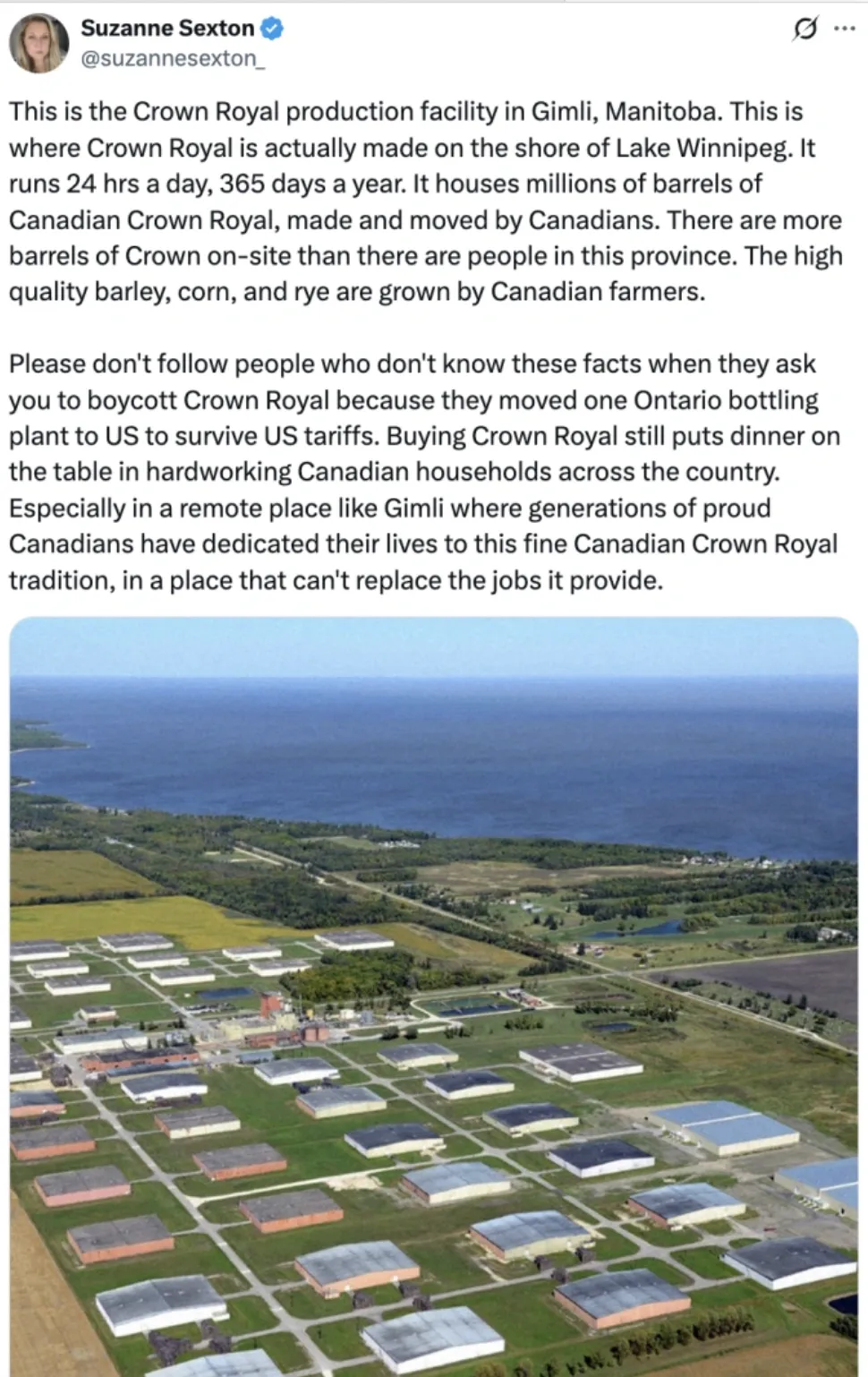
Meanwhile, Canadian whisky has relatively weaker branding when compared to Bourbon or Scotch whisky. A controversial rule allows for up to 9.09 percent of Canadian whisky to be made from other wines or spirits. That means that ‘Canadian’ whisky does not even have to be entirely whisky, let alone entirely Canadian.
While this creates room for creativity from master whisky blenders, big companies can also capitalize on this rule to avoid high export taxes (Canadian whisky is already sold at much lower prices in the U.S. than comparable blends from other countries). We also do a poor job protecting our national brands in the export market: some Canadian whisky is shipped to the U.S. to be aged and then passed off as American rye. We are leaving value on the table.
To support what is truly Canadian, we need to reclaim control over the nomenclature. In order to be called Canadian whisky under Canadian Food Compositional Standards, distilleries must meet specific requirements, like domestically ageing their product for at least three years.
Where is the requirement to label foreign company ownership? Labels based on where a product is assembled often mislead people into assuming that the company itself is Canadian.
The not-so Canadian whisky is only part of a larger story in which Canada has relinquished control of too many markets and products to foreign ownership.
The vulnerabilities this trend has created in our economy have been present for a long time, but current conditions have served them neat. If the word ‘Canadian’ on the label doesn’t mean Canadian-owned, Canadian-controlled or Canadian-benefitting, it is a designation that doesn’t actually mean much at all.
Diageo’s plan to shutter bottling in Amherstburg is a case study in how we quietly lose sovereignty over iconic products that can still claim to be ‘Canadian’ because of the carve outs we’ve allowed in public policy.
Song of the Week
Below is “Did I Say Too Much? from Toronto band The Beaches. The Globe and Mail recently said they are riding a fresh wave of popularity on a mix of pop hooks, spirit and authenticity. Send us the Canadian music you’ve been listening to lately!
The Beaches - Did I Say Too Much

Canada and the EU Can Be Friends With Benefits
Ever since Prime Minister Mark Carney visited the European Parliament in September, we’ve been thinking about what a deeper alliance across the Atlantic Ocean could mean. As we hit send on this email, Carney is meeting with António Costa, President of the European Council, and Ursula von der Leyen, President of the European Commission, in Montreal. At the end of it all, we’re expecting an announcement of … something. There have been a lot of anonymous tips in news reporting, but at the Canadian Shield Institute, we prefer to read the formal communiqué rather than trying to interpret whispers. In the run-up to the summit, we’ve been doing a bit of research, and we published a few articles to set the stage.
EU Media Marketplace
The Europeans are trying to break the AdTech duopoly. Canadian companies have tried to work together to create an alternative to Google and Meta’s dominance. So far, Canada’s efforts have fallen flat. Will this new EU enterprise fare any better? Read our analysis here.
We find this whole situation very interesting for two reasons: First, Canada and Europe have a lot of the same problems right now. We’re all trying to figure out how to reduce vulnerability from the United States, and that vulnerability extends to digital reliance on private-sector technology platforms. It seems like we could benefit by joining forces, but it’s going to take some work figuring out exactly what that looks like in practice. Second, AdTech is just really interesting! Programmatic targeted advertising is the economic engine of the internet, and in turn this kind of advertising is hugely influential on culture and society. AdTech dictates what kinds of businesses thrive and what kinds of content gets posted online. Once you start researching it, AdTech quickly starts to look like one of the most important dimensions of digital sovereignty. If the online economy is entirely dominated by systems controlled by a handful of big American technology companies, realistically both Canada and the EU will always be on the back foot on digital governance.
Digital Services Trade
Speaking of being on the back foot, did you know that U.S. digital services exports to Canada are worth more than all the autos, steel, aluminum, lumber, potash and electricity put together? Why aren’t we talking about digital trade policy more in the negotiations with the United States? Read our analysis here.
And the European Union is in a similar position. The EU has done a lot more to assert digital governance, but their trade deficit on digital services just keeps going up. This is a kind of reliance that creates a meaningful vulnerability if the United States keeps playing hardball. Read our analysis about EU digital trade here.
Digital services might be a promising area for Canada and the European Union to work together. When the final communiqué is delivered from the Canada-EU summit, we will be combing through it for specific mentions of digital trade collaboration.
Digital Sovereignty Policy
Despite the EU’s digital dependence, we see a lot to admire in how the Europeans have been trying to assert their digital sovereignty. To be blunt: They’re trying things! Canada has often been slow to pass meaningful digital regulation, and quick to walk back policies that offend the Americans. The EU has enacted some really interesting regulations. Could Canada use “digital trade alignment” as cover to follow the EU’s lead? Read our analysis here.
The Bottom Line
Overall, when it comes to digital governance, we have a lot of hard work ahead of us. Digital policy is complicated and opaque, and it’s not enough to just pass a good law. Ongoing enforcement is a real challenge too. But this is one of the most pressing policy issues of our time, and with the accelerating deployment of AI systems, this issue is only going to become more urgent. It’s not as easy as striking a deal to sell soybeans, but digital governance is an area where Canada and the EU are natural partners, and it’s something we should be working on.

Subscribe to