What It Means To Be Canadian
Let’s cut right to the chase: The team has been thinking a lot about what makes for an authentically Canadian company. We’ve written about it several times recently. And we’re not the only ones.
Currently, in many instances, the only requirement to call yourself a Canadian company is that you have an address with employees in Canada, and pay taxes here.
Today, we propose a definition of a Canadian company we think can work across all government ministries and programs. We believe that government dollars can build productive capacity in the Canadian economy, but to do that we need to be clear on what makes an authentically Canadian company.
The definition we’re proposing rests on the following elements:
Control: Key decisions are made in Canada;
Headquarters: A substantive headquarters presence in Canada, with senior leadership and strategic decision-makers based here;
Intellectual Property: The firm owns or controls IP resulting from Canadian R&D, and substantially commercializes that IP from Canada;
Ownership: Most companies accept foreign investment to fuel their growth, but a Canadian company cannot be majority owned by a single non-Canadian company or individual.
So, does this feel correct? If you subscribe to The National Interest, you’re probably a policy wonk. You probably have thoughts. We want to hear from you; just reply to this email.
This approach reflects a basic principle: when public dollars are used to build domestic capacity, eligibility should be anchored in where a firm is governed and controlled—not simply where it maintains an office or is incorporated.
You may be asking why we didn’t just require Canadian companies to be majority-owned by Canadians. The reality is that many Canadian companies have more than 51% of their shares held by investors outside of Canada. That’s true with household names — publicly traded companies and many VC-backed startups. The reality is that we need foreign funds to help scale our companies, and realistically, it’s not helpful to penalize firms that meet the other criteria, but fall short because they took VC investment.
Canada benefits from foreign investment and from global firms operating and hiring here. As it stands, Canadian procurement and program eligibility frameworks do not sufficiently distinguish between firms that are genuinely Canadian-owned-and-controlled and branch-plant subsidiaries that operate in Canada but are ultimately accountable elsewhere.
The practical intent of a consistent definition for genuine Canadian companies is that we can then adapt government policy over time to favour those firms. The fact of the matter is that economic nationalism is the way of the world in the 21st century.
Defence and security procurement is a natural starting point. Governments typically have stronger grounds to weigh factors like security of supply, trusted governance, and domestic capacity in sensitive sectors, and existing procurement disciplines include recognized exceptions in national security contexts. A much clearer definition of “Canadian-controlled” within the Defence Industrial Strategy would help ensure those objectives are applied in an administrable way.
We could also start applying a rigorous definition of a Canadian company to government procurement more generally. In 2024-2025, the federal government awarded $66.9 billion in contracts for goods, services, and construction. That’s the state making important decisions about who gets to scale, who gets repeat customers, and what companies get the credibility that comes with being a government supplier.
On intellectual property, public dollars should flow to companies that create long-lasting economic value for Canada, rather than just subsidising companies that conduct R&D here. Natalie Raffoul and Neil Desai wrote about this in the Globe and Mail last week as it pertains to receiving research funding.
If Canadian taxpayer funds are driving invention and commercialization, shouldn’t we be shaping policy to ensure that the IP is creating value in Canada, controlled by authentically Canadian companies?
Eventually the definition of a Canadian company might extend to other kinds of procurement, provincial government economic policy, tax treatment and more.
We know there’s a public appetite for this kind of policy. We see public support everywhere for a bit more economic nationalism.
Just a couple weeks ago, a Loblaw-owned Real Canadian Superstore was fined $10,000 after the Canadian Food Inspection Agency said that maple leaf decals misled shoppers about whether certain foods were actually a “Product of Canada.” The culprit was later revealed to be broccoli slaw.
It goes to show that Canadians are feeling sufficiently patriotic about buying Canadian, businesses think it’s worth their effort to maple-wash their merchandise.
This week we also saw travel data that demonstrates Canadians are eschewing the United States, and choosing to travel more within Canada.
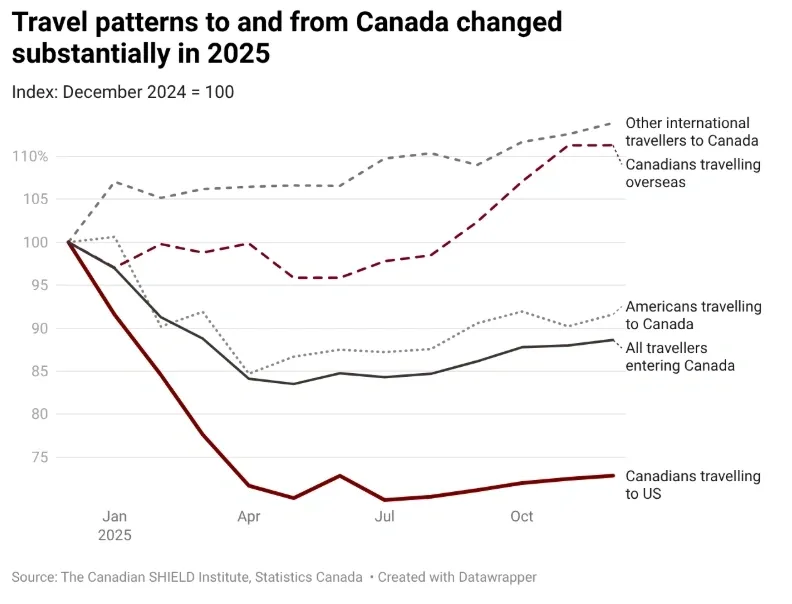
Buy Canadian sentiment remains very strong, to the point where shoppers are willing to pay more for local products.
We talk a lot about the grocery store, because it’s where most Canadians are actually able to use their wallets to help fight the trade war. We also see Canadians making consumer choices by dramatically cutting down on trips to the USA.
But in terms of economic heft, the Government of Canada could be doing a lot more. That starts with a stronger definition of what makes for a Canadian company.
Sovereignty Score:
At the end of 2025, the federal government published details of a Buy Canadian procurement policy.
Our policy team took a close look at the details, through the lens of our Sovereignty Score. Overall, the policy is a good step towards strengthening Canadian sovereignty, but there are some ways that it could be more rigorous.
The short version: It’s a 6/10.
Overall, the policy is moving in a very good direction, but there are some blindspots in the program that could be strengthened. Many industry stakeholders had been calling for a policy of this kind for decades but our trade agreements prevented the government from privileging Canadian companies over companies from other countries including the US and Mexico. As geopolitical arrangements shift, it is clearly in Canada’s national interest to explore policies like this.
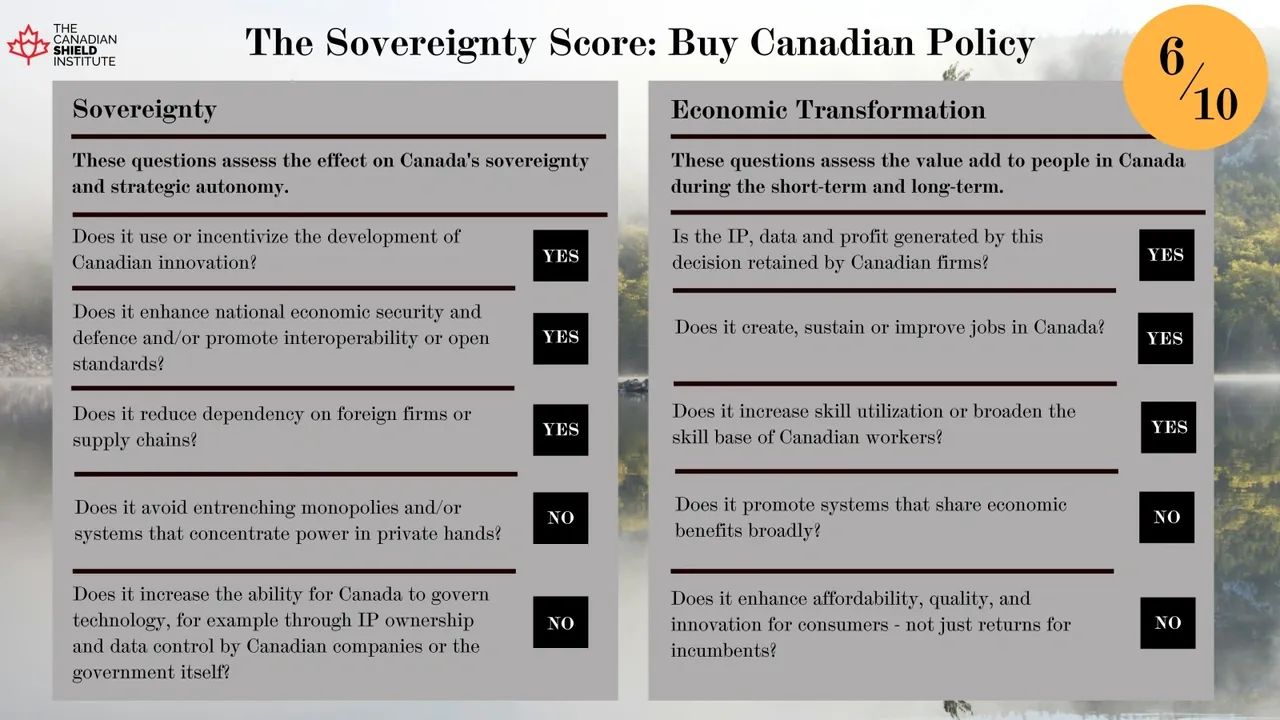
Chart of the Week
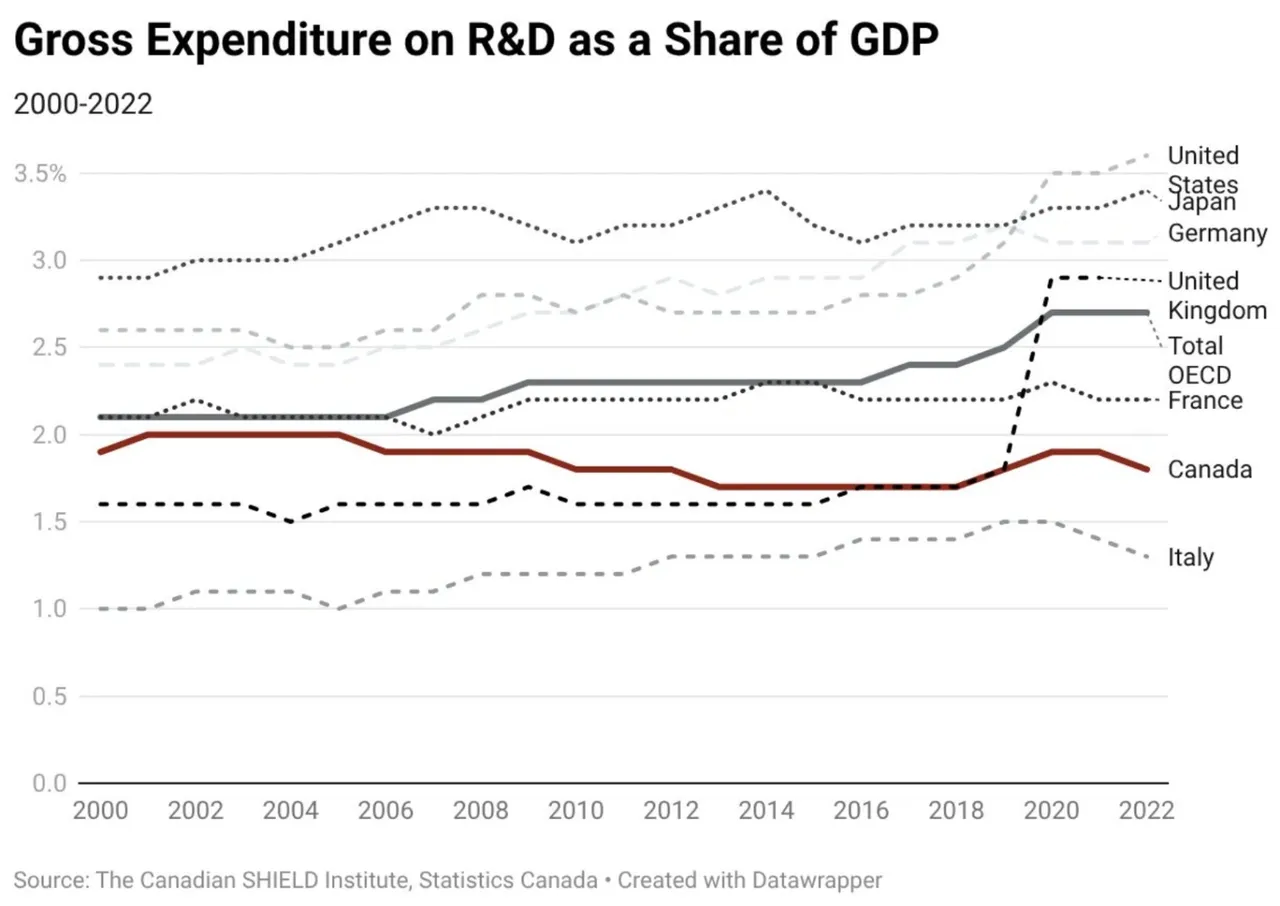
R&D investment and IP ownership matters for Canada’s sovereignty and economic resilience. Either we conduct the research and own the innovations that boost productivity and produce prosperity, or we are sending our dollars elsewhere and buying cutting-edge technology controlled from other countries. That puts Canada in a structurally subordinate position.
Canada is the only country in the G7 that has seen spending on R&D decline as a share of GDP in the 21st century. Our R&D as a share of GDP is one of the lowest in the G7, ahead of only Italy. R&D is a key component in developing Canada’s value-add economy. Value-add includes the inventions and innovations that support technological advancements across all sectors to move economic activity up the supply chain. Think: new technologies to process critical minerals or connect us in the digital world.
We want to strengthen our sovereignty and grow our economic resilience. That can’t happen if Canada doesn’t invest in developing value-added technologies and innovations across all sectors of the economy. Those technologies start with R&D.
Shield in the News
This week, Shield research associate Emily Osborne spoke to CyberNews about digital sovereignty, and the challenges of building independent Canadian cloud infrastructure.
Meanwhile, Shield managing director Vass Bednar was speaking to the Investigative Journalism Foundation about health technology, and the dangers of ceding digital infrastructure to foreign firms.
Song of the Week
This week, Saskatoon’s own The Sheepdogs deliver the Canadian national weather forecast on The Weather Network, to celebrate their release of their upcoming album: “Keep Out of The Storm”.

Subscribe to