Double-Double Duty

Did you know that the cooking oil in your kitchen cupboard was developed for its military applications? During the Second World War, rapeseed oil was valued as a lubricant for engines because it clung to wet, steam-washed metal surfaces better than other oils.
Wartime demand helped spur Canadian R&D, which led to “Canola” — which is short for “Canadian Oil, Low Acid.”
Canola is an iconic Canadian invention, and a low-key example of a “dual use” technology — something that has both military and civilian applications.
History is basically a highlight reel of military R&D spilling into civilian markets. Technology we all use frequently like GPS, the internet, microwaves, super-glue, glow sticks, night-vision baby monitors, EpiPens, Silly Putty, and even Kotex sanitary pads were all kickstarted by defence spending. Maybe even aviator sunglasses, too.
But dual use is also a seductive idea for companies, because adoption often flows the other way too. Civilian products can get adopted for military use. This has happened with cheap drones, Arc’teryx gear, Starlink satellites, X-Box controllers and Mercedes G-Wagons, and many more technologies.
As countries ramp up defence spending, the dual-use concept is a way for politicians to promise voters that military investments will have broader benefits. And they have a point.
Canada’s new Defence Industrial Strategy lays out a massively ambitious plan to expand our military capabilities, while also growing our industrial base of defence suppliers. This is smart policy, and it could have lots of dual-use technology benefits too.
But it’ll be vitally important for policymakers to keep their focus on two critical ideas, as they start to execute on the Strategy:
First, what is the definition of an authentically Canadian company?
Second, what’s Canada’s strategy for ensuring that we retain all of the intellectual property created from defence R&D and procurement?
Taken together, these two ideas are at the core of a sovereign economic policy. We need to have a clear idea of who is a legitimate Canadian company so we can back those companies, and we need to ensure that our economic policy is geared towards intellectual property and other intangible assets, because that’s where the real value is in the 21st century.
And as Canada ramps up defence spending, there’s a real risk that we waste taxpayer money if we don’t get the policy ideas right.
But dual-use spillovers don’t just magically happen. Too often the military foots the bill for expensive R&D, but then the value from these inventions slips out of Canada because we didn’t secure the ownership, control and IP.
Canada has a long history of spending billions on R&D. We take pride in being the place where ideas are born, but then the profits are registered abroad.
Canada’s new Defence Industrial Strategy nods at this IP imperative. But nods aren’t enough.
Shield has advocated for establishing a sovereign patent pool (or “patent collective”), especially for strategic dual-use technologies: to retain critical know-how domestically, and ensure that publicly funded IP remains in Canada regardless of the originating company’s fate.
A stronger intellectual property framework will drive value-added innovation, and a patent collective is the kind of new institution that can champion a stronger culture of IP ownership in Canada.
Acquiring or licensing key patents in major markets would give Canadian firms real freedom to operate and defensive cover when patent sharks circle. And given that public money is in the mix through defence R&D and procurement, we should have guardrails, too. If Canadian-funded IP gets assigned offshore, there should be retained rights or payback mechanisms. Otherwise we’re just subsidizing foreign control and buying back the finished product at monopoly prices.
This idea of retaining Canadian IP ownership goes hand-in-hand with the thorny issue of how to define a Canadian company that we wrote about last week. Canada won’t see much economic benefit from dual-use technology if defence funding just flows to “Palantir Canada” or “Lockheed Martin Canada.”
We’ve been looking at how to take an expansive view of dual-use technology, while also looking into Canada’s history with IP and dual-use tech, and will have more to say very soon.
Everyone loves a two-in-one. Canada just needs to stop treating strategic defence investments like a giveaway.
Defence Industrial Strategy Sovereignty Score
Given the scale of the ambition, we’re going to need to track the follow-through closely, but the Defence Industrial Strategy could turn out to be one of the most important policy roadmaps for Prime Minister Mark Carney and his government.
While more details are still forthcoming, we applied the Sovereignty Score for an early assessment of the approach’s alignment with our sovereignty by design principles.
The Defence Industrial Strategy receives a Sovereignty Score of 8/10. Fundamentally, the document lays out a strategy which is intended to both strengthen Canada’s national security and stimulate its economy. These goals track closely to the questions in the Sovereignty Score framework.
However, success of this strategy will hinge on key elements — in particular, how strictly the government defines Canadian companies for the purposes of procurement, and precision around how IP and other intangible assets will be retained by Canadian companies.
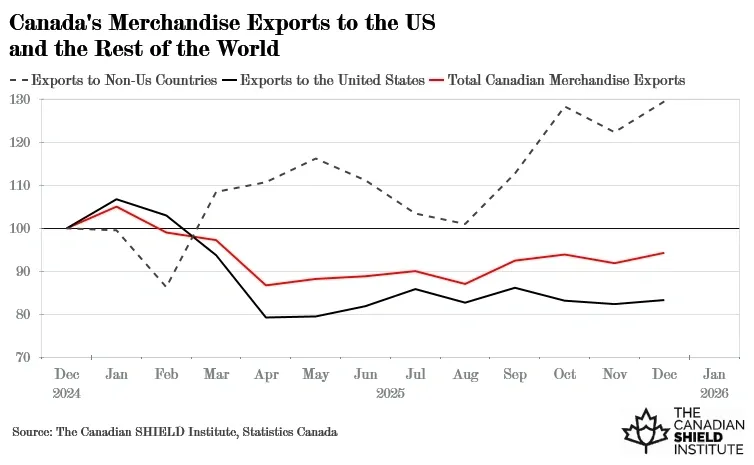
Chart of the Week
One of the key pillars of Prime Minister Carney’s strategy to strengthen Canadian sovereignty is to double Canada’s non-U.S. exports. By December, Canada hit nearly 30% of that goal.
New trade data released yesterday is giving us some good insight into how the federal government’s trade strategy is playing out.
In December, Canadian exports to the USA were down $8.8 billion, but our exports to other countries were up by $4.8 billion. So basically our trade diversification covered half of the loss we suffered from American trade hostility.
The $4.8 billion in increased exports to the rest of the world mostly went to three notable destinations: We sent $4 billion in additional exports to the UK, an additional $613 million to China and an additional $500 billion to the EU.
Earlier this year we wrote about a principled approach to Canada’s trade strategy that strengthens our sovereignty. You can read all about it here.
And check out all of the Canadian Shield Institute’s 2026 charts to watch here.
Shield In the Real World
On Friday Feb 27 in at the CIGI Campus Auditorium in Waterloo Ont., TVO Today Live will be hosting a live panel discussion: Can Canada Regain its Digital Sovereignty? Shield Managing Director Vass Bednar will be on the panel, speaking with ThinkON CEO Craig McLellan, and Mozilla Foundation President Mark Surman. Register here to attend!
Senior Policy Analyst Matthew da Mota co-authored a paper for CIGI about artificial intelligence, and how various scenarios may impact Canada’s national security. Read AI National Security Scenarios here.
Matthew was also at a Queen’s University conference this month, talking about the policy barriers for advancing quantum computing as a national security tool for Canada’s defence sector.
Song of the Week
“What Are You Sayin‘” by Dartmouth-based Aquakultre.
(The whole album is a really great vibe.)

Subscribe to