Intangible assets now make up more than 90% of the value of the S&P 500 — yet Canada treats intellectual property as an afterthought. This is not just an economic problem, it is a sovereignty problem.
Control of IP is how foreign multinationals fortify their market dominance and entrench digital platforms in everyday life. Canada has no homegrown alternatives that compete on equal footing with the hyperscalers that dominate cloud, communications, and AI — in large part because Canadian firms operate at an enormous IP disadvantage.
Canada ranks second-last in the G7 on R&D spending, and lags badly at converting that research into patents, commercialized products, and domestic economic value. The share of Canadian-invented patents transferred to foreign firms has tripled over the past two decades. This chapter argues that Canada needs a dedicated national institution — an Innovation Asset Bank — to acquire, steward, and strategically deploy IP in the national interest.
Key Takeaways
- Intangible assets are the primary driver of value in the modern economy, but Canada has no coherent national strategy to capture, protect, or commercialize them.
- Canada spends roughly 1.8% of GDP on R&D — second-last in the G7 — and converts that research into IP income at roughly half the rate of the U.K. and U.S.
- The share of Canadian-invented patents transferred to foreign firms has tripled from 18% to 56% over the past two decades, which means we are effectively subsidizing foreign economies with Canadian public research.
- Canada’s generational defence spending — now exceeding $60 billion annually, with a plan to reach 5% of GDP by 2035 — represents a major opportunity to anchor domestic IP development, but only if the government is intentional about it.
Canada’s IP Blind Spot
Intellectual property can be easy to overlook, because it is essentially invisible.
Intangible assets, including IP, make up more than 90 percent of the value of the S&P 500. But Canadian policymakers and business leaders often fail to understand the dynamics of the 21st century economy, and the critical importance of asserting ownership over ideas.
Canada’s leaders are attempting to chart a course towards more sovereign infrastructure, economic resilience, and defence capabilities, but if we ignore the control of intangible assets, efforts will fall short.
What is the point of building “sovereign” compute infrastructure on Canadian soil if we don’t have a strategy in place to ensure that Canada retains ownership and control of the valuable innovations and technologies that are commercialized on Canadian compute infrastructure?
Why IP Matters
In the 20th century, if one person made shoes comparatively better, but another person made socks comparatively better, they would trade and both be richer. In the 21st century, an innovative firm creates supply chain logistics software that helps to more efficiently produce both shoes and socks (and pants and shirts and hats). Then the software creator can patent their invention and sell their digital solutions to manufacturers all over the world.
In this model, the supply chain logistics company sells their software at a high margin — because their patent gives them a monopoly over the technology — while the shoe and sock manufacturers are forced to compete on price. The software developer probably also collects data that they can use to further optimize their product, developing new innovations that they can patent in order to maintain a dominant position.
Essentially, intellectual property is the way that research and development is commercialized. On its own, having a good idea is not worth very much. It’s only when a company is able to turn a good idea into a commercial advantage that it becomes an innovation.
Intellectual property is the means by which a company can legally own exclusive rights to commercialize the fruits of their research and development investments.
Canada has been bad at playing this game.Canada’s spending on R&D lags behind peer nations. Generally we spend around 1.8% of GDP on R&D — including government, research institutions and private sector R&D. Canada is second-last in the G7 by this measure.
We are only outpacing Italy on research spending. In 2020, a survey of 30 Canadian research institutions found that Canada’s R&D funders spent roughly $7 billion on R&D based in universities, colleges and other research institutions.
Those institutions earned only $126.6 million from commercialization.
Globally, Canada lags its peers in converting research & development activity into IP income. Research institutions in the UK and the U.S. convert R&D spending into IP income at nearly double the rate of Canada.
That gap points to systemic weaknesses in how we translate public research into domestic, IP‑anchored firms. What’s more, Canada lags on securing patents for the research that we actually do.
Canada's Patent Applications Per Million Population Has Stagnated
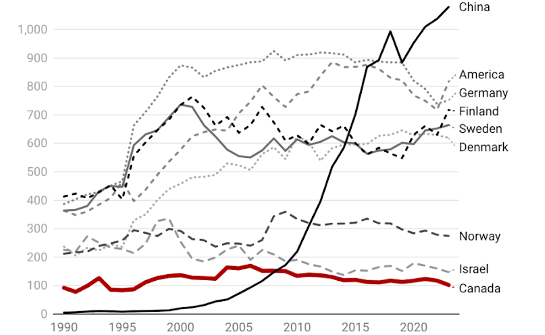
In 1990, Canadians registered about 100 patent applications per million people. In 2024, that number is roughly the same. Over the same period, Sweden, Denmark, Finland, Germany and the United States all climbed above 600 patent applications per million. China’s patent applications increased to more than 1,000 patent applications per million people in 2024 starting from near 0 in 1990.
And while all of this happens, Canada’s national productivity continues to stagnate. Productivity growth averaged 1% per year in the first two decades of this century and fell further after the pandemic. Canada’s GDP growth has been sluggish and sits below the OECD average.
It’s no coincidence that Canada’s productivity growth has stagnated over the same period that Canada’s IP generation has lagged behind peers. In 1975, intangible assets made up 17% of the value of the S&P 500; today 92% of the value of the S&P 500 comes from intangibles. Canada’s innovation underperformance doesn’t just leave us poorer, it also undermines Canada’s sovereignty. In the digital realm, control of intellectual property is the basis for foreign multinationals fortifying their market dominance and entrenching digital platforms in everyday life.
Canada is poorly positioned to govern hyperscalers within the realm of digital communication, cloud services, and artificial intelligence because we have no viable alternatives. Homegrown companies lack the freedom to operate needed to meaningfully compete and grow precisely because Canada operates at an enormous IP disadvantage. Canadians are rapidly becoming more alive to the risks of weaponized interdependence and foreign interference in digital platforms, but strategies to address the risks must include stronger IP control.
The World Has Their Elbows Up
Intellectual property ownership has been weaponized by global powers — Canada’s trading partners and rivals alike.
What was once a regime meant to entice innovation and ensure reasonable returns to inventors has become a system that entrenches market share, deters innovative technologies and constrains the freedom of new and smaller players to operate.
Predatory behaviour has transformed IP from a shield into a strategic weapon wielded by those with the largest portfolios and deepest pockets. The federal government spends about $4.5 billion annually on R&D in colleges and universities.
The inventions and innovations arising from this work are usually translated into IP that is owned by a university, college, or a private partner then sold or licensed, often to the highest foreign bidder. Senator Colin Deacon notes that the share of “Canadian‑invented patents transferred to foreign firms has tripled from 18 percent to 56 percent” over the past two decades.
While the United States, China, and other countries have built policies to ensure that R&D feeds domestic industrial strength, Canada has taken a largely laissez‑faire approach to long‑term ownership — effectively boosting the GDP of other countries and the profits of firms based elsewhere.
Defence Opportunities
For the past couple of decades, Canada’s productivity underperformance and poor IP strategy have been matters of economic policy concern.
In the context of Canada’s place in the world in 2026, the situation represents a dire threat to our future prosperity.
Canada is now spending more than $60 billion on defence spending, with a plan to increase spending to 5 per cent of GDP by 2035. This represents in the range of $230 billion on defence, and the government is already signalling that this level of spending must do more than simply fortify our military capacity.
The federal government’s Defence Industrial Strategy (DIS) published in early 2026 gives due attention to the importance of using defence spending in order to foster economic growth at home.
The DIS also mentions the importance of IP repeatedly, but generally treats it as an afterthought. The strategy takes for granted that if the government simply buys military technology from Canadian companies, then it will just naturally follow that companies will conduct R&D and protect the IP that they generate.
This passive approach of simply funding research and hoping that it turns into IP is exactly why Canada tends to underperform.
Canada Is Ramping Up Defence Spending
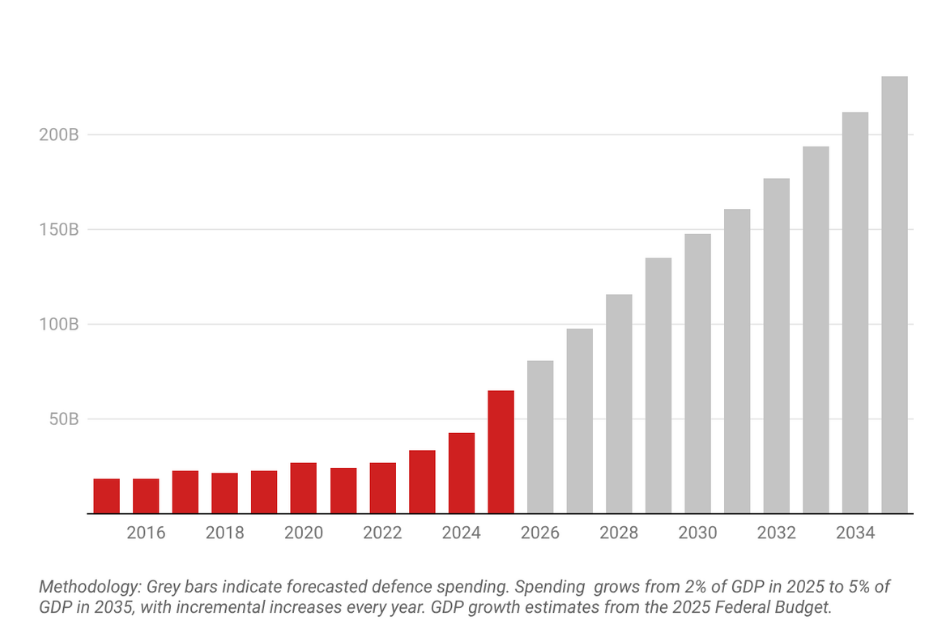
Methodology: Grey bars indicate forecasted defence spending. Spending grows from 2% of GDP in 2025 to 5% of GDP in 2035, with incremental increases every year. GDP growth estimates from the 2025 Federal Budget. Source: Canada Strong Budget 20215, Library of Parliament
The Innovation Asset Bank for IP Strategy
The solution to Canada’s IP underperformance is to create a new institution with the mandate, tools and governance structure necessary to act as a champion and central co-ordinator for a national IP strategy.
The idea of an Innovation Asset Bank is for the federal government to create an institution to acquire, steward and strategically deploy innovation assets in support of Canada’s long-term economic and security interests.
The Bank should have two main goals.
First, it should be mandated to develop IP strategy in the national interest. Second, and more broadly, the Bank should work to secure control over IP assets so that Canada can capture the value created by R&D investments, retain the ability to govern markets and enhance freedom to operate for Canadian firms.
Currently, Canadian IP resources for businesses are disjointed. This is a weakness of Canada’s IP system, and it can be rectified with a one-stop shop approach to IP education. The Innovation Asset Bank would design and deliver high quality support to business, academia, and government in generating IP and leveraging the Bank.
The IAB would also be mandated to steward IP that is derived from publicly-funded research. As it acquires IP, the Bank would also be in a position to design and execute strategies to protect and assert IP rights globally. It would also license IP rights to firms in support of the national interest.
Conclusion
As Canada works to develop a cohesive sovereignty strategy for the digital realm, IP cannot be an afterthought. Whether it’s sovereign compute capacity or generational defence spending, we need to be proactive and focused on ensuring that government nation-building includes securing vital IP.
In the face of IP weaponization, the next stage in IP creation, acquisition and protection is collective action and strategic policy development. It’s no longer enough for individual firms to file a few patents and hope for the best. Governments and industry groups must actively develop shared innovation infrastructure to secure domestic IP and build the freedom to operate. The success of a national IP strategy ultimately looks like a measurable reduction in Canada’s dependence on foreign-owned IP over time, and greater freedom-to-operate for Canadian companies.
This will show up in terms of more IP ownership at Canadian companies, as well as legal support from a national institution like the IAB. Standardized IP governance across research institutions, and publicly funded research turning into publicly owned IP will also be a vital part of the picture.
Solutions
Canada needs an aggressive and ambitious national intellectual property strategy, along with a new institution mandated to execute that strategy and champion IP sophistication — the Innovation Asset Bank. In practical terms, a national IP strategy would include:
1. Increased IP assets held by Canadian entities.
This will include both patents held by Canadian companies, as well as strategically relevant IP held by the IAB — derived from publicly funded research.
2. Defensive enforcement capacity.
This will be led by the IAB’s strategic use of IP, including successful litigation, settlements, or deterrence outcomes that protect Canadian firms and reduce exposure to intellectual property threats, expanding Canadian freedom to operate.
3. Increased IP sophistication across the economy.
This will include better capacity to generate, protect and profit from IP by Canadian firms, supported by strategic guidance from the Innovation Asset Bank.
4. IP value capture driven by government policy.
As the government spends hundreds of billions on defence, procurement criteria and economic development spending should include IP value capture and ownership. This strategic lens could extend to all other areas of government procurement, and policy more broadly, guided by expertise from the Innovation Asset Bank.
Canada currently ranks 17th in the OECD’s Global Innovation Index, and Canada has been at or below 2 per cent in terms of gross expenditure on R&D as a percentage of GDP. If Canadian companies see value in owning the outputs of their research, they will invest more in research and innovation.
Subscribe to