Canada's Pension Funds Are Not Normal
Last week, we published a policy report, suggesting that Canada’s biggest pension funds should be mandated to put 3 per cent of their assets into real Canadian growth.
Globe and Mail columnist Andrew Coyne called it a “really really really bad idea.”
Coyne had a bit more to say about it in his column this week. It’s fair to say that he’d rather see pensions move to passive management, with minimal administrative overhead.
More broadly, Coyne is clearly opposed to the kind of economic policy that deliberately aims to strengthen Canada’s economy. His preferred approach is an economic policy rooted in 1990s-style free trade agreements and minimal government intervention.
Suffice it to say, we really, really, really disagree with Coyne about this. It’s not the 1990s anymore, and the economic and geopolitical realities of 2026 are vastly different.
We believe that the massive pools of capital controlled by the big Canadian pension funds can do more to help grow ambitious Canadian companies. Maybe Taalas would still be Canadian, or Xanadu’s success could have benefited more Canadians if we did.
Critics treat it as sacrosanct that pension funds can only exist as fully independent entities with a fiduciary duty to maximize returns. But the truth is that the fiduciary duty is, itself, a mandate from the government; these funds are creatures of public policy, and we can have a debate about how they should operate.
It’s also strange that defenders of the status quo treat it as a fact of nature that Canadian pension funds would invest very little in Canada. It wasn’t that long ago that we had the Foreign Property Rule which prevented Canadian pensions from investing more than 30 per cent of assets abroad.
Wherever you fall on this debate, it’s important to understand that the hands-off, laissez-faire approach to pension investing is not the only model.
Take a look at where Canada’s pensions sit among the largest 100 pension funds in the world, in terms of overall domestic investment:
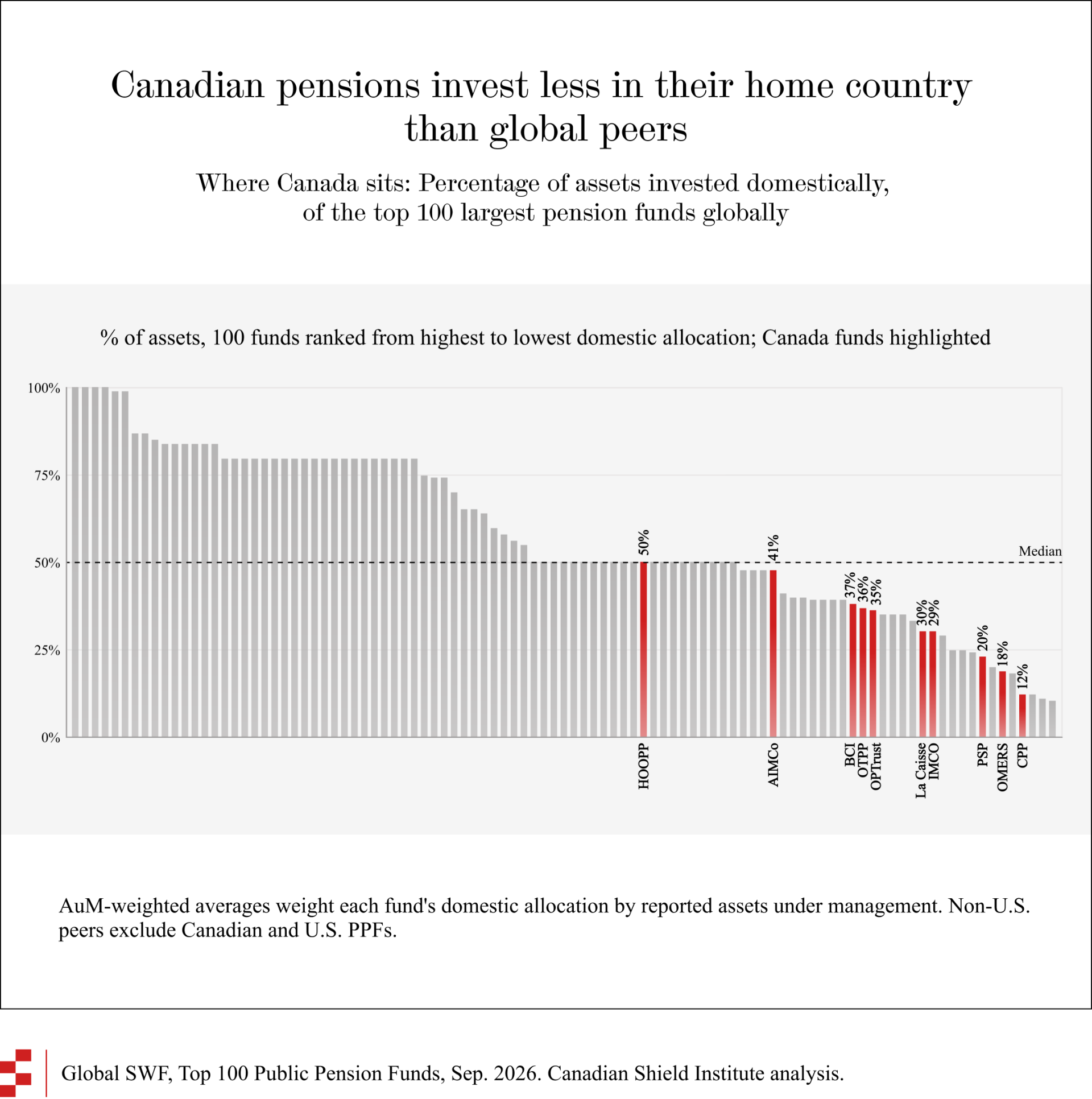
Our proposal that pension funds should be mandated to invest 3 per cent of assets in high-growth Canadian companies is modest.
We don’t need to do a tour of the whole world to illustrate the point; we just need to look at Norway.
Norway has two big public pension funds, with confusingly similar names:
- Government Pension Fund Global
- Government Pension Fund Norway
The first one, the Government Pension Fund Global is the world’s largest sovereign wealth fund, and it invests only abroad. It’s currently worth about US$2.2 trillion. The fund is meant to act as a hedge against oil and the domestic economy.
The second fund, the Government Pension Fund Norway, invests close to home: split 60 per cent equities, 40 per cent bonds, with 85 per cent in Norway and 15 per cent in the rest of the Nordic region. It’s the largest institutional investor on the Oslo Stock Exchange, holding more than 11 per cent of it. As a patient, long-term shareholder, it gives a small market stability and liquidity while also acting as an engaged owner of Norwegian companies. Norway’s bond market benefits, too.
This domestic fund is less than 2 per cent of Norway’s combined public funds.
This is not far from what we’re proposing, albeit our version is much more tightly targeted to high-growth Canadian companies whose success would strengthen Canada’s trade capacity — diversifying not just our export markets, but crucially, diversifying the products and services we sell to the world.
And here’s the funny thing about the Norway experience: it works. The domestic fund has returned 8.09 per cent a year over the past decade, and its active management beat its benchmark by 0.88 percentage points a year. Norway shows that a small, dedicated, openly mandated domestic allocation can sit alongside a global portfolio and perform well.
In Norway, Parliament and the Finance Ministry set the benchmarks openly, and the managers carry them out. Everyone in Norway has a stake and an incentive to build a stronger economy.
Meanwhile Canada is still clinging to this idea of a laissez-faire world, where we all trade freely and nobody abuses their power. Increasingly, it feels like some people are clinging to a world that no longer exists — maybe a world that never truly was.
The world’s economy has changed.
We think it’s high time to create the conditions to build and scale in Canada.

Subscribe to