Okay, but What About the Spillovers?
There wasn’t a whole lot of action in the Spring Economic Update.
There’s money for apprenticeships, and the budget is a smaller deficit than forecast.
That’s good.
We got a hint of what Canada’s AI Strategy will look like in the form of six “pillars” that describe the government’s mindset for artificial intelligence adoptions.
Shield’s AI and security analyst Matthew da Mota broke that down here.
But in terms of the dollars and cents, by far the biggest item was the Canada Strong Fund. In his pre-announcement event, Prime Minister Carney said that the idea is to create a national savings fund, allow retail investors to put money into it too, and use the money to fund “nation building projects” in the national economic interest.
Our policy team took a close look at the details of the plan, and assessed it through our Sovereignty Score framework, looking at 10 different criteria to determine whether a policy meaningfully strengthens or weakens Canada’s national sovereignty.
We gave the Canada Strong Fund a 6 out of 10.
Read the whole analysis here, but essentially, where the Canada Strong Fund lost marks is on the economic spillovers.
“Spillovers” are what economists have traditionally called the side-effects of economic activity.
When a factory’s smokestacks pump out harmful emissions, that’s a negative spillover. When a company trains somebody to be a welder, and she can use those skills to fix her kids’ backyard swing set when it breaks, that’s a positive spillover.
But “spillovers” can give the impression that these economic effects are a minor afterthought. In fact, in the 21st century digital economy, spillovers are a major engine for economic activity, and they are an incredibly important source of value.
This is an idea that Canadian governments have consistently missed, and it is a huge part of why our economy is stagnant and our sovereignty is under threat.
When Ottawa makes policy, we often think in terms of the direct outcomes — the number of jobs created by a project, for example.
So the government will write a cheque from an economic development fund to help a company build a new factory, and in the press release they’ll say that the project creates 500 new high paying jobs.
But where we often fall down is looking at the second- and third-order effects of policy, and all of the ancillary benefits.
We get the foreign multinational to build the factory, and we get the 500 jobs, but we don’t think about the management expertise that they will develop in the project — expertise that resides back at head office. We don’t think about the R&D that will go into building the new industrial processes for the factory, and all that intellectual property will accrue back to head office.
We don’t think about how our specific factory fits into the larger supply chain, and how open that supply chain is for other vendors. Will the existing factory induce a bunch of other suppliers to set up similar factories, and create a cluster of expertise and industrial capacity in Canada? Or will it just be one factory stamping out parts, and putting them on a ship for final assembly somewhere else?
We are living in a world where intangible assets like IP and data make up 92% of the value of the S&P 500, and the value of intangible assets is approaching $100 trillion worldwide.
What’s more, foreign tech giants use things like data, IP and proprietary technologies to dominate markets and stifle competition.
The technical economic term for some of these things may be “spillovers” but if we don’t treat them as vitally important aspects of the economy, we will continue to get lapped by the countries that take it seriously.
Shield Chief Economist Kaylie Tiessen has been thinking a lot about these different kinds of value-add, and whether Canadian policy does a good job of capturing the spillovers. Read her take on the Spring Economic Statement here.
The Sovereignty Score attempts to capture the constellation of different factors that strengthen or weaken Canada’s resiliency and economic sovereignty. A lot of the questions come down to spillovers. Are we trying to capture the IP? Are we fostering a dynamic and complex marketplace, or are we letting a few incumbents continue to dominate?
The Canada Strong Fund is what it is. It’s a government vehicle aiming to build infrastructure. In fact, if you squint and tilt your head, the suggestion that retail investors can put money into the plan looks a bit like the Sovereignty Bonds idea that we floated a few months ago.
We need the “new ports, mines and trade and energy corridors” that the Canada Strong Fund news release highlighted.
But the fund would be a lot better with a clearly thought-out strategy for capturing the economic spillovers.
If we miss out on all of the other elements that drive value in the 21st century, we won’t actually be strengthening our economy very much.
Chart of the Week
The Prime Minister announced a new sovereign wealth fund that will be used to attract foreign investment into Canada’s nation building projects. Prime Minister Carney announced that Canada will hold our first ever investment summit this summer inviting 100 of the world’s largest investment institutions.
And this week, the full FDI numbers for 2025 were released by Statistics Canada.
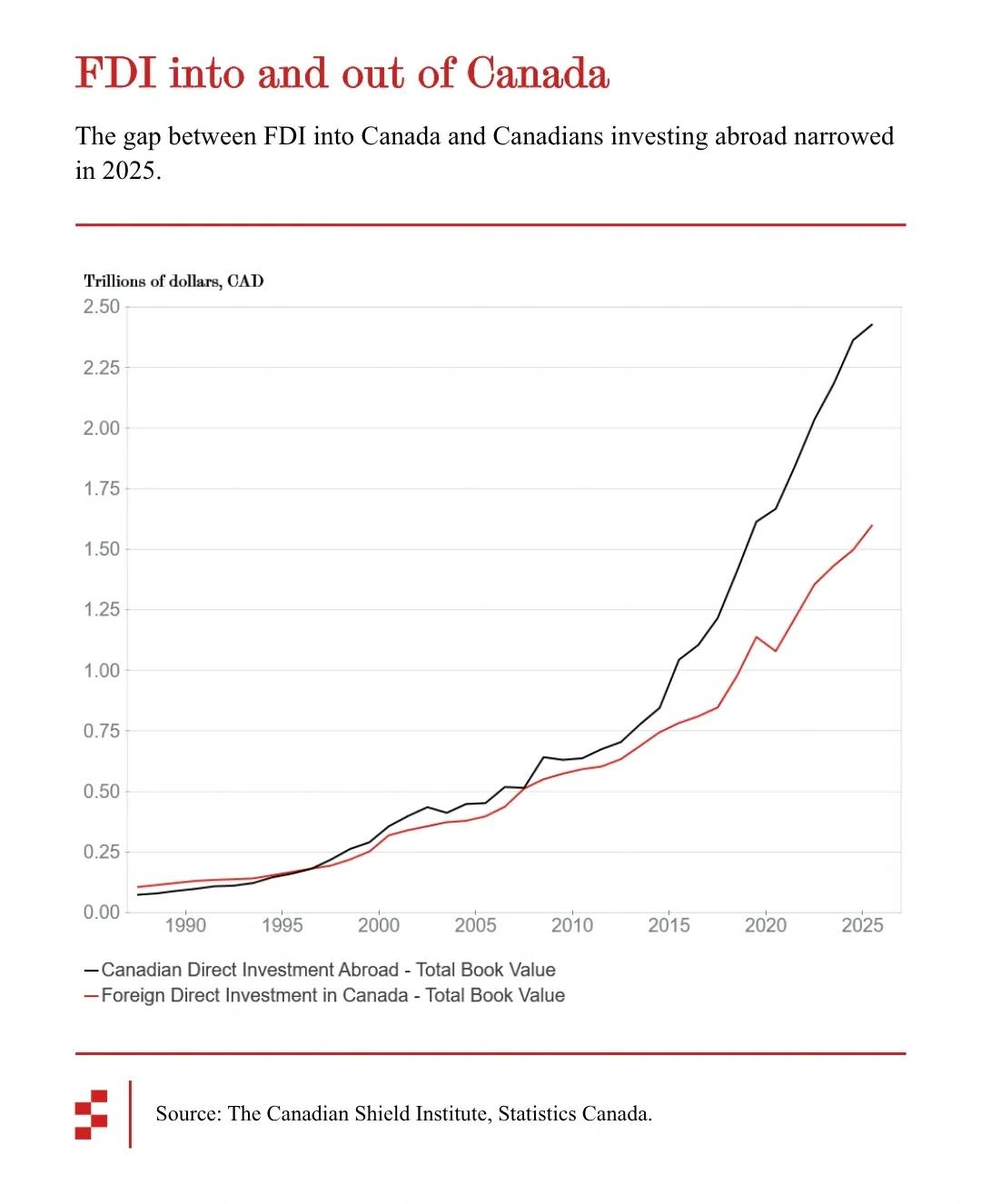
We’ve been following the FDI numbers all year. We made them one of our 2026 charts to watch where we wrote that Canada’s foreign investment position abroad was double the FDI present in the country. We predicted Canada would try to close that gap and this week, the numbers show that the gap is narrowing.
The stock of FDI in Canada increased by $103 billion in 2025 while Canadian direct investment abroad rose by $65.9 billion. Statistics Canada said, “The difference between the stock of outward and inward direct investment—dropped for the first time since 2012.”
At a high level, the numbers are moving in the right direction. But Canada really needs to be more attentive to the types of FDI we are attracting and the ultimate intentions of the investors. As researchers have shown, FDI is just as likely to be extractive as it is beneficial, and countries like Canada need to be more strategic in how we are arranging FDI and making deals.
For example, last year merger and acquisition transactions were the largest contributor to the increase in FDI. In Q4, at least three Canadian firms were bought up by foreign investors meaning that the FDI being celebrated is also a prosperity leak sending valuable assets like data, intellectual property, profit and management expertise abroad for spillovers to accrue.
Attracting capital is an important component of Canada’s shift from reliance to resilience, but we need to be more strategic about what type of investments we are attracting and the conditions we place on them.
Song of the Week
John K. Samson is one of Canada’s greatest lyricists.
He’s written a lot of great songs. This one is also a great petition.
The title of this song is: “www.ipetitions.com/petition/rivertonrifle/”
It’s more commonly known as “We, The Undersigned”

Subscribe to