FDI Fever: Investment Boom or Sovereignty Bust?
Mark Carney is banking on foreign capital to kickstart Canada’s pivot from reliance to resilience, but this strategy comes with some risks.
According to this week’s Spring Economic Statement, Canada is knocking it out of the park when it comes to attracting FDI. The statement highlights a few numbers showing that Canada’s per capita inward direct iInvestment is leading the G7. This tracks with the 2025 Kearney FDI Confidence Index , which surveys large investment institutions for which countries are most likely to provide favourable returns. It ranked Canada as the second out of 25 global markets behind the United States for favourable FDI conditions.
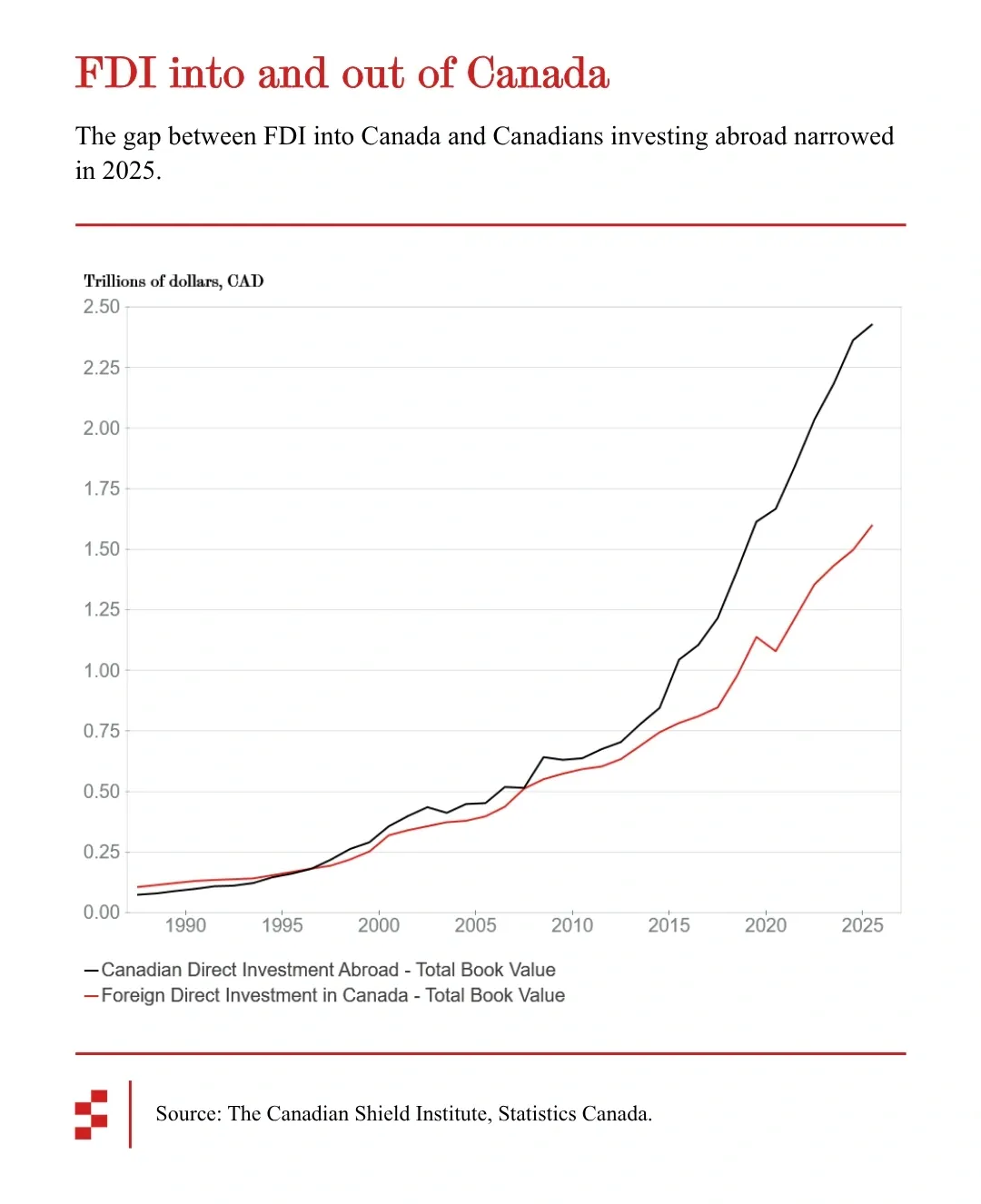
The fact that the Spring Economic Statement is focused on attracting investment into the country should not surprise anyone, Carney has already been making FDI a cornerstone of his economic policy.
He recently announced Canada’s first ever Investment Summit aimed at mobilizing $1 trillion in investments into Canada.
He’s met with more than a dozen countries since taking office to talk specifically about investment deals. He’s signed new investment related deals with the United Arab Emirates, Indonesia, Germany, Qatar, China, Malaysia, Singapore, Belgium, the UK, India, Australia and Japan.
FDI is good for Canada but there are hidden risks if we aren’t strategic about how we invite foreign investors to deploy their capital in Canada.
This is one of the reasons we made FDI a 2026 chart to watch and flagged the importance of turning our attention to the composition and consequences of FDI. Without guardrails, more foreign ownership of our critical infrastructure can carry practical implications for pricing power, supply chains and overall prosperity.
One important question the government does not seem to be particularly concerned about at the moment is who gets the lion’s share of the economic benefit from all of this investment.
In the old economic orthodoxy, FDI was understood as an unalloyed good. No matter what, FDI meant economic growth, jobs and opportunity to be connect to global value chains.
New economic wisdom throws that orthodoxy on its head, showing that FDI is just as likely to be extractive as it is to deliver benefits.
Sometimes, it does both at the same time.
Recent research from the Centre for Economic Policy Research finds that FDI leads to growth only in very specific circumstances. What matters is that foreign direct investment needs to be designed to generate domestic value add, support capability building and enable upgrading within value chains. Otherwise, economic spillovers are just captured by the foreign investors.
Take an example from the old economy: ports. The Port of Churchill is on the list of nation building projects. If it is expanded and modernized, it will become a hub for jobs and an additional point from which exporters can ship their goods to international markets other than the United States.
If the Port of Churchill is primarily owned by foreign capital, however, most of the profit will flow out of the country. So will many of the spillover benefits arising from any new technology that is developed to operate the port. Foreign owners would control intangible assets like data and intellectual property that optimize business processes. That IP and data could then be packaged and sold as technology for managing other ports around the world, further profiting the owners of the Port of Churchill.
The port would also be controlled by foreign owners who may have the ability to make decisions over the infrastructure Carney has decided is critical to Canada’s future – deciding price, organizing operational timelines and prioritizing content.
So far, the prime minister has been silent on how the government will manage these risks associated with FDI.
The government has made hay about the fact that FDI in Canada reached a record high in the fourth quarter of 2025, marking the highest level since 2007.
Unfortunately, two-thirds of that record breaking FDI was the result of 3 Canadian companies being acquired by foreign firms — Nova Chemicals, GFL Environmental and Sandstorm Gold. Those acquisitions won’t boost the level of economic activity in Canada, but they will mean that the expertise and intangible assets developed by those firms have been extracted away.
This is why researchers who study FDI are recommending a shift in mindset. We shouldn’t only be asking,“How do we attract more FDI?” We should be asking “What kind of FDI helps capture more value, and how do we ensure domestic firms benefit? “
We can no longer take a laissez-faire approach to FDI. The need to change tack grows more acute as the amount of FDI attracted rises.
Other countries are taking action or took action years ago.
The European Union implemented requirements on FDI exceeding EUR 100 million, to capture things like corporate ownership and control, IP ownership and licensing agreements, employment and training, R&D expenditures and value chain enhancements., corporate control, workers’ benefits and other spillovers.
The American answer to this problem is the Committee on Foreign Investment in the United States (CFIUS) which handles investment screening policies, conducts risk reviews and publishes guidance.
In the face of the coming tidal wave of FDI, Canada must follow suit. We urgently need to develop a new framework for FDI that prioritizes Canada’s sovereignty.



Subscribe to