Ok, So What’s Our Trade Strategy Now?
We were told earlier this month that we are living through a geopolitical rupture, and that we need to rethink our approach to international integration. For a relatively small, open economy like Canada, a big question will be: Will we adjust our trade strategy?
For more than a generation, a guiding idea of Canada’s trade strategy was that we could negotiate away a little bit of our sovereign ability to govern, in exchange for preferential market access in the form of free trade agreements with other countries.
In truth, the idea that Canada must choose between sovereignty and market access is a weak starting position from which to negotiate. Over decades, this mindset has slowly led Canada to give away more and more of our ability to govern.
In return, we’ve secured customers in foreign markets, and we’ve secured the ability to buy cheap goods from abroad. But has it been a good deal?
Well.
Let’s just ask Prime Minister Mark Carney. Here’s his perspective, delivered from the lectern of the World Economic Forum in Davos:
“Over the past two decades, a series of crises in finance, health, energy, and geopolitics have laid bare the risks of extreme global integration.
“More recently, great powers have begun using economic integration as weapons, tariffs as leverage, financial infrastructure as coercion, and supply chains as vulnerabilities to be exploited.
“You cannot “live within the lie” of mutual benefit through integration when integration becomes the source of your subordination.”
(Emphasis added)
This is bracing stuff! Perhaps all those free trade deals haven’t been such an unalloyed good.
Prime Minister Carney described the current geopolitical moment as a “rupture” with the global rules-based order of the past 70 years. We need a new long-term economic strategy.
But more immediately, if we really, truly believe that economic integration has been weaponized against us then we’re experiencing the seismic rupture of Canada’s economic and geopolitical strategy in the 21st century.
It isn’t ancient history to remember when Canadian prime ministers boasted about our extreme economic integration. Here’s Carney’s immediate predecessor, Justin Trudeau, speaking at the Munich Security Conference in 2020:
“In the last four years, Canada has renegotiated NAFTA, signed the Comprehensive Economic and Trade Agreement with the European Union, and joined the Comprehensive and Progressive Agreement for Trans-Pacific Partnership.
“We are the first and only G7 country to have a free trade agreement with every other G7 country. But had we chosen to ignore the real concerns of people across the political spectrum on free trade and globalization, we might not have preferential access to two-thirds of the global economy today.”
(emphasis added)
The fact is that Prime Minister Carney is right.
The risks of extreme economic integration go well beyond the mercurial and imperialist instincts of U.S. President Donald Trump.
In the Digital Chapter of USMCA, Canada gave up the ability to regulate American tech companies’ activity inside our borders, and we are unable to compel companies to provide descriptions of how their algorithms work.
How can you govern something if you can’t even require companies to tell you clearly and honestly what their product does?
But in spite of Prime Minister Carney’s warnings about the risks of extreme global integration, Canada hasn’t given up on signing new free trade deals. In fact, just this week the government closed consultations on four new free trade projects — India, Thailand, UAE and Mercosur.
Canada’s guiding ethos in these trade talks should be this: We don’t need to surrender the right to govern in exchange for market access. Trade agreements should focus on making and shaping markets, instead of strictly reducing perceived barriers to trade.
The Canadian Shield Institute has submitted a full policy brief to the government on these free trade consultations. You can read it here.
But the nub of it is this:
Canada needs a principles-based approach to trade.
A principled approach starts from the premise that Canada is a self-governing democracy first, and a trading nation second. Trade policy must preserve our ability to make decisions in the public interest—not pre‑empt or override it. That means:
- Making sovereignty a non‑negotiable objective, alongside export growth and investment. Canada should enter talks with explicit red lines: we will not sign agreements that unduly restrict our capacity to regulate digital platforms, protect privacy, direct public procurement, or pursue industrial and climate strategies tailored to Canadian priorities.
- Refusing the false trade‑off between market access and policy space. Tariff reduction, predictable rules-of-origin, and fair treatment for Canadian exporters do not require surrendering our ability to set rules for data, algorithms, labour, or the environment. Where partners demand such concessions as the “price” of access, Canada should be prepared to walk away.
- Insisting on broad, explicit carve‑outs for domestic governance. Any new agreement must preserve room for:
- Digital and data regulation, including data localization where needed, algorithmic transparency, and platform accountability.
- “Buy Canadian” and strategic procurement in critical sectors and public services.
- Strong labour, environmental, and climate measures that can be strengthened over time without triggering trade challenges.
- Investor–State Dispute Settlement and similar mechanisms that elevate corporate interests above elected legislatures should be excluded. Disputes should be resolved state‑to‑state, respecting Canadian courts and Canadian law.
- Building strategic capacity and expertise by:
- Re-establishing Sectoral Advisory Groups on International Trade (SAGITs) to supply sector-specific intelligence ahead of CUSMA and future negotiations.
- Recreating a modern Economic Council that integrates trade, innovation, and industrial policy advice.
As others have emphasized, Canada currently lacks the institutional scaffolding needed to develop and execute proactive trade strategy on an ongoing basis. Over time, the machinery of trade policymaking has become reactive and fragmented, leaving Canada without the sustained intelligence and advisory capacity that complex, modern trade environments require.
Rebuilding this strategic capacity begins with re-establishing Sectoral Advisory Groups on International Trade (SAGITs) — permanent, expert bodies that can provide forward-looking intelligence and sector-specific advice.
A principled agreement acknowledges that technologies, security risks, and public priorities evolve. By setting these principles in advance Canada can shift the terms of negotiation. And potentially cowrite rules with like-minded partners that allow companies to operate in similar ways across certain countries.
We will still pursue diversified markets and deeper trade ties, but on terms that recognize that sovereignty is not a bargaining chip. It is the foundation on which any durable, legitimate, and broadly shared economic security must rest.
Until next week,
– Kaylie Tiessen
Chief Economist, Canadian Shield Institute
Chart of the Week
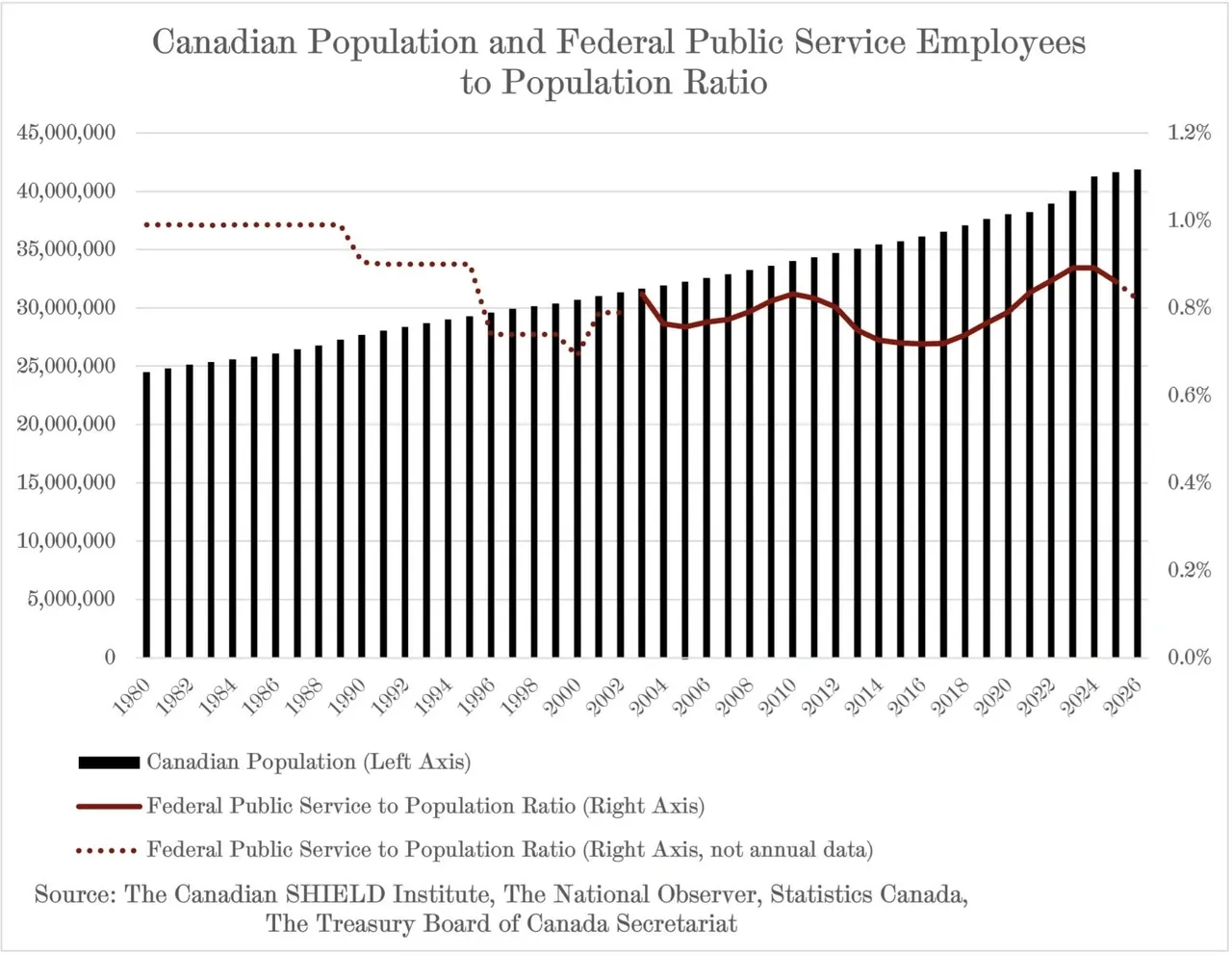
At the same time as Prime Minister Mark Carney was capturing the world’s attention from the lectern in Davos, the federal government was issuing layoff notices to nearly 15,000 public servants.
Fiscal discipline will be important, as Canada navigates the tumultuous years ahead. But state capacity from the federal public service will be necessary to pivot trade relationships and foster new economic development.
This week’s chart shows that by historical standards, the size of the federal public service is not overly bloated. Making cuts in the midst of a tremendous pivot puts the quality and care of that pivot at risk.
Shield In the News
There’s lots to talk about in the Canadian economy! Shield Chief Economist Kaylie Tiessen spoke to The Tyee about public service layoffs.
We were also in Canada Healthwatch talking about risks associated with AI adoption. And in The Peak, Kaylie was talking about food affordability.
Song of the Week: “Relative Surplus Value” by The Weakerthans

Ever since Prime Minister Mark Carney visited the European Parliament in September, we’ve been thinking about what a deeper alliance across the Atlantic Ocean could mean. As we hit send on this email, Carney is meeting with António Costa, President of the European Council, and Ursula von der Leyen, President of the European Commission, in Montreal. At the end of it all, we’re expecting an announcement of … something. There have been a lot of anonymous tips in news reporting, but at the Canadian Shield Institute, we prefer to read the formal communiqué rather than trying to interpret whispers. In the run-up to the summit, we’ve been doing a bit of research, and we published a few articles to set the stage. EU Media Marketplace The Europeans are trying to break the AdTech duopoly. Canadian companies have tried to work together to create an alternative to Google and Meta’s dominance. So far, Canada’s efforts have fallen flat. Will this new EU enterprise fare any better? Read our analysis here. We find this whole situation very interesting for two reasons: First, Canada and Europe have a lot of the same problems right now. We’re all trying to figure out how to reduce vulnerability from the United States, and that vulnerability extends to digital reliance on private-sector technology platforms. It seems like we could benefit by joining forces, but it’s going to take some work figuring out exactly what that looks like in practice. Second, AdTech is just really interesting! Programmatic targeted advertising is the economic engine of the internet, and in turn this kind of advertising is hugely influential on culture and society. AdTech dictates what kinds of businesses thrive and what kinds of content gets posted online. Once you start researching it, AdTech quickly starts to look like one of the most important dimensions of digital sovereignty. If the online economy is entirely dominated by systems controlled by a handful of big American technology companies, realistically both Canada and the EU will always be on the back foot on digital governance. Digital Services Trade Speaking of being on the back foot, did you know that U.S. digital services exports to Canada are worth more than all the autos, steel, aluminum, lumber, potash and electricity put together? Why aren’t we talking about digital trade policy more in the negotiations with the United States? Read our analysis here. And the European Union is in a similar position. The EU has done a lot more to assert digital governance, but their trade deficit on digital services just keeps going up. This is a kind of reliance that creates a meaningful vulnerability if the United States keeps playing hardball. Read our analysis about EU digital trade here. Digital services might be a promising area for Canada and the European Union to work together. When the final communiqué is delivered from the Canada-EU summit, we will be combing through it for specific mentions of digital trade collaboration. Digital Sovereignty Policy Despite the EU’s digital dependence, we see a lot to admire in how the Europeans have been trying to assert their digital sovereignty. To be blunt: They’re trying things! Canada has often been slow to pass meaningful digital regulation, and quick to walk back policies that offend the Americans. The EU has enacted some really interesting regulations. Could Canada use “digital trade alignment” as cover to follow the EU’s lead? Read our analysis here. The Bottom Line Overall, when it comes to digital governance, we have a lot of hard work ahead of us. Digital policy is complicated and opaque, and it’s not enough to just pass a good law. Ongoing enforcement is a real challenge too. But this is one of the most pressing policy issues of our time, and with the accelerating deployment of AI systems, this issue is only going to become more urgent. It’s not as easy as striking a deal to sell soybeans, but digital governance is an area where Canada and the EU are natural partners, and it’s something we should be working on.

Subscribe to