Canada’s Pensions Are Making Moves
Here are a few news items that caught our attention in November:
CPP Investments was reportedly laying off “dozens of employees” in their beleaguered active equities investing division. Canada’s biggest pension plan won’t be giving up on trading stocks entirely, but the story makes it sound like they’re shifting strategy.
One interpretation might be that CPP Investments is just going to pay other (smarter?) people to trade stocks for them instead. Bloomberg reports that the fund is planning to double its investments in hedge funds, growing their investment portfolio in that area to $160 billion.
Meanwhile, the Globe also reports that PSP Investments (the other big federal pension fund) will pay $1.6 billion to buy a 50% stake in Enercare. The story frames the move as a bet on stable, essential home services like furnaces and air conditioners.
The wider context
Throughout the fall, we’ve been taking a close look at Canada’s biggest pension funds, and their dismal rates of investing in the Canadian economy.
We definitely are not suggesting that PSP Investments is closing a $1.6 billion deal because of some policy papers we wrote. But the recent pressure to invest more at home is significant.
We saw an eruption of spontaneous announcements from the Maple 8 pension funds around Prime Minister Mark Carney’s big Canada Investment Summit in September. They were all talking about investing more money in Canada, because clearly that’s the way the wind is blowing.
If you don’t think much about capital markets and pension funds, you might assume these are all stable, boring behemoths, investing in a dry and diversified fashion. But when you actually dig into the numbers and start charting them out, you see some wild swings in their investment strategy.
For example, here’s a chart depicting CPP’s private equity investment since 2002. These are some big swings!
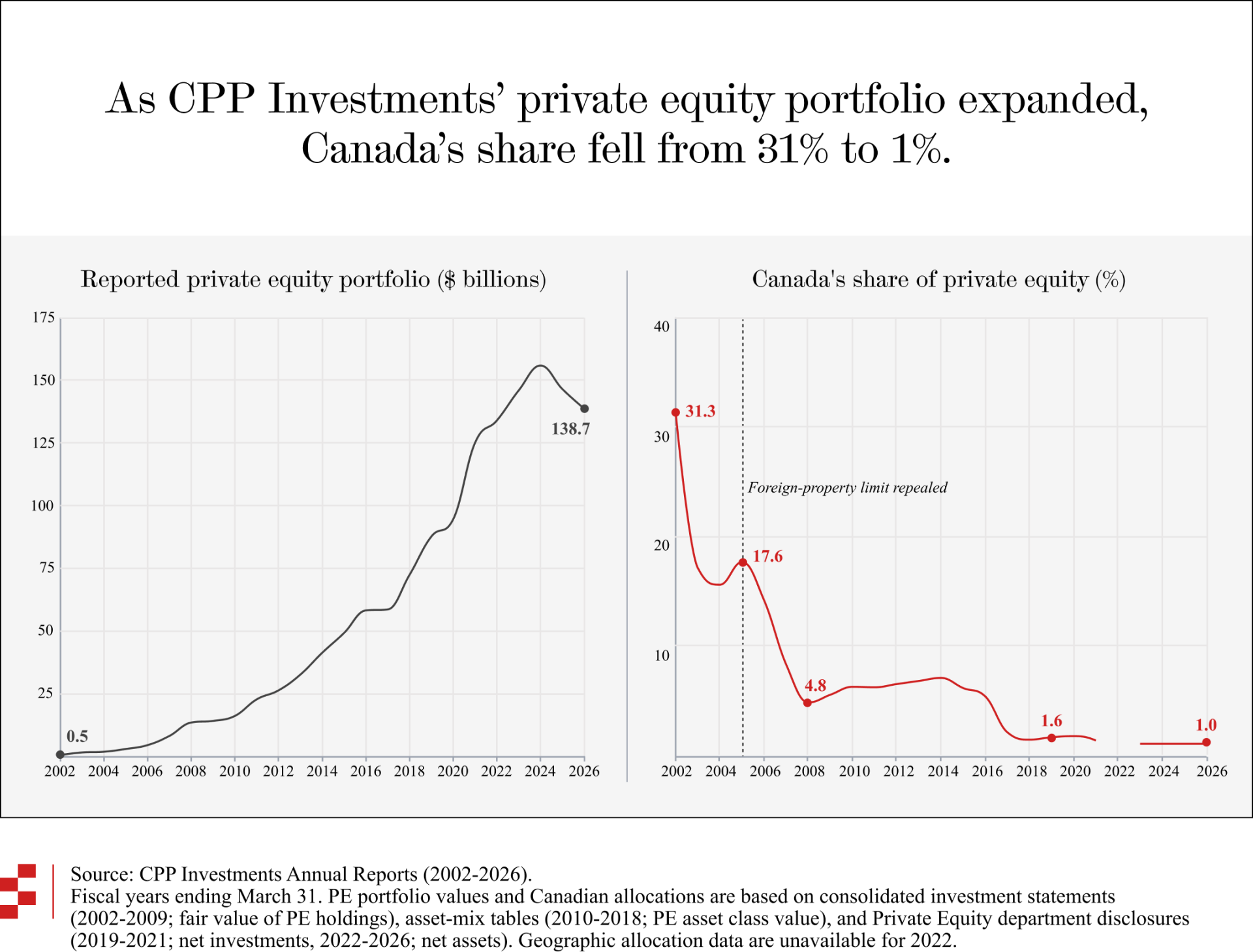
We focus on private equity because we believe that investing capital directly in private companies is the area where pension dollars are most likely to move the needle economically — as opposed to playing it really safe by buying bonds, infrastructure, or real estate.
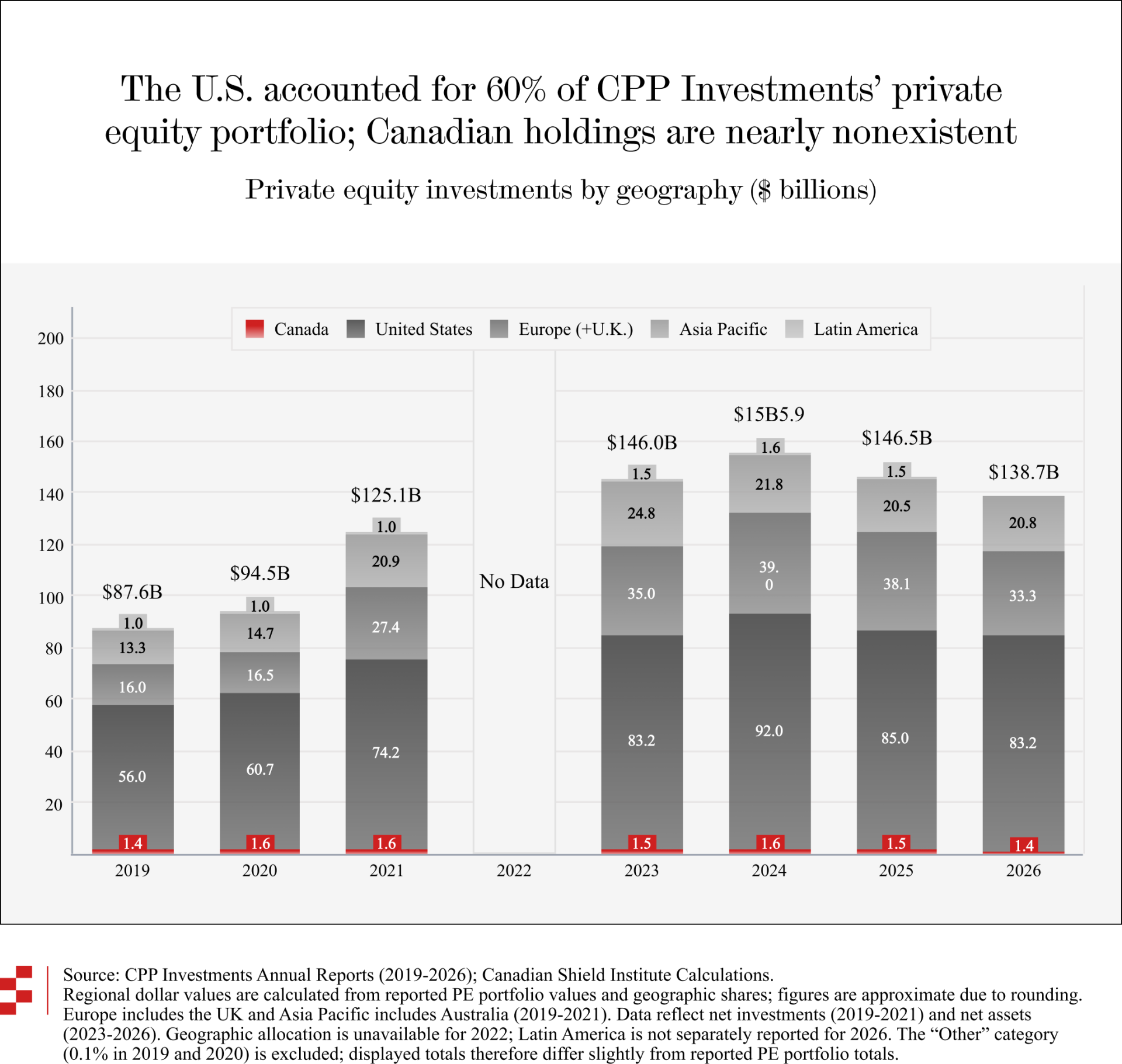
Here’s another view of CPP Investments’ private equity investments from the past few years.
A fun observation: PSP Investments’ $1.6 billion stake in Enercare is bigger than CPP Investments’ entire Canadian private equity portfolio!
Pensions are a creature of public policy
If you dig into the history of Canada’s pension funds, you quickly come to understand that the so-called “Canadian model” of independent globally invested pension funds has only been around since the 1990s.
Up until the early 2000s, the foreign property rule limited how much the pension funds could invest outside of Canada.
The idea that it is an irrefutable truth that Canadian pension funds must be entirely independent from policy direction, and that they should invest most of their capital overseas, is arguably a reflection of a certain time, and a certain attitude.
The 1990s and early 2000s was also a period where Canada was gung-ho for trade liberalization. We were signing free trade agreements and finding our place in global supply chains. It makes sense that the biggest pools of Canadian capital would be diversifying globally in parallel.
Today, we are faced with a very different global economic reality.
Prime Minister Carney is warning about weaponized interdependence, and talking about how we need to be our own best customer.
Most Canadians now understand the value of economic nationalism, using policy to drive homegrown Canadian prosperity.
One possible path here is that the government, the media, and even plucky public policy think tanks keep cajoling and castigating the Maple 8 funds, and the investment manager reluctantly invests a bit more in Canada to mollify the criticism.
This would be a bad way to go.
We see it with the Healthcare of Ontario Pension Fund, which notionally invests nearly half of their dollars in Canada, but most of that is just in bonds that do very little to drive meaningful economic growth.
Our solution is to set a 3% target for pension funds to invest in high growth Canadian companies — the kind of investments that really could set Canada up for future growth and prosperity. You can read more about the rationale behind that policy recommendation in our paper “Worth It: How Canada’s Pensions Can Invest in Real Canadian Growth.”

Canada and the EU Can Be Friends With Benefits
Ever since Prime Minister Mark Carney visited the European Parliament in September, we’ve been thinking about what a deeper alliance across the Atlantic Ocean could mean. As we hit send on this email, Carney is meeting with António Costa, President of the European Council, and Ursula von der Leyen, President of the European Commission, in Montreal. At the end of it all, we’re expecting an announcement of … something. There have been a lot of anonymous tips in news reporting, but at the Canadian Shield Institute, we prefer to read the formal communiqué rather than trying to interpret whispers. In the run-up to the summit, we’ve been doing a bit of research, and we published a few articles to set the stage.
EU Media Marketplace
The Europeans are trying to break the AdTech duopoly. Canadian companies have tried to work together to create an alternative to Google and Meta’s dominance. So far, Canada’s efforts have fallen flat. Will this new EU enterprise fare any better? Read our analysis here.
We find this whole situation very interesting for two reasons: First, Canada and Europe have a lot of the same problems right now. We’re all trying to figure out how to reduce vulnerability from the United States, and that vulnerability extends to digital reliance on private-sector technology platforms. It seems like we could benefit by joining forces, but it’s going to take some work figuring out exactly what that looks like in practice. Second, AdTech is just really interesting! Programmatic targeted advertising is the economic engine of the internet, and in turn this kind of advertising is hugely influential on culture and society. AdTech dictates what kinds of businesses thrive and what kinds of content gets posted online. Once you start researching it, AdTech quickly starts to look like one of the most important dimensions of digital sovereignty. If the online economy is entirely dominated by systems controlled by a handful of big American technology companies, realistically both Canada and the EU will always be on the back foot on digital governance.
Digital Services Trade
Speaking of being on the back foot, did you know that U.S. digital services exports to Canada are worth more than all the autos, steel, aluminum, lumber, potash and electricity put together? Why aren’t we talking about digital trade policy more in the negotiations with the United States? Read our analysis here.
And the European Union is in a similar position. The EU has done a lot more to assert digital governance, but their trade deficit on digital services just keeps going up. This is a kind of reliance that creates a meaningful vulnerability if the United States keeps playing hardball. Read our analysis about EU digital trade here.
Digital services might be a promising area for Canada and the European Union to work together. When the final communiqué is delivered from the Canada-EU summit, we will be combing through it for specific mentions of digital trade collaboration.
Digital Sovereignty Policy
Despite the EU’s digital dependence, we see a lot to admire in how the Europeans have been trying to assert their digital sovereignty. To be blunt: They’re trying things! Canada has often been slow to pass meaningful digital regulation, and quick to walk back policies that offend the Americans. The EU has enacted some really interesting regulations. Could Canada use “digital trade alignment” as cover to follow the EU’s lead? Read our analysis here.
The Bottom Line
Overall, when it comes to digital governance, we have a lot of hard work ahead of us. Digital policy is complicated and opaque, and it’s not enough to just pass a good law. Ongoing enforcement is a real challenge too. But this is one of the most pressing policy issues of our time, and with the accelerating deployment of AI systems, this issue is only going to become more urgent. It’s not as easy as striking a deal to sell soybeans, but digital governance is an area where Canada and the EU are natural partners, and it’s something we should be working on.

Subscribe to