What Gunboat Diplomacy Looks Like in 2025
Ever wondered what 19th-century gunboat diplomacy looks like in a digital era? The U.S. just published the manual.
As we near the end of the year, the policy and actions of the US government in 2025 signal a stark new era of US ‘gunboat diplomacy’ in the Western Hemisphere. The phrase “gunboat” means essentially relying on the visible threat of force to achieve foreign policy goals without necessarily starting a war.
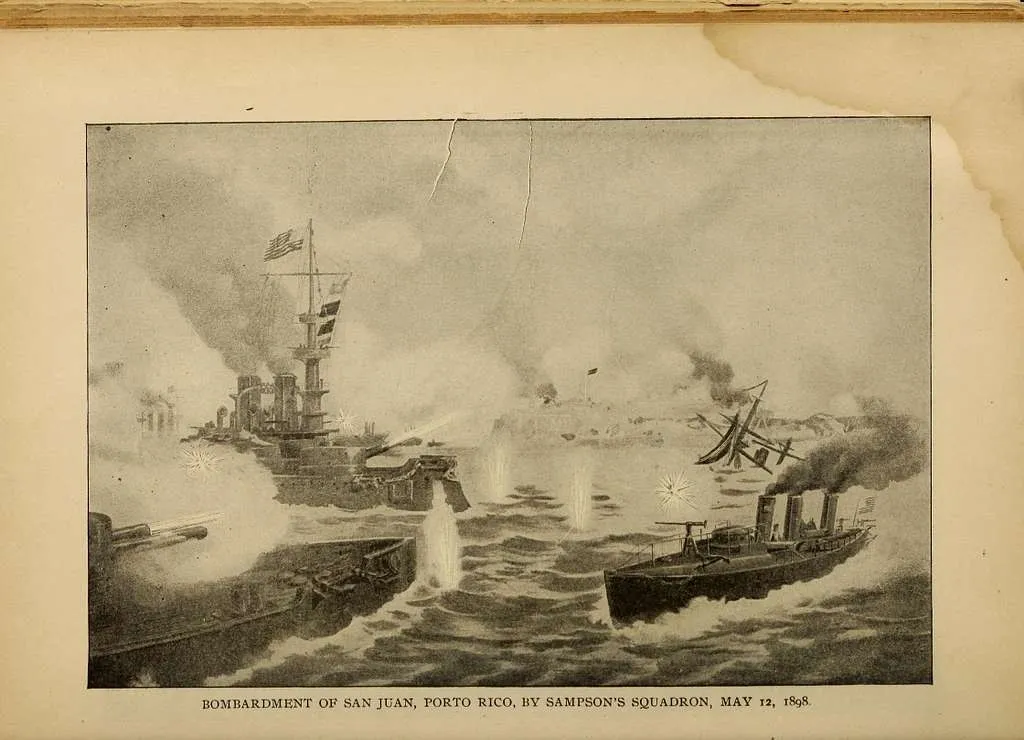
Last week, on December 5th, the Trump Administration released its new National Security Strategy (NSS). It’s the next step in this increasingly belligerent foreign policy and a declaration that private economic interests and national security policy will go hand in hand moving forward.
One of the most striking elements of the NSS is that it invokes the Monroe Doctrine, a nineteenth-century neo-imperialist foreign policy that claimed the Western Hemisphere as the US’s domain to control. This new Monroe Doctrine maintains the US’s regional hegemony, but adds a “Trump Corollary” highlighting the strategic importance of supply chains, barring foreign powers from the West and shoring up defences.
This aggressive approach has significant implications for Canada. Prime Minister Mark Carney is testing the waters to diversify trade and decrease dependency on the US, while seeking to expand value-add industries and manufacturing. But these efforts to diversify may undermine US access to our resources and put Canada in direct opposition to the Trump administration’s efforts to consolidate control over fortress America. In this context, Canada must read these NSS goals as explicit threats against the very actions we’re currently exploring to expand our sovereignty and establish ourselves as an independent power.
While the US might not be threatening us with real gunboats (yet?), Canadians must understand the NSS is an acknowledgement of the continued colonization of our country by US interests. It is an explicit articulation of the ways in which US companies, especially in the digital sphere are tools of that colonization. Corporate domination of digital infrastructure is an extension of US foreign policy, and US foreign policy, lobbying and economic warfare could be deployed to ensure favourable conditions for those corporate interests wherever needed.
The Revival of the Monroe Doctrine
The Monroe Doctrine was an 1823 US foreign policy position that claimed the entire Western Hemisphere as America’s strategic domain. Initially pitched as opposition to European colonial interventions in Latin America, it became justification for extensive US intervention throughout the nineteenth and twentieth centuries including multiple coups d’état against democratically elected leaders like Salvador Allende in Chile and Jacobo Árbenz in Guatemala.
A key instrument of the doctrine was what is now referred to as “gunboat” diplomacy—using the threat of superior naval firepower to coerce trade concessions and political compliance. This approach shaped US policy, particularly in the Caribbean for over a century, from the Spanish-American War to Cold War interventions in Cuba and beyond, establishing a pattern of leveraging military and economic dominance to secure strategic interests in the region.
Trump’s addition to the Monroe Doctrine, the Trump Corollary, updates the strategy for a new geopolitical order. While the NSS highlights drugs and migration as key challenges (the same ill-defined threats used to justify tariffs on Canada), the corollary focuses on protecting strategic interests in keeping with the spirit of the original doctrine.
The strategy has two prongs. First, enlist “regional champions” to secure the hemisphere “beyond their borders,” including partnering with “governments with different outlooks,” opening the door for transborder security operations with potentially autocratic allies. Second, expand US hegemony by making America “the partner of first choice” while using “various means” to discourage collaboration with others, particularly China.
The most sweeping element is the commitment to “monitor key supply chains and technological advances around the world to ensure we understand and mitigate vulnerabilities and threats to American security and prosperity.” Given Trump’s recent initiatives around AI supremacy (America’s AI Action Plan and Launching the Genesis Mission), and the push to Revitalize American Industry, this language encompasses a vast range of materials, technologies, and resources that the US may now claim as vital interests to be aggressively protected under the Monroe Doctrine.
What does this mean for Canada?
Multiple commentaries have noted that the US NSS is hostile to Canada and that it turns Canada into a target for US aggression. But what might that aggression actually look like? Three key categories of aggression are available: economic, military, and corporate. We have already seen extensive use of tariffs to coerce Canada and allies, while direct military strikes on Canada seem unlikely at this time. However, the most pressing and potent ‘gunboat’ deployed by the US against Canada is in the corporate sphere in the form of the Magnificent 7 tech companies. It remains to be seen whether and how complicit these companies could be in enforcing Trump’s vision; perhaps shifting from “magnificent” to “malevolent.”
The corporate tools of the US neo-imperialist expansion are the most varied and perhaps the most effective in terms of violating and undermining Canadian sovereignty. While US forces may never cross the Canadian border to secure supply chains of critical minerals (though, never say never), US companies, especially big tech companies, have dominated our markets and captured our political apparatus through lobbying to an alarming degree. This domination precedes the current administration and has had great success in controlling our resources, our digital and some physical infrastructure, and capturing our R&D funding system such that our tax dollars flow right into funding US multinational R&D and IP ownership both directly and indirectly. With tools like these, and so deeply rooted, who needs boats? Rather than the threat of an attack, these digital gunboats threaten to remove the very infrastructure on which our economy and society runs.
In the recently published responses to the USTR consultation on the review of CUSMA the think tank Information Technology and Innovation Foundation (ITIF) – funded by all but one (Tesla) of the “Magnificent 7” companies – pushes back against the idea of digital sovereignty itself, framing the concept as misleading and discriminatory, highlighting Canada’s sovereign cloud efforts. Before Canada’s digital sovereignty efforts are even fully developed, corporate tech interests are already rejecting and seeking to undermine them, representing another front in the US’s 21st century gunboat diplomacy and an extension of the state’s national security priorities.
In contrast, as a start, our friends at the Canadian Council of Innovators have called for a convening of Canadian business leaders to respond to the NSS.
With the new Monroe Doctrine outlined in the NSS, US companies will be some of the most effective, and willing, tools of the US government to control resources and supply chains, and to hold our essential digital infrastructure hostage. However, efforts to loosen the grip of big tech on our infrastructure and economy through reforms, and digital sovereignty measures, might be perceived under the Monroe Doctrine as a threat to US supply chains and interests and may provoke the deployment of further economic or potentially even military or security-related interventions. The NSS even states that “countries that depend on [the USA] most and therefore over which [the USA has] the most leverage, must be sole-source contracts for our companies” seeming to explicitly express the intention to exploit weaker countries to ensure favourable conditions for US companies. Does this mean the robust homegrown Canadian defence industry Carney is hoping to build will be expected to go the way of the Avro Arrow?
The Monroe Doctrine 2.0, Trump edition, is not a truly new set of policies. The US has made their economy and empire on strategically deploying economic and military tools to support and expand their strategic interests globally for over a century. However, in the context of direct belligerence in the economic sphere, and now increasingly militarily (such as recent US aggression against Venezuela), in the Western Hemisphere and even against current or former allies like Canada, this revival of a 19th century doctrine should indicate to us a willingness to employ 19th century tactics of all kinds.
What comes next?
What can be done when Canada is negotiating at the barrel of a gun? The unified front between US government and corporate interests is perhaps more evident now than ever. Big tech is a trojan horse of US power in Canada hiding in plain sight. New policies like the AI Action Plan to “win” the AI race, blur the lines between corporate interest and government policies to the point where success for the leading US tech multinationals is becoming an extension of US power, while the US government’s work to secure critical minerals is deeply linked to its support of private AI and other tech companies’ access to materials to build their tech. No matter how much AI might seem like a bubble it seems the US government is determined to invest and find markets for leading AI companies and associated infrastructures to ensure the bubble never bursts.
Some may see the NSS and the 51st state rhetoric over the past year as indicators of potential for conflict down the road and a slowly souring relationship. But, when we look at the multiple fronts by which the US is pursuing its strategic goals in Canada, the long-term undermining by corporate and private interests of our democracy and sovereignty, and the implied entitlement to the hemisphere contained in positions like the Monroe Doctrine, we might find we are already squarely in a deliberate and coordinated takeover that is years or even decades in the making.
While the Government of Canada might think the Budget and Defence Industrial Strategy are good responses to forge our own path independent of the US, the NSS clearly shows that the Trump administration aims to treat those efforts as threats to national security and to combat them by any means necessary. It’s time to look with clear eyes at the big picture and get coordinated on real, substantive measures to regain our sovereignty now, without caveats or equivocation. We’re going to need a bigger (gun)boat.
Chart of the Week
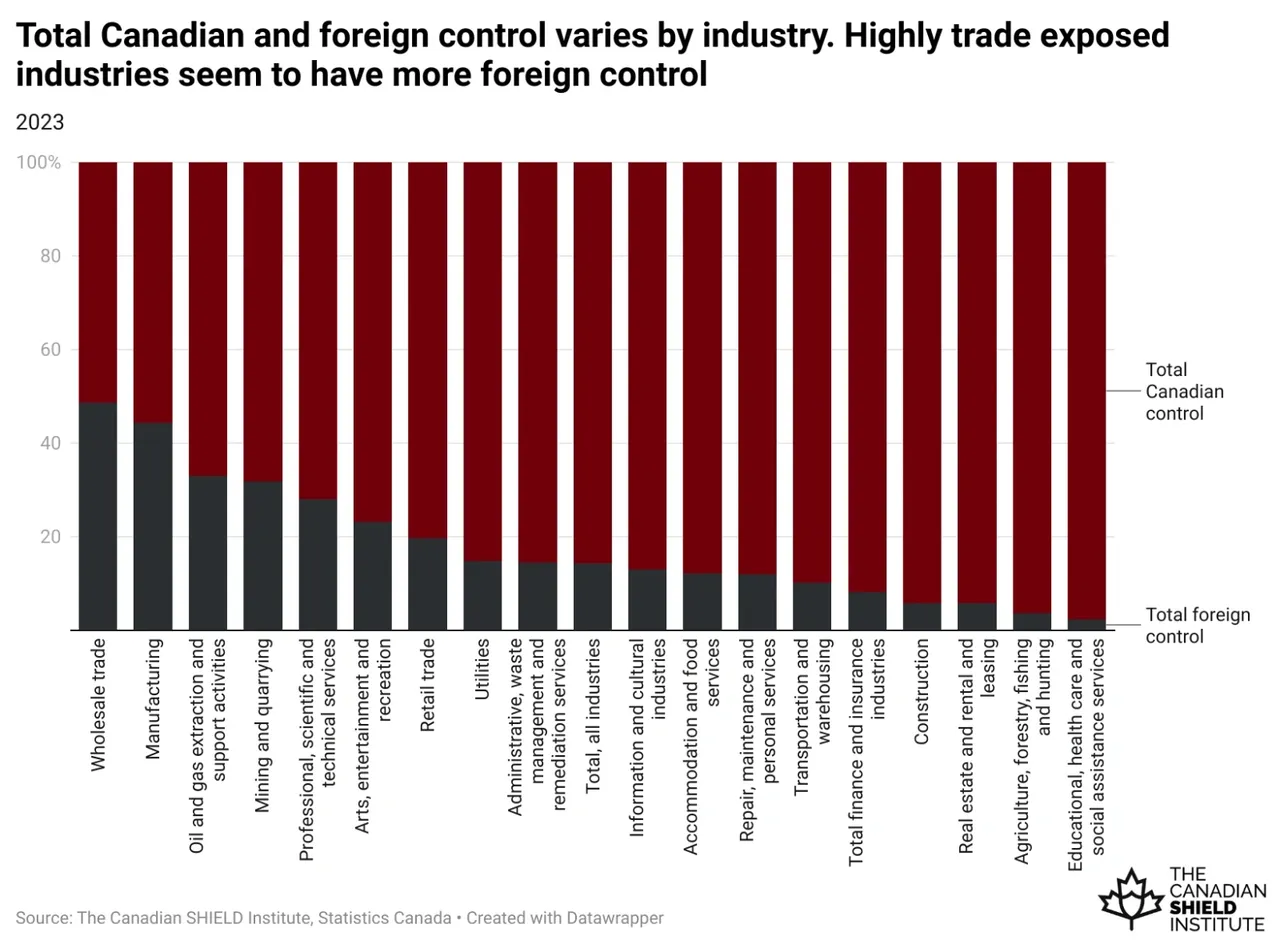
Canada’s ownership structure quietly determines who makes decisions about our economy, and who captures the value it creates. While foreign control has declined over the past 15 years, it remains strikingly high in trade-exposed sectors and is actually rising in cultural industries like film, broadcasting, and newspapers. As the federal government courts more private investment to finance critical infrastructure, foreign ownership will likely tick up again.
That’s not inherently a problem, but concentration in the wrong places can weaken our ability to set our own rules, protect data, or keep Canadian value in Canada. Tracking foreign control isn’t about rejecting global capital; it’s about being strategic. If sovereignty is the goal, governments need to revisit ownership limits in key sectors and be prepared to use the Investment Canada Act to ensure investment strengthens — rather than erodes — our economic resilience.
Shield In the News
In new Globe and Mail commentary, Managing Director Vass Bednar argues that loyalty points — much like money — shouldn’t vanish simply because time passes. With many Canadians frustrated by expiring travel and rewards points, the piece makes the case that expiry policies often benefit companies more than consumers; eroding trust and value in loyalty programs. As debates grow over how points are regulated and whether current expiry rules are fair, the op-ed urges a rethink of how we value and protect what consumers have already earned.
In the latest Policy Prompt episode from the Centre for International Governance Innovation, hosts Vass Bednar and Paul Samson sit down with human-rights lawyer Jared Genser to unpack the rapid rise of neurotechnology — from implantable devices helping treat disease to consumer wearables that could soon decode thoughts. While the promise for medical breakthroughs and new human-technology interfaces is huge, Genser warns that the ethical, legal and privacy risks are profound. The conversation highlights the urgent need to rethink protections for “neuro-data” and fundamental freedoms like mental privacy as these technologies move out of sci-fi and into everyday life.
Vass Bednar was quoted in this article from The Logic: Canada forges deals with Europe in search for new AI allies. She also delivered this guest lecture to the University of Waterloo.

Song of the Week
For this newsletter, we’re playing Barrett’s Privateers by Stan Rogers, for these lyrics: “I was told we’d cruise the seas for American gold, we’d fire no guns, shed no tears, now I’m a broken man on a Halifax pier.”

Subscribe to