Required Reading (Not Really)
Thank you for reading The National Interest.
There’s a version of Canada where we don’t have to keep saying “economic sovereignty” like it’s a new idea. Where critical infrastructure isn’t perpetually up for grabs, where policy isn’t always playing catch-up and where the “national interest” doesn’t feel like a luxury add-on.
But that’s not the version of Canada we lived in this year. So we read and wrote through it.
Since June, the Canadian Shield Institute has been at Parliamentary Committees, meeting with trade representatives, submitting to public consultations (CUSMA and AI), on stages, in newspapers, magazines, podcasts and coasting on airwaves making sovereignty make sense.
Through this newsletter, we’ve been tracking how power actually moves now: through “boring” financial plumbing, what sovereignty looks like at the checkout, platform tolls that function like trade barriers and culture that gets “slopified” at scale. We’ve also looked at the sharper edges—counterfeit people, smart glasses and what “sovereignty” even means when everyone claims it.
This week’s Buy Canadian Policy announcement is a great example of the tension baked into “sovereign” choices: we’re trying to be Canada’s best customer, without pretending that we can (or should) build everything alone. The government is now prioritizing Canadian suppliers for big “strategic” procurements, starting at contracts above $25 million now, with an expansion to contracts over $5 million by Spring 2026. The federal government is also layering in requirements for Canadian-produced steel, aluminum and wood in large construction and defence projects.
There are two design choices that will determine whether this policy is catalytic or merely symbolic.
First, what counts as “Canadian”? Under the strategic procurement policy, a “Canadian” supplier is essentially defined by footprint and activity: having a place of business here, tax registration and filing here, personnel and day-to-day activity here, and not subcontracting in a way that leaves only “minimal value-added” in Canada. Ownership and control isn’t core to the test, meaning that a firm can be foreign-controlled and still qualify. So public dollars could “buy Canadian” while the underlying profits, IP and strategic decision-making happen elsewhere.
Second: the carve-outs could swallow the rule. The policy allows departments to exclude procurements when, among other things, there’s “no capacity or availability” (not produced in sufficient quantities or satisfactory quality), “undue delay” (especially for critical defence/national security equipment), or where “best value” would be compromised (including an expected 25%+ cost increase over market rates).
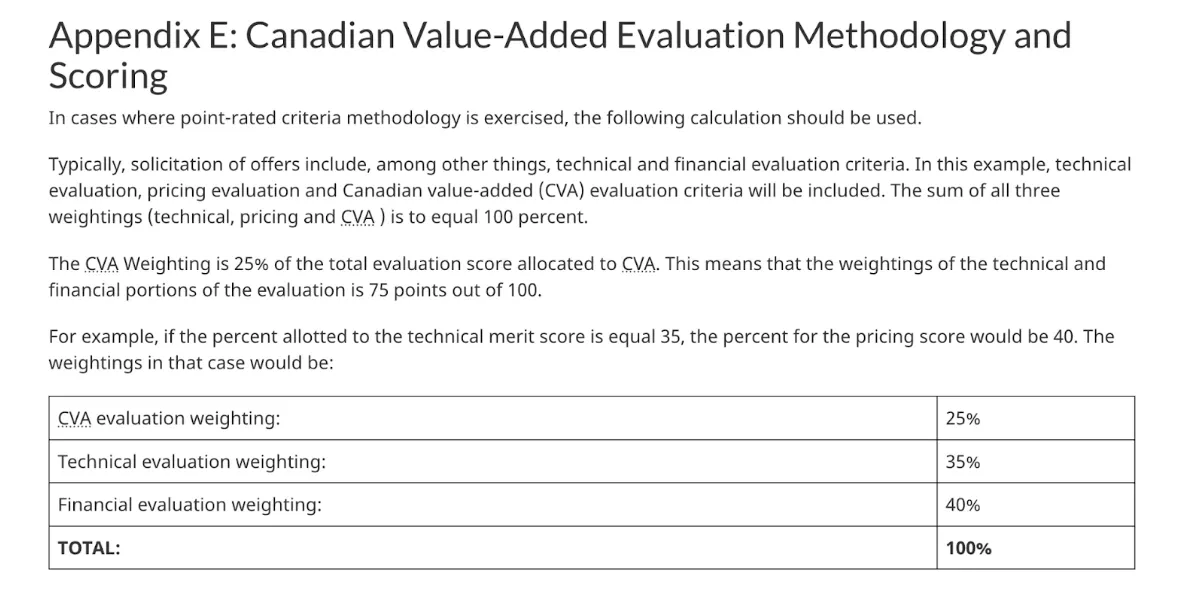
Chatting this through with Laurent Carbonneau, the Council of Canadian Innovators’ Director of Policy and Research, we dug into the annexes of the announcement. While all sorts of companies can be deemed “Canadian” under the policy, the associated benefit with being a “Canadian” supplier is modest: your price is viewed as being 10% more competitive than a non-Canadian bidder for the purposes of assessing a bid’s financial score. In contrast, one-quarter of the total scoring (25%) considers whether and how the firm adds value to their product or service in Canada. That difference suggests that the Government is emphasizing economic activity more than whether and how a company operates here.
It’s easy to argue that almost anything lacks a “suitable” Canadian option when there’s almost always going to be a bigger foreign incumbent who can deliver faster, cheaper or with a longer track record.
That gets to the hard truth: if the goal is to really drive Canadian investment and capability, we have to tolerate some friction. Not chaos (!)—just an explicit willingness to help domestic suppliers cross the threshold.
The policy itself nods at this logic—departments are “strongly encouraged” to apply it “wherever feasible,” even below thresholds. That needs to be a mandate to build capacity on purpose.
That’s why we built our repeatable framework, The SHIELD Score (which was featured in The Hill Times this week), to make such trade-offs explicit, and to pressure-test whether a policy is building sovereignty by design or just branding it that way.
Alright. As a reader, you’ve mostly heard from me. Last week, my colleague Matthew da Mota wrote about what gunboat diplomacy looks like in 2025. This work is a team effort—research, reporting, editing, strategy and the day-to-day grind of turning big ideas into usable policy.
Today, I want you to meet more of the people behind it—and share some of the books and other media that got us thinking this year, and that you may enjoy.
We’ll be back in January to keep pushing for the structural fixes that make independence possible. You know, until economic sovereignty stops being a niche beat and starts being basic governance.
Wishing you rest without optimization, and time offline with the people you love.
Vass Bednar
Jessica Stewart, Operations Manager
My picks all circle the same preoccupation: what gets hidden, what gets silenced and what it takes to break free—personally and politically.
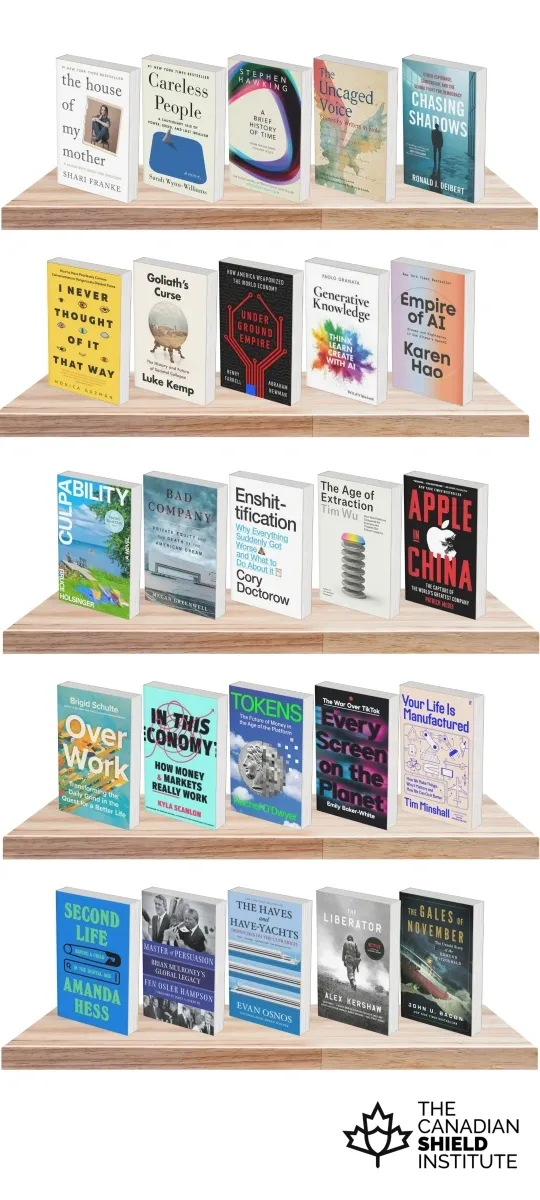
Chasing Shadows and The Uncaged Voice pulled me toward stories about what’s obscured and what finally gets spoken. A Brief History of Time zoomed me all the way out—when I need perspective, I go cosmic. And The Liberator brought it back down to earth, reminding me that freedom isn’t a vibe—it’s something people fight for, and then have to keep defending.
Emily Osborne, Policy Research Associate
My reads, Careless People and The House of My Mother (a memoir by the eldest daughter of a famous family vlogger) expose what happens when intimate lives become content—one from inside the machinery of a platform built to harvest attention, and the other from inside a family shaped by perpetual public display. Read side by side, they reveal how the incentives of online visibility distort relationships, erode boundaries and leave real people to navigate the fallout long after the views fade.
David Corbett, Policy Research Associate
If you’re like me and prefer to listen in long-form, these Lex Fridman episodes are excellent “put your phone down and let your brain stretch” listens. Together they trace a surprising arc—from what intelligence might look like in biology (and beyond), to the geopolitical and industrial machinery powering today’s AI race, to a real-world story of deception and systems-gaming that feels like a human-scale mirror of the bigger themes.
They are:
Michael Levin: Hidden Reality of Alien Intelligence & Biological Life;
Deepseek, China, OpenAI, NVIDIA, xAI, TSMC, Stargate, and AI Megaclusters;
Sara Walker: the Physics of Life, Time, Complexity, and Aliens; and
Matthew Cox: FBI Most Wanted Con Man – $55 Million in Bank Fraud.
Ana Qarri, Fractional Policy Counsel
Paris Marx’s Tech Won’t Save Us is always sharp, but “Will the Pope Be an Ally Against AI?” (with Paolo Benanti) is a surprisingly fun doorway into the ethics-and-power side of AI—and he also has a more straight-ahead episode on digital sovereignty worth queuing up.
Matthew da Mota, Senior Policy Researcher
These works trace the hidden architectures of global power. Power takes a lot of forms, from the rise of AI empires and the reshaping of knowledge itself, to the financial and geopolitical systems the United States has long used to govern the world economy, to the fragility and recurring patterns that make societies vulnerable to collapse. Layered with a gripping historical account of Cold War proxy conflict, they reveal how technological, economic and military forces intertwine; and how today’s world is shaped as much by algorithmic dominance as by the unresolved tensions of past empires. My top reads were: Empire of AI, Generative Knowledge, Underground Empire: How America Weaponized the World Economy and Goliath’s Curse: The History and Future of Societal Collapse.
If you want one more truly absorbing listen: Blowback (Season 6). This year’s season dives into the hot war in Angola during the Cold War—Angolan forces alongside Cuba on one side, and apartheid South Africa backed by the U.S. on the other. It’s vivid and clarifies how “proxy war” is often just a polite euphemism for real people paying the price for a great-power strategy. The whole series is great, and this season is especially gripping.
Kaylie Tiessen, Chief Economist
My picks sketch a map of how people make sense of a world that feels increasingly unstable. I Never Thought of It That Way shows how our information silos and conversational breakdowns distort our understanding of one another; Over Work: Transforming the Daily Grind in the Quest for a Better Life reveals how work itself has become unsustainable, shaped by outdated norms and invisible pressures; and In This Economy? How Money & Markets Really Work decodes the economic forces beneath it all, translating markets and monetary policy into something people can actually feel in their daily lives. Read as a trio, they offer a guide to navigating an economy that’s confusing on purpose, and remind us that clarity and better design are still possible.
If you want a smart, highly listenable refresher on how the 2007–08 crisis actually unfolded—and what we still haven’t learned—The Big Short Companion is a great pick. Built around the anniversary of The Big Short (the film), it revisits the characters, incentives and institutional failures that made the crash possible, then fast-forwards to what changed, what didn’t and why the same dynamics keep resurfacing in new forms. It’s part memory lane, part systems autopsy—in the best way.
Vass Bednar, Managing Director
We’re living through a transition from an industrial economy to a platformed, financialized, extractive one—and the giveaway is how little of it is legible. Prices move, terms change, rankings wobble, fees proliferate and somehow it’s always your problem to figure out what happened. My reading list has been a helpful diagnostic: platforms aren’t just marketplaces anymore; they’re increasingly the monetary system—minting their own currencies, permissions, and incentives (Tokens: The Future of Money in the Age of the Platform) while also becoming geopolitical infrastructure we fight over in real time (Every Screen on the Planet: The War Over TikTok). At the same time, the “real economy” hasn’t vanished—it’s just been boxed up and shipped out of sight: who makes things, who controls value and how responsibility gets dissolved in the process until no one’s accountable (Your Life is Manufactured; Culpability).
And then there’s the lived experience: when everything gets worse, it rarely feels like an accident. It’s a business model. Once dependency is built, extraction follows—on the platform side (Enshittification; The Age of Extraction) and on the ownership side (Bad Company), with supply chains and geopolitics turning “efficiency” into a form of capture (Apple in China). Inequality starts to look less like a side effect and more like architecture—parallel rules for the ultra-rich (The Haves and Have-Yachts), and mounting pressure on families trying to raise kids inside attention markets (Second Life). The question I’m trying to hold onto is the unfashionable one: what would it take to make this economy contestable again instead of treating scarcity as a permanent personality trait (Abundance)?
Also, I cried while reading The Gales of November.
Chart of the Week
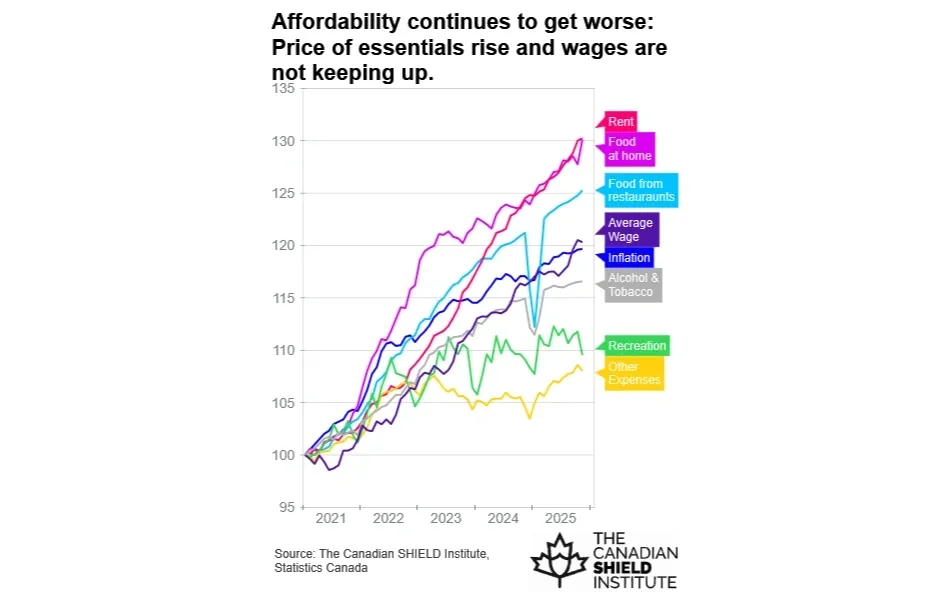
Canada’s affordability crunch is still squeezing household budgets. Inflation may have eased to 2.2% in November, but grocery prices rose 4.7%—more than twice the headline rate.
And in poll after poll, food and shelter sit at the top of Canadians’ economic worries. It tracks: since 2021, groceries and rent are up roughly 30%, while average wages have risen about 20%. In other words, essentials are climbing about 50% faster than paycheques.
Prime Minister Carney’s plan to catalyze $1 trillion in economic activity aims to shore up the economy amid a trade war—but turning that growth into real relief for regular people will take an additional strategy.
Shield In the News
Chief Economist Kaylie Tiessen elaborated on the inflation numbers with CTV News.
Managing Director Vass Bednar spoke with The Globe and Mail’s daily news podcast, The Decibel, about firm re-pricing strategies and loyalty programs as surveillant, extractive architecture. She was also quoted in a CBC News story about what it would take for concert tickets to become accessible again, and mentioned in the BetaKit podcast’s interview about how Rogers v. Rogers is Canada’s real-life Succession story
Song of the Week
We chose TUNS’ “Mind Over Matter” a bright, propulsive reminder that choosing Canadian right now isn’t just a vibes-based shopping preference—it’s a daily discipline. It’s the feeling of trying to make intentional choices in an economy engineered for convenience, consolidation, and defaults and still sticking with it anyway—mind over (market) matter.

Subscribe to