Let's Think Big To Fix Canada's IP Woes
It’s spring. The ice is melting, and people are putting their skates away until the next season.
In the capital, Ottawa’s Rideau Canal skating rink is maintained by a homegrown invention so iconic it has a neat nickname: the “Froster.” It’s kinda famous:

The inventors filed a patent in 2010, and later lost it after missing electronic renewal notices that ended up in a junk mail folder.
The vignette suggests to us that some of the mechanics related to IP retention can be strengthened. But that only scratches the surface.
Ever since it was announced in the 2025 federal budget last fall, we’ve been eagerly awaiting the government’s comprehensive intellectual property review.
We were excited to see a consultation pop up last week but it’s a lot more narrow than we were hoping for.
In that budget, Finance Minister François Philippe Champagne allocated $159 million toward better IP education and support for Canadian firms. But the budget also effectively acknowledged that the government needs to take a hard look at ways we can improve the systems that support IP generation and retention.
To further strengthen the intellectual property ecosystem in Canada, the government will conduct an intellectual property performance review to identify new ways to partner with emerging and scaling intellectual propertyintensive firms, increase domestic investment in leading and high-potential firms, retain and commercialise intellectual property in Canada, and help firms to protect and commercialise their intellectual property in foreign markets to advance trade diversification.
This is nerd stuff. Most Canadians don’t spend much time thinking about the role of IP in economic performance. And even fewer people get excited about participating in a policy review.
But the fact is that IP is vitally important and Canada has been lagging behind many of our peers when it comes to turning research strength into owned, usable economic assets.
Every year, Canada grants about 100 patents per million people. This has remained pretty much flat since the early 1990s. But other countries have taken a strategic approach to creating IP and have increased their patents per million people to more than 600.
China, the USA, Germany and Finland have been leading the pack (see below).
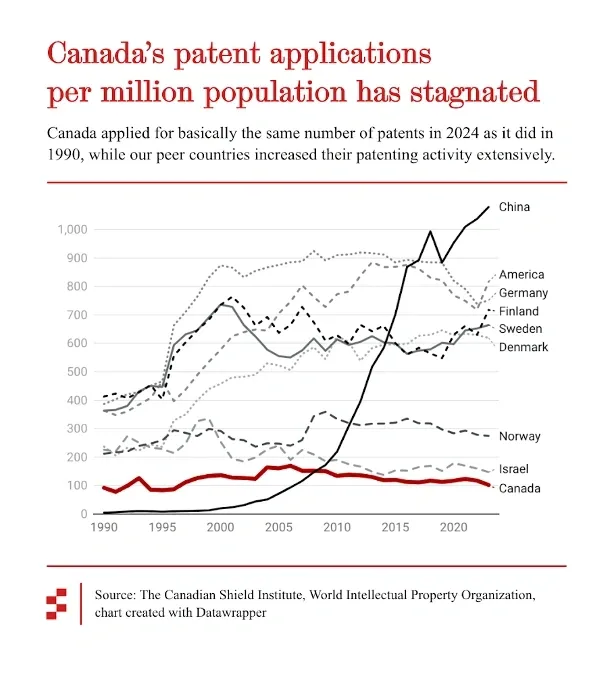
Canada invests more money as a share of GDP in post-secondary research and development but the outputs are commercialized in other countries; meaning that the benefits from this spending are being realized elsewhere. Canada is a world leader in research and development capabilities but runs a persistent deficit in IP ownership which means our research is delivering economic benefits away from Canada’s economy.
At Shield, we have all this research at our fingertips because we’ve been working on some big policy ideas in this area. We can see what our peers are doing, and how they’re thinking about IP.
In March, the US Patent and Trademark Office issued guidance saying that it will take American manufacturing supply chains into consideration when adjudicating patent disputes. John Squires, director of the USPTO, called his office the “central bank of innovation” in testimony to Congress.
South Korea’s early sovereign patent fund model emerged as a defensive response to foreign litigation and portfolio pressure, using centralized purchasing and deal-making to give domestic firms bargaining power they couldn’t build alone. Japan’s IP Bridge shows a more market-savvy approach: it aggregates under-used or “dormant” patents (often via revenue-sharing arrangements), then licenses and defends them—helping keep valuable rights from quietly flowing abroad at undervalued prices while supporting startups and SMEs.
Canada doesn’t approach IP strategy with this kind of sharp-elbowed lens.
Last year the Council of Canadian Innovators proposed something called an Innovation Asset Bank — “a public institution with a mandate to generate, assert and defend Canadian IP to catch up with countries where IP has been a cornerstone of their economic strategy for decades.”
We thought this is a pretty interesting idea, and our team has been working on developing a more detailed sketch of what a national public institution to promote IP ownership would look like.
We’re not quite sure what to make of the federal government’s very narrow public consultation that launched last week. The government is looking for IP lawyers, patent agents and business leaders who engage heavily with IP, and essentially wants to hear if there are ways to streamline bureaucratic processes for filing patents and other technical details.
This is fine work, but it’s a far cry from a strategic approach to generating and retaining more IP in Canada’s benefit.
As Canada looks to develop a new economic strategy for a volatile world, one of the big questions we should be asking is: Why have we been so poor at playing the intellectual property game, and how can we get better?
We’re hoping that the consultation announced last week is just a small process study, before the government launches a larger effort to understand why Canada is underperforming on this.
We’ll keep tracking the government’s policy moves closely on intellectual property, and stay tuned for that larger report on an Innovation Asset Bank.
The problem of Canada’s poor IP ownership record isn’t going away.
As the ice melts and the season shifts, Canada’s weak approach to intellectual property remains stubbornly frozen in place. We’ll be chiselling away at it.
In The News
THE WALRUS — Shield’s Vass Bednar and David Corbett are still talking about defining a Canadian company. Fixing this policy really matters. “Ottawa Hands Billions to Firms Calling Themselves Canadian. Most Aren’t”
iPOLITICS – Algorithmic pricing is an issue right at the intersection of affordability and data privacy. Manitoba has banned it. Other provinces are watching, and maybe we’ll even see moves at the national level. Vass talked to iPolitics about the issue. Read it here!
IN WATERLOO — On April 9, Vass will be on stage at CIGI, discussing a public lecture by Ricardo Hausmann, Founder and Director of Harvard’s Growth Lab. The lecture is part of a series on productivity, prosperity and Canadians’ standard of living. Learn more here!
Hit Play
Joni Mitchell received a well-deserved lifetime achievement award at the Junos last weekend. What a great moment to celebrate the grande dame of Canadian folk music!
And, as the NHL regular season winds down, we would like to apologize to everyone who has “a little money riding on the Maple Leafs.”
Maybe next year. (Probably not.)

Subscribe to