Hunting for Fake Canadian Firms - A Deep Dive into the Procurement Data
In December, the Ottawa Citizen published a piece about the new Buy Canadian policy, which included a rather striking stat: According to Noah Fry, a Dalhousie academic who studies procurement, more than 90 per cent of Canadian federal purchasing already goes to “notionally Canadian suppliers.”
If you read the article, it’s clear that Fry knows there are problems with the Canadian procurement system. He’s concerned with loopholes that allow non-Canadian companies to feed into the process.
The good news here, though, is that the government actually publishes a database of procurement contract history, and so this year Shield has been diving in and trying to figure out how much government purchasing is going to genuinely Canadian companies.
And when you look at the data, it’s abundantly clear that a lot of “Canadian” vendors are really just foreign companies with a Canadian business address.
The CanadaBuys Contract History datasets lists contracts, and contract amendments. (Amendments are updates to the contract due to continued negotiations, changes to the original requirements, or unforeseen complications.)
We looked at the 100 largest contracts and amendments for two key government departments: the Department of National Defence (DND) and Public Services and Procurement Canada (PSPC).
At DND, 52 of the top 100 contracts and amendments went to companies with a Canadian address, but when we dug into the data, only 19 of the 52 firms are genuinely Canadian controlled.
We looked at the Inter-corporate Ownership Database to determine the country of control for a company, and when we couldn’t get the answer from that database, we used other indicators to determine corporate control.
At PSPC, of the top 100 contracts and amendments, 98 of them went to firms with a Canadian address (!), but in reality only 55 of those contracts were going to companies that were genuinely Canadian controlled or primarily owned by Canadians.
By way of an example, let’s look at this $92 million contract for “Fire control systems” sole-sourced to Lockheed Martin Canada, with a business address in Kanata, just outside of Ottawa. On paper, this is a ‘Canadian’ company.
But of course, that’s not the whole truth. And indeed, if we look at the Inter-Corporate Ownership Database maintained by Statistics Canada, we see that Lockheed Martin Canada is 100% owned by U.S.-based Lockheed Martin. You can learn more about the database here.
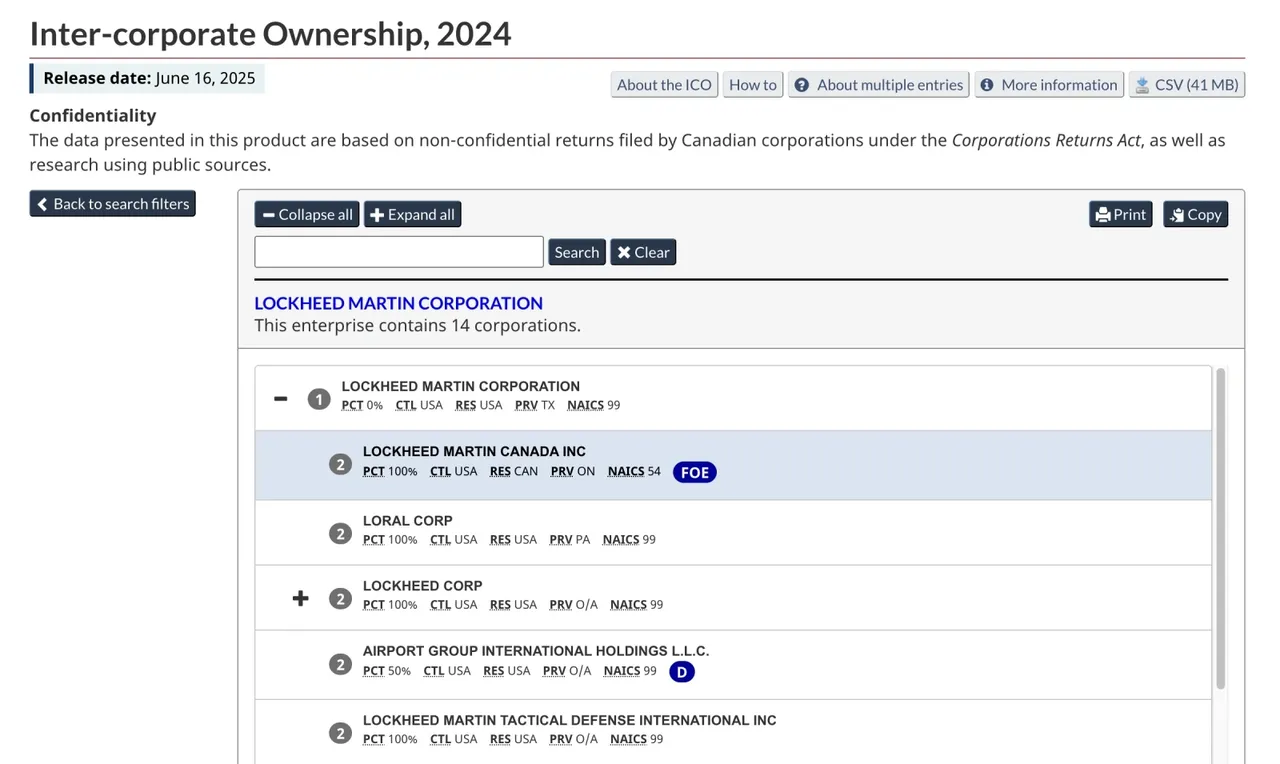
The Inter-Corporate Ownership Database clearly shows that Lockheed Martin Canada is 100% owned by Lockheed Martin Corporation, and that the country of control is the USA
Under the government’s new Buy Canadian policy, companies like Lockheed Martin Canada would likely count as a “Canadian Supplier” and receive preferential treatment within the procurement process. All it takes to be a Canadian supplier is that you maintain an address with employees in Canada and pay taxes here.
But in reality, the profits accrued by Lockheed Martin “Canada” flow back to the United States. The intellectual property developed through R&D flows back to head office, and it is commercialized by Lockheed Martin headquartered in beautiful Bethesda, Maryland.
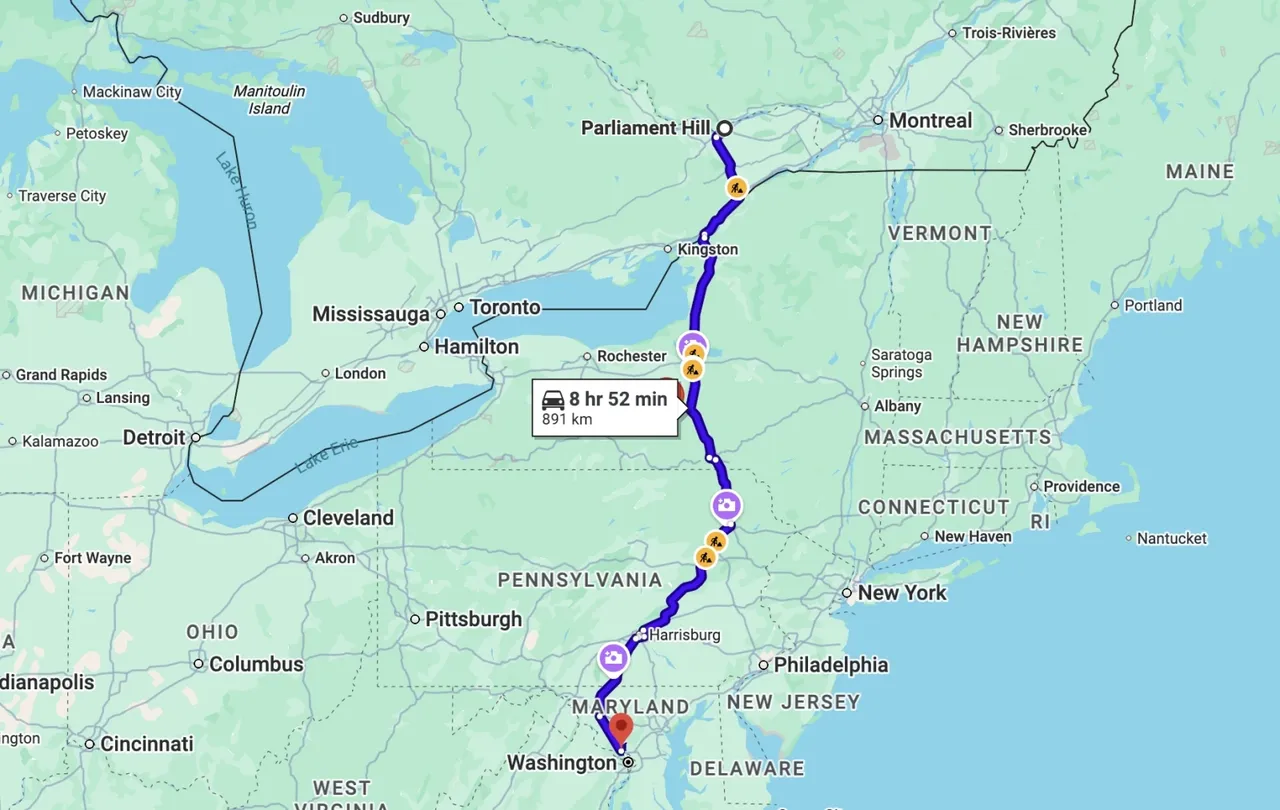
(About nine hours with bathroom breaks)
For a lot of the companies we examined, it was as simple as looking at the Inter-Corporate Ownership Database. But in some cases, we needed to trace ownership through federal and provincial business registries, stock screeners, company websites, press releases, and news articles.
This project focused on corporate control as the main factor for determining whether a company is truly Canadian, and when the Inter-Corporate Ownership Database didn’t list a company, we looked at ownership and other factors. But in truth, Shield’s view is that defining a genuine Canadian company is more nuanced and complex, including factors like the location of headquarters and where IP resides.
After many hours poring through spreadsheets and clicking through government databases, the main takeaway here is that corporate structure is complex. Technicalities abound.
That’s why Shield’s working definition of a Canadian company is built on principles that can be readily applied:
– Control: Key decisions are made in Canada
– Headquarters: A substantive headquarters presence in Canada, with senior leadership and strategic decision-makers based here
– Intellectual Property: The firm owns or controls IP resulting from Canadian R&D, and substantially commercializes that IP from Canada
– Ownership: Most companies accept foreign investment to fuel their growth, but a Canadian company cannot be majority owned by a single non-Canadian company or individual
But these aren’t just tedious bureaucratic technicalities. Canada’s new Defence Industrial Strategy sets a target of 70 per cent of contracts going to Canadian companies. But the strategy only uses the phrase “Canadian-controlled” once. It’s clear that the federal government’s idea of Canadian suppliers includes any branch plant subsidiary of a foreign multinational.
We think that’s not good enough.
More than anything else, I think we can all agree on one thing: Lockheed Martin is not a Canadian company. Like … c’mon.
Policy Research Associate
The Canadian Shield Institute
In the News
TVO TODAY LIVE — At a live event at CIGI in Waterloo, Ont., Canadian Shield Institute Managing Director Vass Bednar joined ThinkOn CEO Craig McLellan and President of the Mozilla Foundation Mark Surman to talk about Canada’s digital sovereignty.
Watch the full discussion on YouTube here.
THE CANADIAN PRESS — Kaylie Tiessen, Shield’s chief economist, talked about foreign direct investment, and how it interacts with Canadian economic resilience.
“Government needs to be really careful about which FDI they are courting, allowing, hyping,” Tiessen said.
CBC’s THE CURRENT — Vass was also on CBC’s The Current talking about Canadian competition policy, and the dominant role of Ticketmaster in the marketplace. Listen here!
MARCH 20 IN TORONTO — Vass will be on a panel discussing digital sovereignty organized by the Canadian International Council. If you’re interested in attending, register here!
Chart of the Week
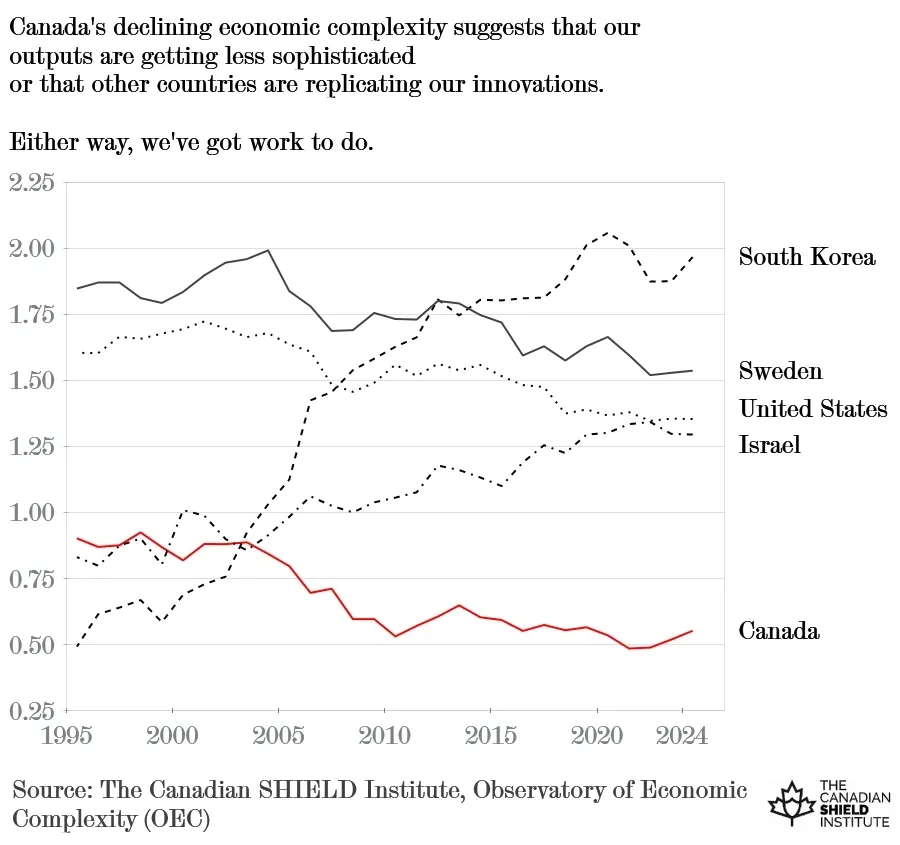
Economic complexity measures the diversity and sophistication of the goods and services a country produces and exports. The Economic Complexity Index is published by the Observatory of Economic Complexity. It’s a useful aggregate measure for an important concept and it’s another indicator we’re studying for our upcoming paper on IP and R&D.
The Economic Complexity Index reflects the knowledge, skills and technologies in an economy and how they are combined to produce outputs. Higher scores indicate a country produces specialized products.
A low or falling score, like Canada’s, shows that outputs are declining in sophistication or that other countries have caught up and can produce similar products and services.
The good news is that Canada has the ingredients needed to improve. The complexity of our research ecosystems rank third in the world, even though our products and services rank 35th. Translating this research strength into Canadian innovation and value‑added production would raise Canada’s economic complexity.
Song of the Week
A Canadian classic: “Signs” by Five Man Electrical Band.
The song is a metaphor for … various things. Think about it.

Subscribe to