How realistic is 60% AI adoption?
Forecasting the economic impact of a new technology is notoriously difficult to estimate — just ask Nobel Prize winning economist Paul Krugman, who in 1998 predicted the internet would matter about as much as the fax machine.
When the federal government announced the AI for All strategy earlier this year, they set a target to increase Canadian business AI adoption from 12.2% to 60% by 2034, which would require an average adoption increase of around 5.3 percentage points per year. At The Canadian Shield, we wanted to understand just how significant this projected growth rate is, so we compared it against the adoption curves of other technologies businesses have taken up over the past three decades.
Suffice it to say, an annual rate of 5.3% would be really fast. Here’s what that would look like:
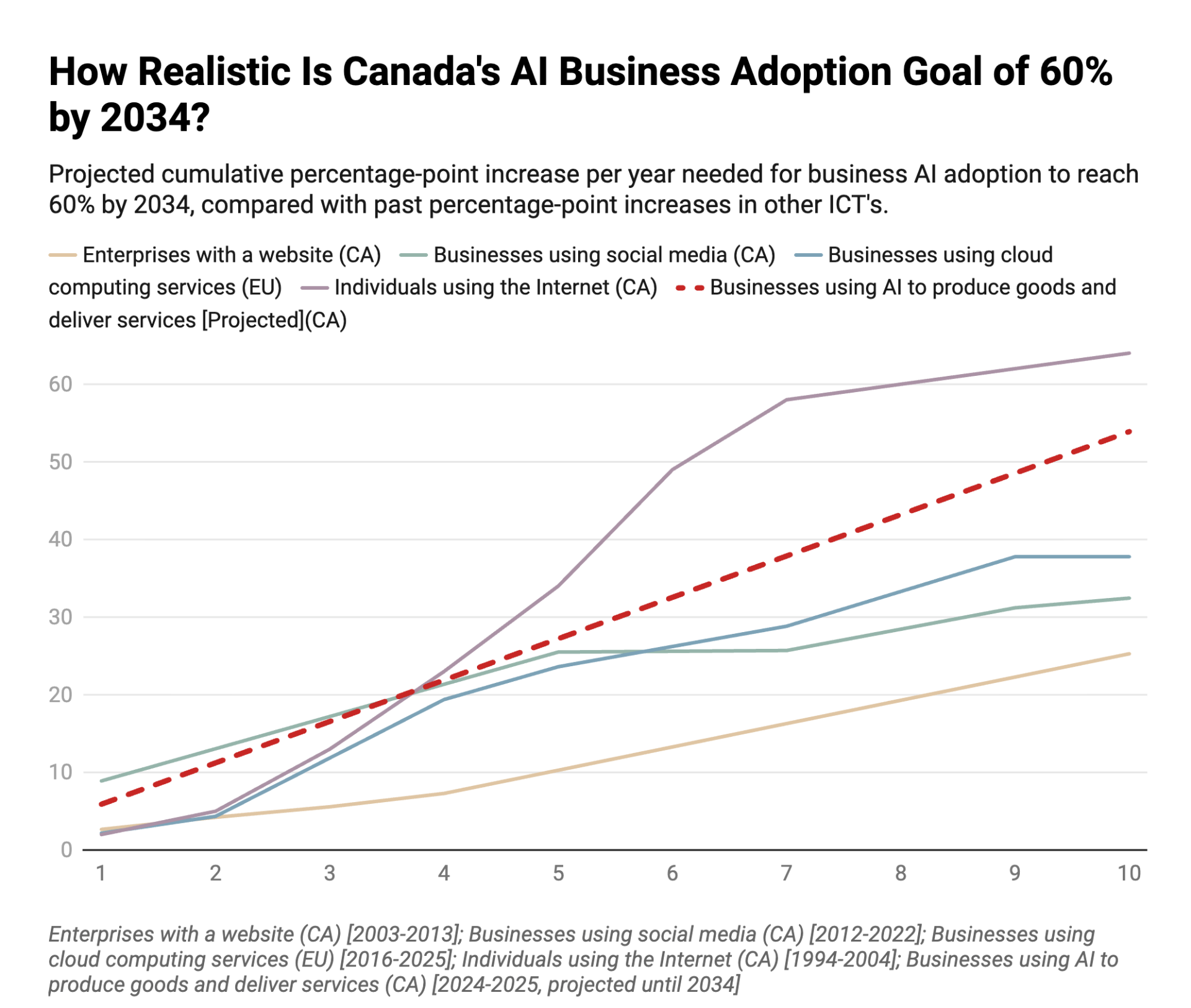
The chart above indexes each technology to its first observable data point. Canada’s projected AI trajectory already outpaces cloud computing across EU businesses, Canadian social media adoption, and enterprise website uptake. The only historical parallel that moves faster is personal internet use — the same technology Krugman famously underestimated.
The 12.2% adoption rate comes from Statistics Canada’s Canadian Survey on Business Conditions (CSBC) which was conducted between April 1st and May 5th 2025 and gathered responses from 9,103 Canadian businesses. It captures the share of businesses that used AI to produce goods or deliver services, and breaks down the specific AI applications used by respondents.
While there is an extensive list of 18 different AI applications such as deep learning, chatbots, and decision making models, the exact criteria for using AI to ‘produce goods or deliver services’ remains unexplained.
Looking at this methodology, it’s entirely possible that some respondents are using AI-powered services without knowing it, and they’re going uncounted in the statistics. But also, Google Search uses deep learning, and approximately 100% of the population uses that already. Does that mean that we already have 100% AI adoption?
Ultimately, it’s difficult to judge the adoption target without a more robust definition of what counts as AI.
The 60% target may be ambitious, but we have already seen the percentage of businesses using AI double over the past two years.
If this pace holds, the forecast may not be as far-fetched as it sounds. The better question to ask is not whether AI will be a part of our future, but how it will change labour for both the worker and the firm long term.


Subscribe to