Internet Traffic from Canadian Sources to Canadian Destinations
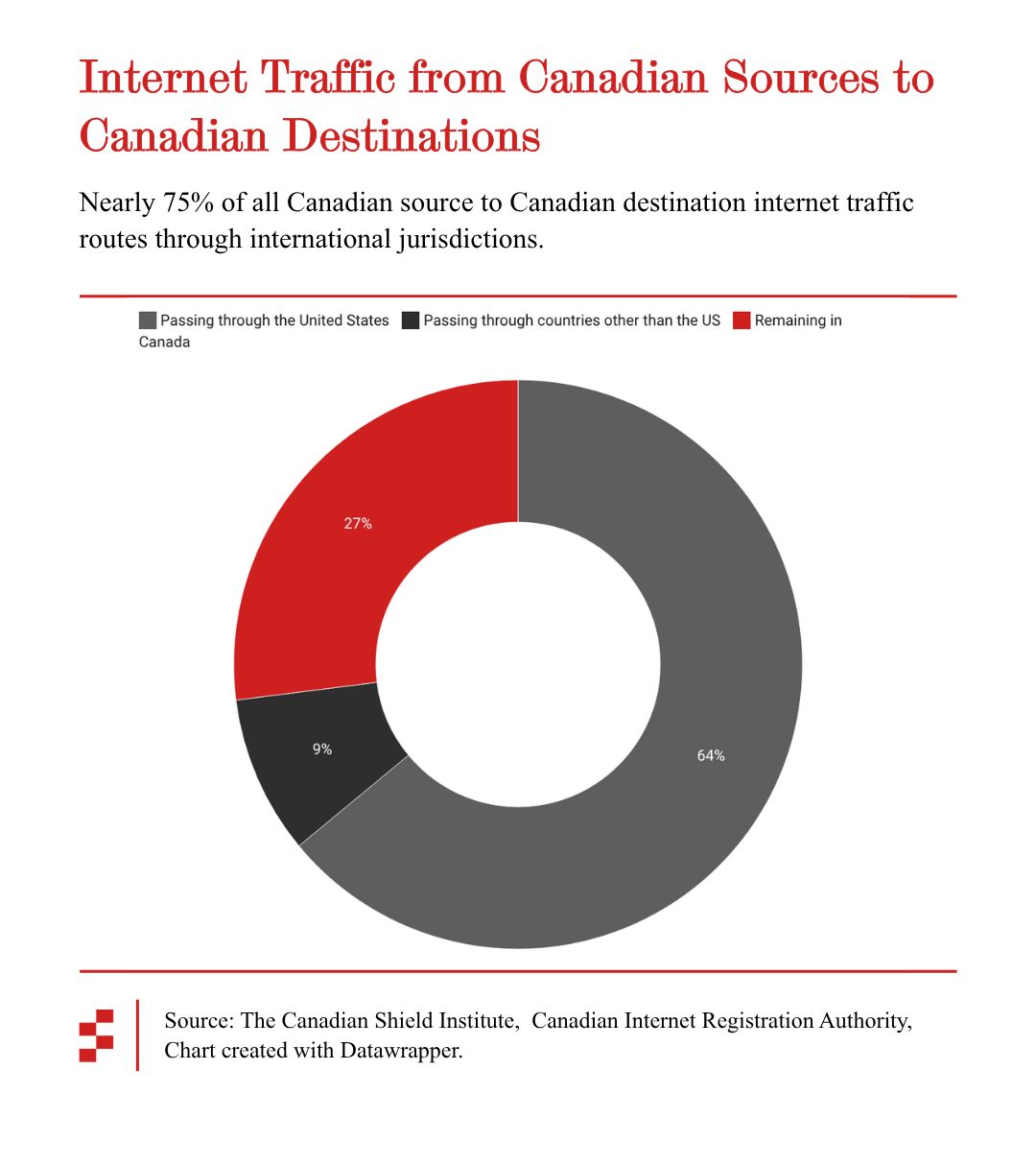
Nearly 75% of all of the Canadian-to-Canadian internet traffic routes through foreign jurisdictions.
About 64% of Canadian source-to-destination internet traffic boomerangs through the United States and another 9% routes through other countries. Only about a quarter routes through Canada alone.
In The Canadian Shield Institute’s Foundations of Digital Sovereignty series, we have explored how trade rules, standards and intellectual property have been weaponized by certain countries in order to assert dominance over markets and sovereign nations. The same is true of the cables that route internet traffic around the world. For decades, the U.S. has ensured that internet traffic was routed through the hubs under their jurisdiction in order to ensure the ability to surveil communications and now to exploit that for market dominance of American firms.
This week in Foundations, we present a framework for the market for cloud services to identify the level of sovereignty a certain service needs and the type of cloud that it should procure as a result.
The solution is not to attempt to switch all data and compute to sovereign alternatives, but rather to determine which use cases require sovereign capacity and to what degree. This framework would help the government and other cloud services users identify the risks associated with each cloud provider (foreign and domestic), prevent sovereign washing and enhance the discourse around digital sovereignty.

Subscribe to