Data Centre Backlash is a Policy Signal
Kentucky farmers are reportedly turning down millions of dollars for their land, by a mysterious company that wants to build a 2.2 gigawatt data centre.
Across Canada and the United States, we are hearing more and more stories about grassroots local opposition to power- and water-hungry data centres. In Quebec, residents are gathering signatures on a petition to shut down a proposed data centre, and Albertans are breathing a “sigh of collective relief” as a massive project was nixed.
It’s tempting to read these as local NIMBY skirmishes, but this pushback is also early evidence of something a little more structural: data centres are now a contested class of industrial infrastructure.
This matters, because we are in a domestic push to enable large-scale commercial AI centres to be built in Canada, but we need to clarify how we ensure that these structures will stay truly sovereign.
The reality is that no one really likes data centres. They’re noisy neighbours politically, visually ugly, water- and power-hungry, low on jobs, and increasingly met with deserving suspicion from citizens. They are environmentally damaging eyesores, and a sort of necessary evil in anchoring digital resilience.
As far as the physical data centre infrastructure is concerned, people mostly only experience the downsides of this big, aggravating thing in our communities. They are the physical substrate of a general-purpose technology era where compute power, data and models behave like a single integrated production system.
We need data centres as strategic infrastructure, but we need to attach conditions that force public value capture.
To quote President Donald Trump, “Data centres…they need some PR help.” Big Tech companies just signed a performative pledge at the White House in an effort to protect taxpayers from high utility bills due to data centres. But the pledge doesn’t address the utility of data centres overall: that they tend to service private interests, not public ones.
Europe is moving in a different direction. The European Commission is planning a Cloud and AI Development Act (CADA) later this quarter, and it is explicitly framed around boosting secure EU-based cloud and AI capacity for critical uses.
A new data centre on its own does not substitute for a sovereignty strategy. It’s more of an extraction and processing site for a new factor of productivity. We should consider data centres as a kind of enabling asset, and focus on how Canada can convert this kind of independent compute presence into explicit domestic capability and measurable public benefit. Building up our compute capacity won’t meaningfully contribute to our economy if the data that feeds it is unmanaged or governed primarily by foreign platforms.
Compute capacity without a corresponding data strategy will not deliver public value; paired with a data utility and value-capture framework, it absolutely can.
Canada needs a coherent approach to treating key datasets as national productive assets — especially in domains where the state is the main steward and the public interest is clear: health, environment, infrastructure, education, and procurement.
And there’s lots we can learn from other jurisdictions when it comes to cherishing data as an asset.
Finland does this well in health and social data by treating “secondary use” as a governed public function. It built a clear legal pathway and a dedicated permit authority (Findata) that manages access so that reuse is normal, but not sloppy.
Denmark’s model is a national health registry that can be accessed for research through tightly controlled and secure environments.
Estonia is probably the best example of treating interoperability itself as public infrastructure. Instead of one mega-dataset, it built a secure data exchange layer (X-tee/X-Road) so institutions can share what they need, when they need it, with traceability. This kind of model is highly relevant to education, infrastructure, and benefits administration.
The UK offers a strong “data as a productivity input” framing, paired with a public-service emphasis. Their National Data Strategy explicitly names data as a strategic asset and sets expectations about responsible use.
In policy conversations, Canadians talk a pretty big game about privacy and innovation, but we have failed to build the corresponding governance infrastructure that allows the country to use data productively while remaining accountable.
Any new data centres in Canada kickstarted with public funding through the Canada Infrastructure Bank should explicitly privilege domestic cloud and compute capability and be tethered to a broader plan to capitalize on shared data assets and modernize our economy.
The protests we are seeing related to new data centres are a local recognition that data centres are chokepoint infrastructure that tends to be extractive. If we choose to build them more intentionally, they can help us build up some relative leverage: strengthening Canadian compute capacity and responsibly governing our data as the asset it is.
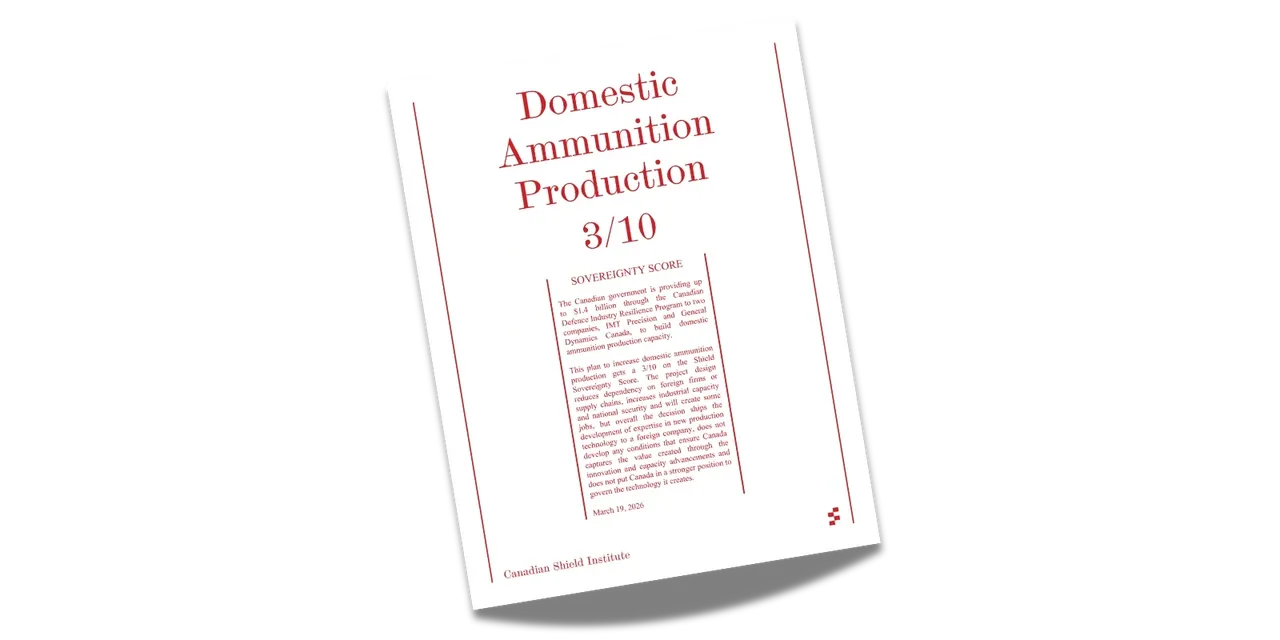
Sovereignty Score
The Canadian government is providing up to $1.4 billion through the Canadian Defence Industry Resilience Program to two companies, IMT Precision and General Dynamics Canada, to build domestic ammunition production capacity.
This plan to increase domestic ammunition production gets a 3/10 on the Sovereignty Score.
The project design reduces dependency on foreign firms or supply chains, increases industrial capacity and national security and will create some jobs, but overall the decision ships the development of expertise in new production technology to a foreign company, does not develop any conditions that ensure Canada captures the value created through the innovation and capacity advancements and does not put Canada in a stronger position to govern the technology it creates.
Read the full analysis here:
In the News
THE GLOBE AND MAIL — Nobody is really sure about how artificial intelligence will be shaping the labour force, and finding clear signals in the data is tough. Shield Chief Economist Kaylie Tiessen spoke to Vanmala Subramaniam about how policymakers should be thinking about the issue. Read it here.
POLICY PROMPT — Tim Wu worked in the White House on antitrust policy, and he has a lot to say about the predominant business model of big tech his latest book “The Age of Extraction.” For CIGI’s Policy Prompt podcast, Shield Managing Director Vass Bednar interviewed Tim on the ways that the extraction economy costs us more. Listen here.
PERSONALIZED PRICING — Earlier this week, the Manitoba government proposed legislation that would make using data to increase prices an unfair business practice. Shield offered comment to The National Post, The Canadian Press, and The Peak, and also appeared on CBC’s Morning Live television show.
Chart of the Week
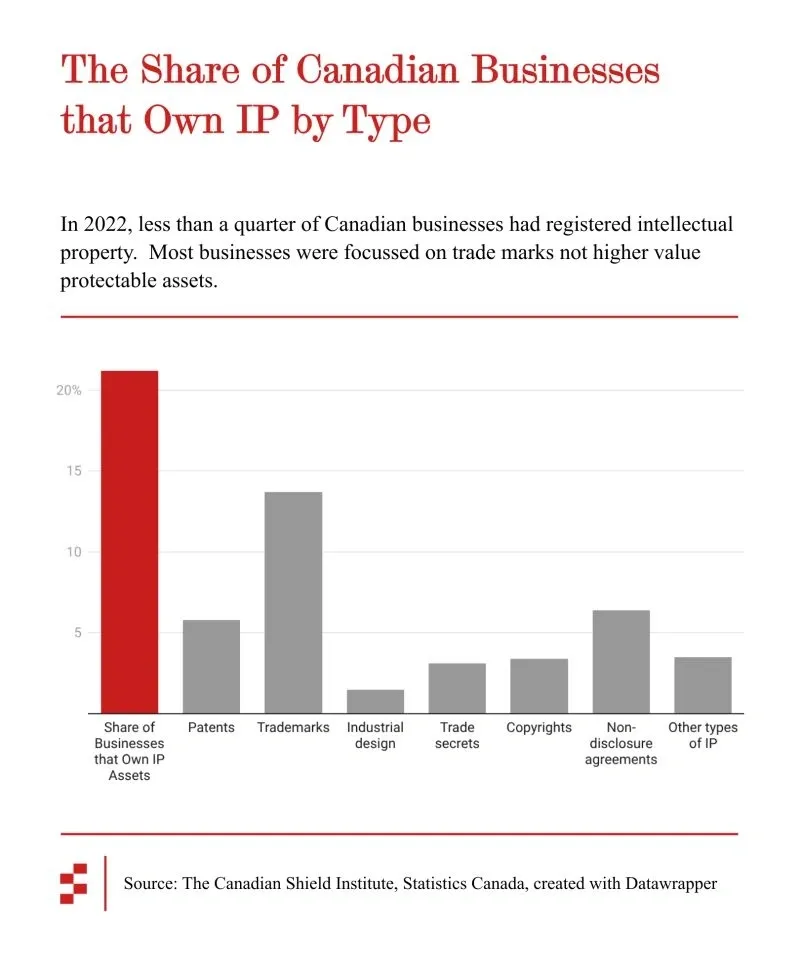
Shield Chief Economist Kaylie Tiessen has been writing a lot about intangible assets recently, and she was getting a few questions about intellectual property: Namely, what is it, and who owns it in Canada? This week’s chart dives into that question a bit.
Intellectual property includes patents, trademarks, copyrights, trade secrets, non-disclosure agreements and industrial designs.
Only 21% of Canadian businesses own formal intellectual property. Just 5.8% of Canadian firms hold patents. Only 13.7% own trademarks. Even fewer hold other forms of IP: 3.1% own trade secrets, 3.4% own copyrights and 6.4% use non‑disclosure agreements to protect their business from competitors copying or appropriating their ideas and inventions.
This pattern suggests that most Canadian firms either do not generate protectable intangible assets, or, more likely, they are not systematically protecting or managing them. If we had access to this data from other countries, it could also help explain Canada’s deficit in IP payments and our weak IP export performance.
We tried to find this type of information for other countries but haven’t had any success so far. If anyone has a recommendation please send it along!
Song of the Week
It’s cold and grey in March, and reading the news is heavy. Let’s take a break and listen to something warm. Cat Clyde‘s new album is good.
The song is “Another Time.”

Subscribe to