Building Canada's Dual-Use Commons
Canadian Shield Institute Chief Economist Kaylie Tiessen recently did some pretty simple math:
- Start with Canada’s current level of defence spending, which just recently passed 2 per cent of GDP.
- Take the government’s own forecast for future years, from the 2025 federal budget.
- Assume that Prime Minister Mark Carney is serious about Canada’s goal of hitting a defence spending target of 5 per cent of GDP by 2035.
The chart looks like this:
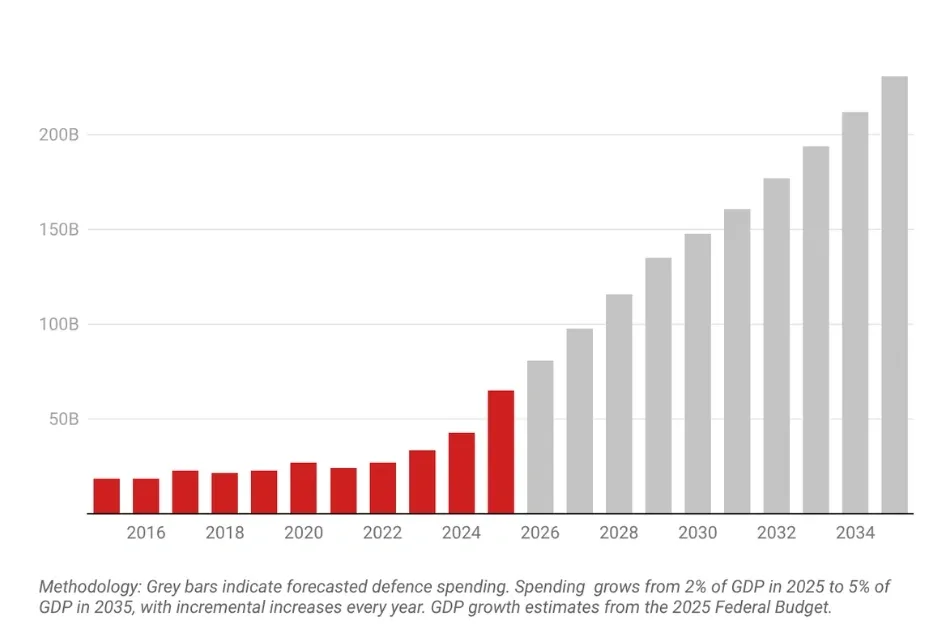
If we actually do it, Canada will be spending a staggering $230 billion annually on defence spending, up from around $80 billion today.
Simply pouring a huge amount of money into defence procurement will not in itself drive the economy, if we don’t fix three essential deficits:
First, there’s Canada’s manufacturing capacity.
Second, there’s Canada’s retention and strategic use of intangible assets produced through defence R&D.
And finally, there’s the governance of emerging dual-use technologies.
Given the amount of taxpayer money involved, and what it means for Canada’s geopolitical stance in the wider world, we really need to get the policy right.
Earlier this year, I co-wrote a paper with Laurent Carbonneau, Vice-President of Policy & Advocacy at the Council of Canadian Innovators. Our two organizations are closely aligned, and we both work on issues at the intersection of defence policy and economic strategy.
It turns out that there’s been a fair bit of scholarship on the idea of knitting together manufacturing and R&D, and the idea has a name: “The Industrial Commons.”
The idea here is that it’s no good if you go all-in on R&D work, without also having local manufacturing capacity to go along with it. The government is already looking to foster innovation hubs tied up with the Defence Industrial Strategy, and there are real benefits in taking steps to ensure that high quality manufacturing is co-located in the same place as the R&D.
Essentially, if you’ve got people designing drones or quantum computing or aerospace technologies, it’s very useful to have the factory right down the road to build things. For one thing, the factories will likely have some excess capacity, which can be used by other innovators in the region, or potentially it can create positive spillovers for other non-defence use cases.
The “Industrial Commons” here is the idea of bringing together researchers (which is already a strength for Canada) alongside manufacturing (less of a strength for Canada, but we have some under-used capacity that we can retool). The whole is greater than the sum of its parts, and the shared industrial capacity for both research and production becomes a public resource — i.e. a “commons.”
You can read a lot more about all of these ideas in the longer paper that we wrote, which is posted online here.
But in a nutshell, we propose three institutional design recommendations to make this idea of a defence dual-use industrial commons happen in Canada:
- Building manufacturing capacity around the new Defence Innovation Secure Hubs, designed for dual-use civilian and defence production;
- A dual-use Innovation Asset Bank to acquire patents, attach IP and data retention requirements to public funding, and stop Canadian-funded research from flowing abroad;
- A Strategic Standards Office to proactively shape defence procurement and interoperability standards, giving Canada more control and modularity over its defence and potentially dual-use systems.
The political will and capital are aligned now to take action on this. Without building a full ecosystem that can produce ideas, make things, govern strategically, and retain value, we risk spending money on immediate needs without building for the future.
This project was developed in collaboration with the Centre for Industrial Policy. Read the whole report here.

Subscribe to