A Real Framework For Assessing Policy
Sovereignty is a fairly simple concept, when you boil it right down to the basics.
Sovereignty means we get to decide for ourselves how we run this country, without undue influence from other countries or multinational corporations.
Sovereignty is the ability for Canada to freely make decisions that reflect Canadian values. And in a democratic society, Canadians all need to be able to have some say in the decision-making process.
Simple enough.
But where it gets complicated is assessing the strength of Canada’s sovereignty. Sovereignty isn’t a simple binary. Every country on earth is influenced by geographic realities, global markets, foreign trade relationships, investment deals and other external forces.
One of the very first public projects that the Canadian Shield Institute launched was to develop a “Sovereignty Score” assessment. A repeatable way to assess policies and programs and determine whether the government’s choices are strengthening or degrading our sovereignty.
We’ve been assessing various government policies using this tool for the past five months, and over time we’ve seen some room for improvement. So this week we published an updated version of the sovereignty score — tweaking the questions and adjusting the methodology.
Read the updated version here.
The Sovereignty Score is inspired by similar policy assessment tools adopted by the OECD, the Competition Bureau of Canada and others. The idea is to identify the key attributes of a public policy, and quickly examine it in a standardized way.
The reality of policymaking will always be more complex and messy than 10 bullet points, but the assessment reflects a constellation of considerations that, taken together, will move Canada into a stronger place to freely govern ourselves in a democratic society. Canada needs to reclaim sovereignty in areas where we’ve allowed it to degrade, and we need to build sovereign capacity in emerging areas like the digital realm. Each policy decision will help put us on a stronger footing, or it will be a missed opportunity.
The Shield Sovereignty Score is divided into two sections:
- Sovereignty (surprise!)
- Economic Prosperity
In the first section, the framework looks at the various pressure-points that foreign actors can use to undermine Canada’s ability to assert sovereign governance:
- Supply Chain Chokepoints
- Technology Platforms That Resist Government Regulation
- Defence and National Security Threats
- Corporate Market Dominance
- Extractive Foreign Investment
In the second section, the framework looks at whether the policy shapes the Canadian economy in ways that make it more resilient and prosperous for Canadians:
- Canadian Ownership of Vital Assets
- Job Creation
- Skills Utilization
- Broad Income Distribution
- Pro-Social Economic Growth
Put simply: We believe Canada will be more sovereign if our policies reduce reliance on any one foreign actor, and if our economy is shaped to be resilient and prosperous for as many Canadians as possible.
Most government policies will not check every box on the Sovereignty Score. We shouldn’t expect everything to be a 10/10. A low score doesn’t necessarily mean that it’s a ‘bad’ policy, but it does mean that there are missed opportunities to bolster Canadian sovereignty. But by examining policies through our assessment framework, we can determine which policies are most likely to move the needle on the factors that will ultimately strengthen or weaken Canadian sovereignty, and when/how they can be improved to better serve the national interest.
What’s Happening in Quebec?
In February, the Québec government published a new Digital Sovereignty and IT Procurement Policy, with $1.4 billion worth of potential projects under consideration. Initially, we thought it would be good to run this policy through the Sovereignty Score, but when we dug into it, we found that the current policy is too vague to properly assess.
Still, there are some interesting ideas in the Québec digital sovereignty policy. Shield Policy Research Associate Emily Osborne summarized our analysis on what La belle province is doing. Read it here!
In the News
THE GLOBE AND MAIL — We often think about data collection as a matter of individual privacy, but in truth, mass digital surveillance is also about exerting power. In the Globe and Mail, Shield Managing Director writes about the economic and geopolitical ways that data collection affects us all.
THE NATIONAL — Shield Managing Director Vass Bednar was on CBC The National, talking about the Live Nation/Ticketmaster case in the United States. If we’re serious about Canadian sovereignty, we can’t rely on the U.S. regulatory state to tackle competition policy for companies that have a huge impact on Canadian culture.
We should be tracking the Canadian action more closely, and Canada shouldn’t settle. Watch the full segment here.
TVO BIG [IF TRUE] — On TVO we were talking about AI generated music, and how it has the potential to shape Canadian culture. These conversations are especially timely, with the federal government convening a national AI and Culture Summit in Banff next week.
CANADA HEALTHWATCH — In Canada Healthwatch, we’re talking about the way AI systems are being polluted by misinformation.
Chart of the Week
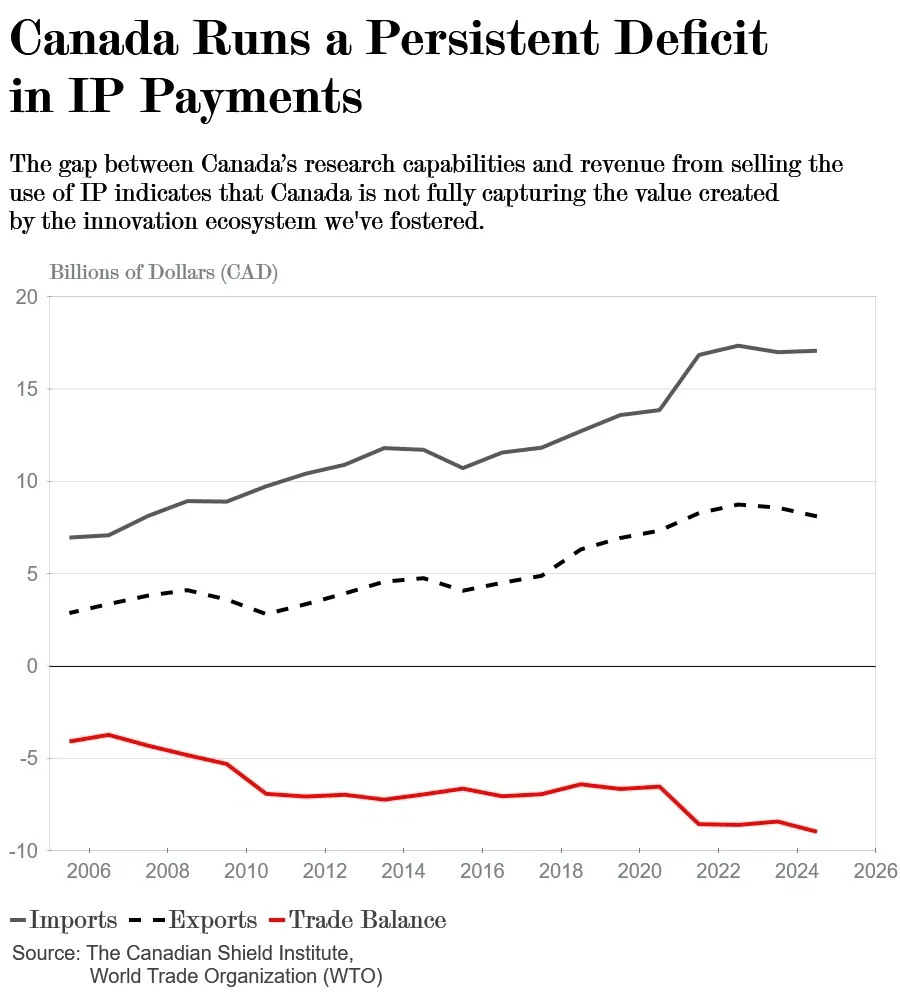
Canada runs a persistent deficit in intellectual property payments.
That means Canada’s companies and institutions pay more to use patents, trademarks and other protected knowledge from abroad than we earn from selling the use of Canadian IP to organizations operating in other countries. Our deficit has doubled in the last 20 years as trade expanded.
This fact confounds innovation researchers, because Canada leads the world in research capabilities, ranking third in economic research complexity. Based on this ranking, our IP exports should be higher, but Canada doesn’t do a good job of converting research into IP.
The IP deficit suggests that Canada is not fully capturing the value created by our research ecosystem. Translating our research into IP ownership is essential if we are to capture the full value of our public investment in research and development. We will have more to say on that soon as we finalize some initial research and policy development on IP ownership and R&D.
Song of the Week
“Not In Love” by Platinum Blonde.
Did you know Platinum Blonde was Canadian? Not naming names, but this week at least one member of The Canadian Shield Institute learned something new about our country’s proud history of glam rock.

Subscribe to