Spending on Higher Education
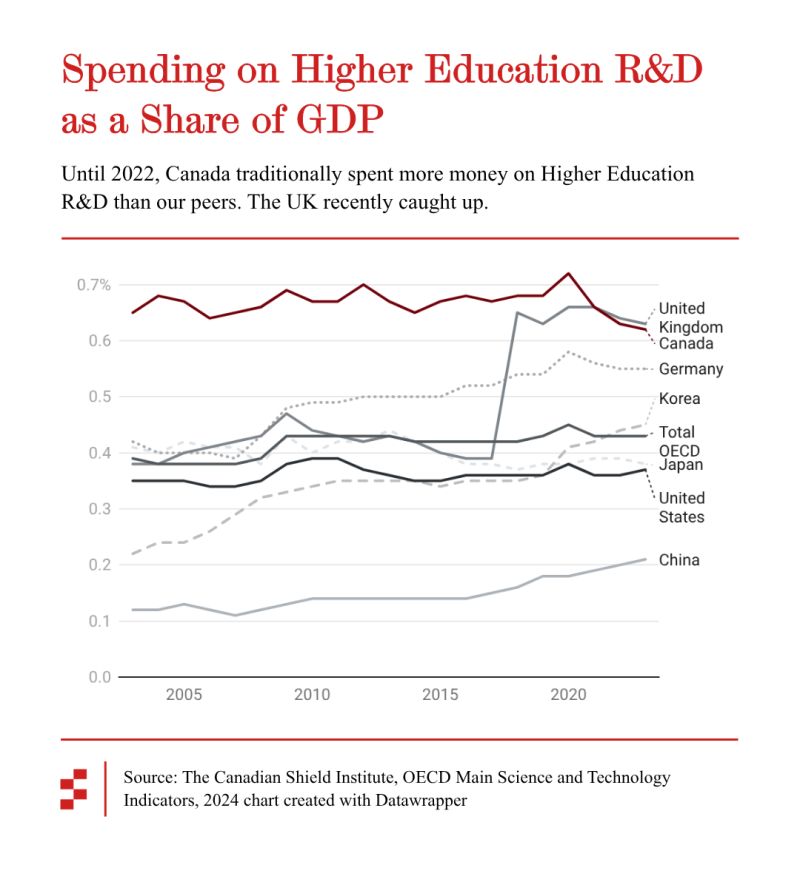
While much focus has been placed on Canada’s lagging innovation indicators, we have some bright spots in the innovation landscape too. One of them is spending on research and development in higher education, also known as “HERD.” Our colleges, universities and other research institutions spend more money as a share of GDP than their counterparts in other countries.
HERD investments support high tech research labs. This attracts top domestic and international talent, and trains the next generation of researchers. It also helps to explain why Canada ranks third in research complexity but 35th in economic export complexity.
But, as the previous charts in this series have shown, HERD investment is not enough. Too little of the resulting IP is owned by Canadian companies and the value created by our research excellence is captured elsewhere. Some of this weakness is by design: much of the HERD research is done in partnership with local subsidiaries of foreign companies, even when the research is partially funded by the public sector.
For example, public funding at Dalhousie University contributed to the suite of patented inventions that now form the basis for Tesla’s new million mile battery. Canadians will not benefit from this, but we will be paying money to buy the batteries as part of the finished product.
The foundations of artificial intelligence and even some building blocks of the COVID-19 vaccine are other examples for Canadian inventions and discoveries that have been commercialized elsewhere with all the value-added benefits accumulating in other countries instead of for the benefit of the Canadian economy.
To turn this strength into long‑term prosperity, Canada needs policies that connect campus research to domestic IP ownership, firm growth and good jobs.

Subscribe to