Evolution of Canadian Economy across Provinces
Trade tensions are not having equal impact across the country. That statement may feel obvious to some but it is important to grasp the details of what that means.
When we hear things like, the economy created 60,000 jobs in September, policy makers may breathe a sigh of relief – thankful that the impacts of tariffs have not been as bad as expected. But that doesn’t erase the pain and uncertainty experienced by many whose livelihoods are disrupted or at risk in the current economic context of tariffs, uncertainty and transition.
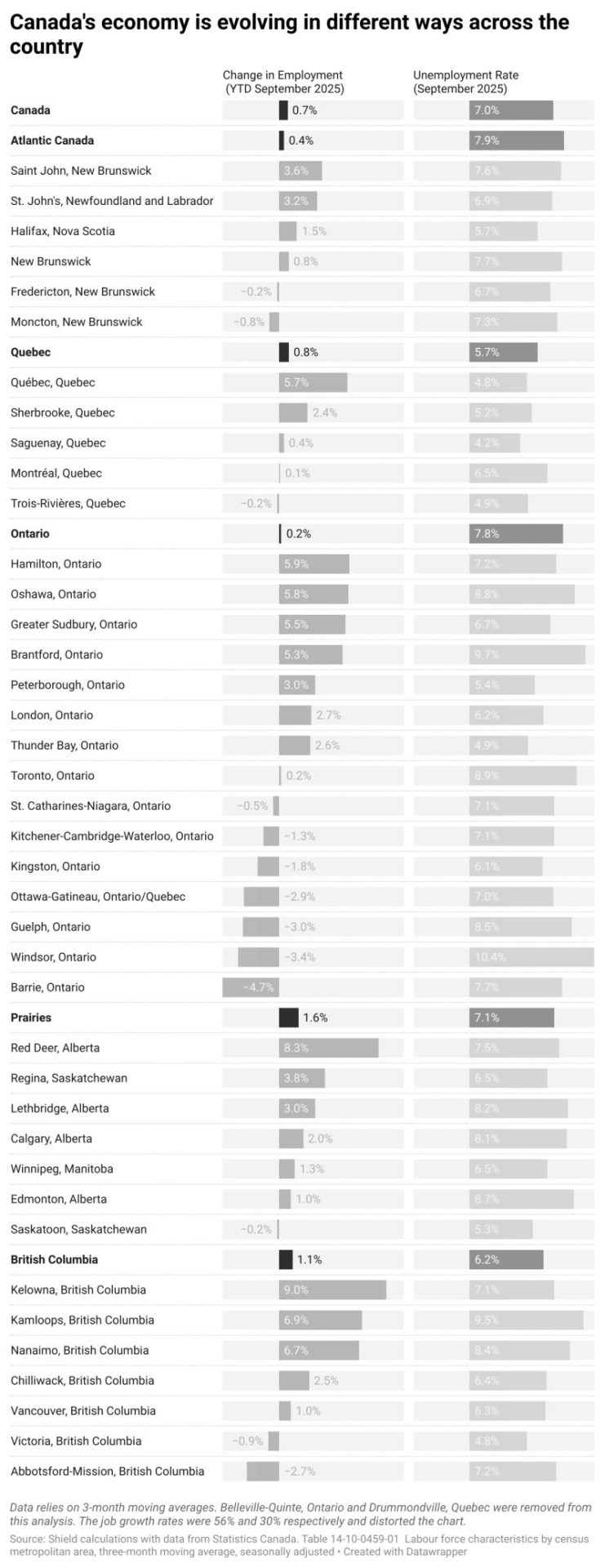
The chart below demonstrates the uneven outcomes at the city level.
Kelowna, Red Deer, Kamloops and Regina have seen large jobs gains, in percentage terms, so far this year while Barrie, Windsor and Guelph have seen big losses.
Overall, Ontario’s job growth was essentially none (0.2%) and Atlantic Canada saw a small 0.4% increase. The Prairies and British Columbia, on the other hand, have seen their labour markets grow by more than 1% each so far in 2025.
Even this detailed data still leaves many jurisdictions out. Rural Canada continued to lose jobs in September even as they increased in urban areas. In fact, the month of September recorded the largest drop in jobs in rural areas so far this year. (-2.9%). I haven’t broken the data by region yet, but more to come on that front.
Canadians are experiencing our current economic context in silos. Our individual experiences and those of our close colleagues, friends and neighbours who we interact with regularly are likely not representative of the experiences across the country – positive or negative.
It’s important that the country’s policy makers and we as individual community members work to gain a better understanding of the wide ranging experiences across the country instead of moving on when the headline numbers deliver a slightly better picture than expected.

Subscribe to