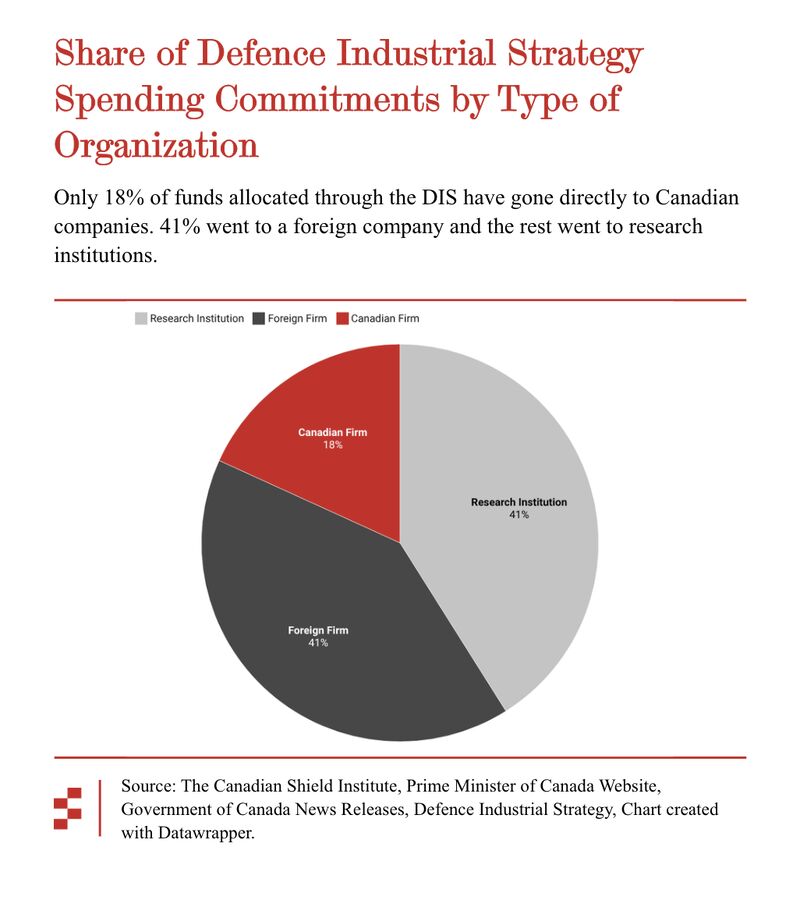
DIS Spending Commitments by Organization
Canada’s Defence Industrial Strategy presents itself as a long-term plan to overhaul military procurement and strengthen Canada’s defence ecosystem. The first phase, which was announced in February, will invest $6.6 billion over 5 years and aspires to strengthen Canada’s domestic defence industrial base, reduce dependence on foreign suppliers and boost economic growth by fostering “national champions in key technology areas.”
By the end of March, Canada had announced $2.5 billion in spending out of the DIS—that’s nearly 40% of the spending planned for the first 5 years. At Shield we’ve been keeping track of the announcements. So far, the government is not doing great at meeting its own aspirations.
Of the $2.5 billion in announced DIS spending, only 18% will go directly to procurement from Canadian companies to purchase or develop products or services for defence.
Meanwhile, 41% of that committed funding went to a single American firm for ammunition production. The remaining 41% has gone to research institutions that will develop technology, but they have no mandate to specifically work with Canadian-owned firms.
Defence spending could reach more than $230 billion a year by 2035. If “Canadian company” is allowed to include foreign‑controlled subsidiaries, money meant to strengthen Canada’s defence industrial base will end up strengthening foreign firms. Even when the production is done here we are missing out on important value add like intellectual property ownership, high-value engineering work and strategic decision making.
The DIS is an opportunity to build strategic capacity in defence capabilities that suit our values and our strengths. But it only works if Ottawa tightens the definition of a Canadian company and directs funds towards those firms. Without that change, Canada is destined to repeat its history of strengthening foreign firms instead of domestic ones.
Matthew da Mota, Ph.D. from The Canadian Shield Institute and Laurent Carbonneau from Council of Canadian Innovators | Conseil canadien des innovateurs (CCI) released a new on the DIS, looking at the potential for creating a dual use industrial commons to underpin this important industrial policy. The report is published as part of the Centre for Industrial Policy through the The Transition Accelerator / L’Accélérateur de transition. Read the report here.

Subscribe to