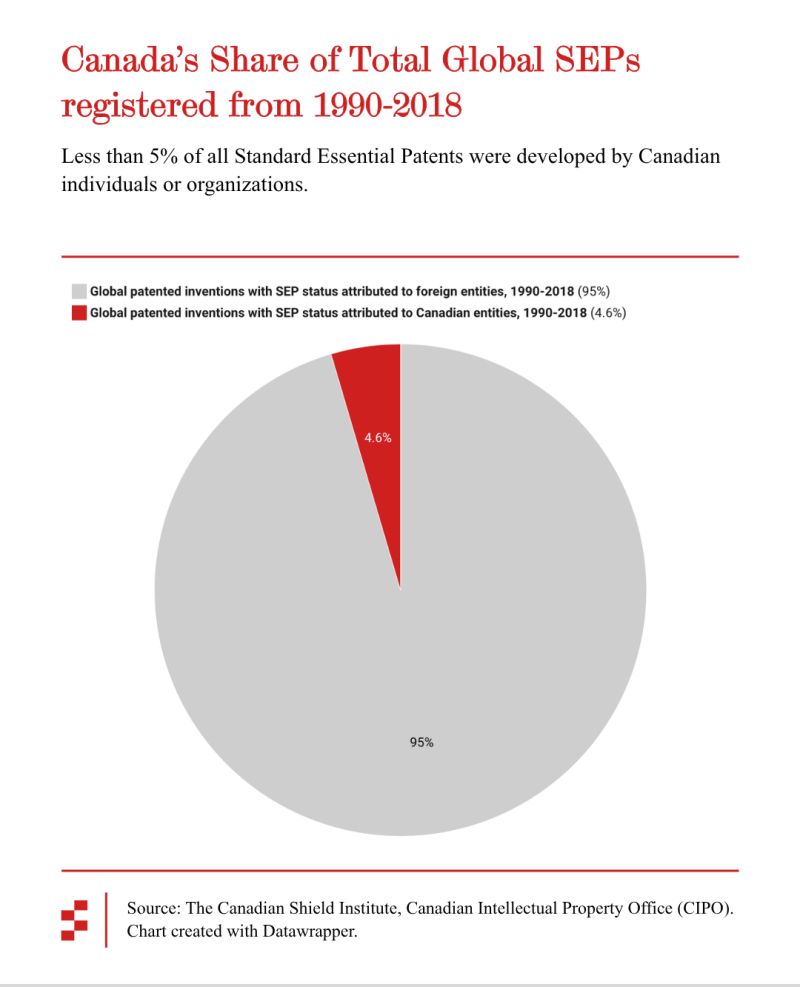
Canada's Share of Total Global SEP's
This week in The Foundations of Digital Sovereignty, Shield’s 8-week series on building the governance structures necessary to secure digital sovereignty, we are digging into a very technical area – standards.
Canada has typically treated technical standards (as well as trade agreements and other venues for international co-operation) as systems of neutral rules, operating on a level playing field. Unfortunately, the playing field is anything but level. In truth, companies and countries that take a strategic view of competition can use these governance systems to tilt the playing field in their favour.
Standards are documents which aim to ensure consistency and interoperability among systems and products. Standards are meant to be consensus-based technical documents developed by expert stakeholders — usually representing interested companies or governments in national and international standardization processes.
Some standards include Standard Essential Patents (SEPs) which means that in order to use the standard, you need to pay a licensing fee to a company that owns essential IP.
In 2018, there were 22,851 standard essential patented inventions globally. 5% of those were attributable to Canadian institutions or inventors. Our filing activity in this realm was very low. China and the United States, on the other hand, ramped up their SEP filing activity through the 2010s. These two countries are now dominating the landscape taking, the lion’s share of licensing fees and other benefits from the use of SEPs.
Shield’s recommendations to address the worst of this situation include:
Mapping a national approach to domestic and international governance frameworks. Developing government standards for procurement and governance across strategic sectors including AI, quantum, communications, space, infrastructure, manufacturing, and defence. Establishing a national trust verification and conformity assessment framework providing credible third-party validation of conformity with technology standards making Canada a destination for verification and compliance.
You can read the full report here.

Subscribe to