Canada's Productivity Index, 2018-2025
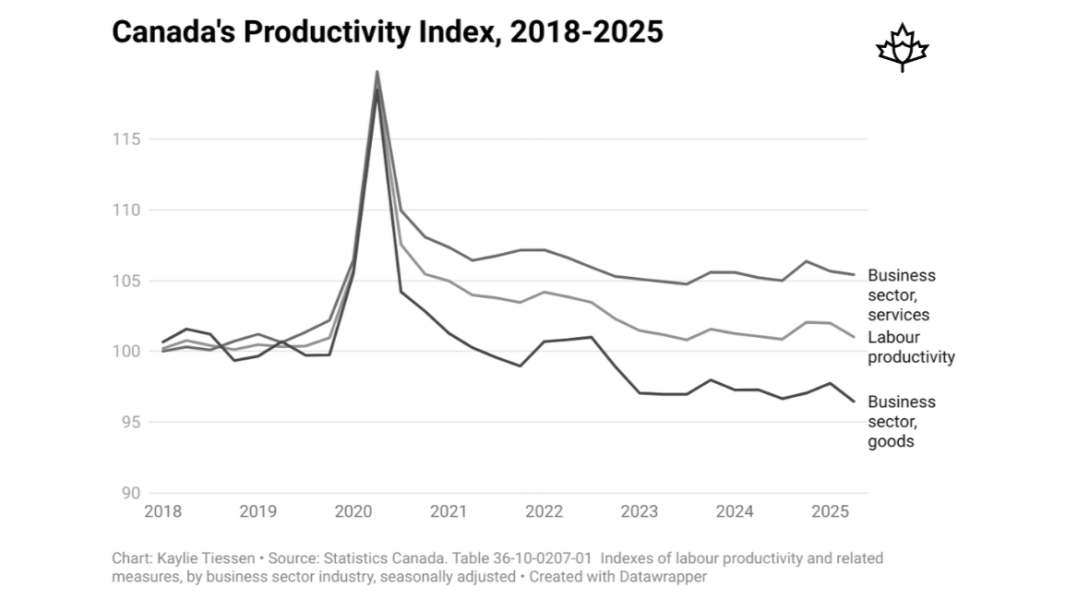
Between April and June of this year, Canada lost nearly all productivity gains it had made in the previous 6 months.
Note: Labour productivity is defined as GDP divided by number of hours worked. It is reported as an index for ease in interpretation.
Statistics Canada reports thatthe last time productivity fell so sharply was in Q4 2022. This was when Canada’s economy was still in the tail end of opening back up after waves of lockdowns and business restrictions. At that time, lower productivity sectors like hospitality and tourism were continuing to come back on-line. That’s not what is happening this time.
This time, businesses are holding on to workers during a period of extreme uncertainty. They’re probably hoping that the drop in demand for their goods and services is temporary, and holding onto staff makes it easier to ramp back up when demand returns.
Labour productivity is a simple calculation (GDP/Hours worked) but a complicated concept. It includes GDP and hours worked but doesn’t capture the underlying short-term decisions that businesses make in uncertain times.
From April to June, many firms held on to workers or hired new staff even as their output shrank. The manufacturing and mining/oil and gas extraction sectors were main drivers of this pattern. In Q2, manufacturing output shrank by 2.1% but total hours worked remained unchanged – people were working the same but producing less. There were some layoffs leading to a 0.4% reduction in the number of jobs but the average hours of work increased in the same proportion. In the mining and oil & gas industry, labour productivity declined and average hours worked per worker did too.
Read more analysis from Kaylie here.



Subscribe to